Mao Kai, Franco Marcia, Xu Yi, Chai Huan, Wang Jian, Huang Shuai, Wang Zhiyong, Xun Wenjuan, Liang Zuoxiang, Yu Zhu, Wang Musen
School of Tropical Agriculture and Forestry, Hainan University, Haikou 570228, China.
Natural Resources Institute Finland (Luke), Tietotie 4, FI-31600 Jokioinen, Finland.
Animals (Basel). 2024 Aug 18;14(16):2397. doi: 10.3390/ani14162397.
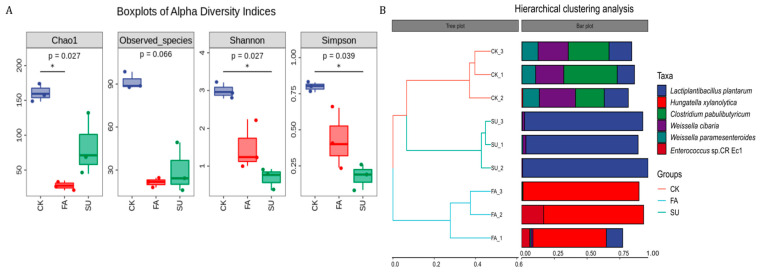
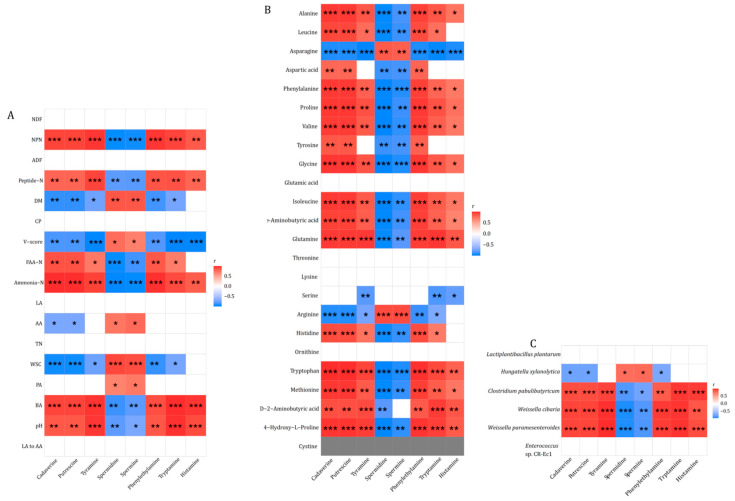
Substantial proteolysis occurs and free amino acids can be degraded to biogenic amines by decarboxylation during stylo () ensiling. High biogenic amine concentrations in silage are harmful to the health of ruminant animals. The purposes of this work were to (1) analyze the biogenic amines and amino acids concentrations, bacterial composition, and fermentation profile of spontaneously fermented stylo silage, (2) explore the effect of formic acid or sugar additive on these silage parameters, and (3) further reveal the correlations between silage amines and fermentation parameters, amino acids, and bacteria. Freshly chopped stylo was treated with distilled water (control), formic acid (4 mL/kg), and sugar (20 g/kg) and fermented for 28 days. The results indicated that putrescine (321 mg/kg dry matter), cadaverine (384 mg/kg dry matter), and tyramine (127 mg/kg dry matter) rapidly increased in concentration and become predominant in the control silage after 28 days of fermentation. Applying formic acid and sugar at ensiling, especially the acidifier, significantly decreased putrescine, cadaverine, tyramine, and total biogenic amine concentrations compared with the control treatment ( < 0.0001). , and were the predominant bacteria in the control silage, and the application of both additives remarkably lowered their relative abundance in comparison with the control treatment ( < 0.001). Correlation analysis showed that putrescine, cadaverine, and tyramine were positively related to pH, butyric acid, non-protein nitrogen, and ammonia nitrogen ( < 0.01). These amines also had significant correlations with , and ( < 0.001). Putrescine, cadaverine, and tyramine were the main biogenic amines and was the predominant undesirable bacterium in naturally fermented stylo silage. , and were positively related to putrescine, cadaverine, and tyramine formation. The application of formic acid or sugar significantly reduced the undesirable bacterial population and improved the fermentation and hygienic quality of the stylo silage. These findings lay the foundation for further elucidating the microbial mechanism underlying the main biogenic amine formation during fermentation of stylo silage.
柱花草青贮过程中会发生大量蛋白质水解,游离氨基酸可通过脱羧作用降解为生物胺。青贮饲料中高浓度的生物胺对反刍动物健康有害。本研究的目的是:(1)分析自发发酵柱花草青贮饲料中生物胺和氨基酸浓度、细菌组成及发酵特性;(2)探究甲酸或糖添加剂对这些青贮参数的影响;(3)进一步揭示青贮饲料中胺类与发酵参数、氨基酸及细菌之间的相关性。将新鲜切碎的柱花草分别用蒸馏水(对照)、甲酸(4 mL/kg)和糖(20 g/kg)处理,发酵28天。结果表明,腐胺(321 mg/kg干物质)、尸胺(384 mg/kg干物质)和酪胺(127 mg/kg干物质)浓度在发酵28天后迅速增加,并在对照青贮饲料中占主导地位。青贮时添加甲酸和糖,尤其是酸化剂,与对照处理相比,显著降低了腐胺、尸胺、酪胺和生物胺总浓度(P<0.0001)。对照青贮饲料中,肠杆菌属、梭菌属和芽孢杆菌属是优势菌,与对照处理相比,两种添加剂的应用均显著降低了它们的相对丰度(P<0.001)。相关性分析表明,腐胺、尸胺和酪胺与pH值、丁酸、非蛋白氮和氨态氮呈正相关(P<0.01)。这些胺类与肠杆菌属、梭菌属和芽孢杆菌属也存在显著相关性(P<0.001)。腐胺、尸胺和酪胺是天然发酵柱花草青贮饲料中的主要生物胺,肠杆菌属是主要的有害菌。肠杆菌属、梭菌属和芽孢杆菌属与腐胺、尸胺和酪胺的形成呈正相关。甲酸或糖的应用显著减少了有害菌数量,提高了柱花草青贮饲料的发酵和卫生质量。这些研究结果为进一步阐明柱花草青贮发酵过程中主要生物胺形成的微生物机制奠定了基础。