Institute of Industrial Crops, Jiangsu Key Laboratory for Horticultural Crop Genetic Improvement, Jiangsu Academy of Agricultural Sciences, Nanjing 210014, China.
Institute of Crop Germplasm and Biotechnology, Provincial Key Laboratory of Agrobiology, Jiangsu Academy of Agricultural Sciences, Nanjing 210014, China.
Genes (Basel). 2024 Jul 24;15(8):976. doi: 10.3390/genes15080976.
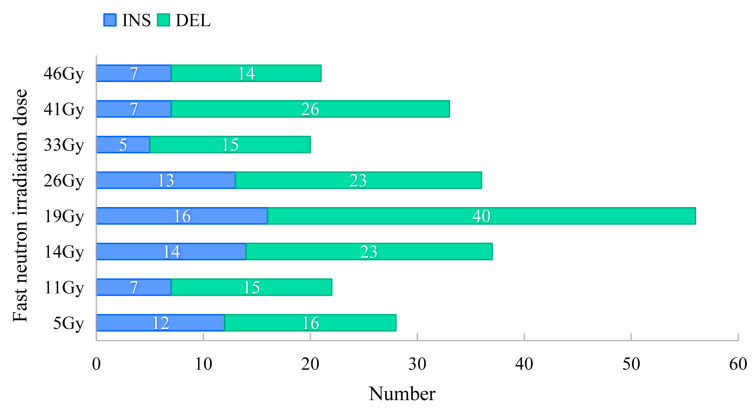
Sorghum is an important C crop with various food and nonfood uses. Although improvements through hybridization and selection have been exploited, the introduction of genetic variation and the development of new genotypes in sorghum are still limited. Fast-neutron (FN) mutagenesis is a very effective method for gene functional studies and to create genetic variability. However, the full spectrum of FN-induced mutations in sorghum is poorly understood. To address this, we generated an FN-induced mutant population from the inbred line 'BTx623' and sequenced 40 M seedlings to evaluate the mutagenic effects of FNs on sorghum. The results show that each line had an average of 43.7 single-base substitutions (SBSs), 3.7 InDels and 35.15 structural variations (SVs). SBSs accounted for approximately 90.0% of the total number of small mutations. Among the eight treatment groups, FN irradiation at a dose of 19 Gy generated the highest number of mutations. The ratio of transition/transversion ranged from 1.77 to 2.21, and the G/C to A/T transition was the most common substitution in all mutant lines. The distributions of the identified SBSs and InDels were similar and uneven across the genome. An average of 3.63 genes were mutated in each mutant line, indicating that FN irradiation resulted in a suitable density of mutated genes, which can be advantageous for improving elite material for one specific or a few traits. These results provide a basis for the selection of the suitable dose of mutagen and new genetic resources for sorghum breeding.
高粱是一种重要的 C 作物,具有多种食用和非食用用途。虽然通过杂交和选择已经进行了改良,但高粱中的遗传变异和新基因型的引入仍然有限。快中子(FN)诱变是研究基因功能和创造遗传变异的非常有效的方法。然而,高粱中 FN 诱导突变的全貌还了解甚少。为了解决这个问题,我们从自交系 'BTx623' 中产生了一个 FN 诱导的突变体群体,并对 40 M 幼苗进行了测序,以评估 FNs 对高粱的诱变效应。结果表明,每条系平均有 43.7 个单碱基替换(SBSs)、3.7 个 InDels 和 35.15 个结构变异(SVs)。SBSs 约占小突变总数的 90.0%。在八个处理组中,19 Gy 的 FN 照射产生了最多的突变。转换/颠换的比值在 1.77 到 2.21 之间,所有突变系中 G/C 到 A/T 的转换是最常见的取代。鉴定的 SBSs 和 InDels 的分布在整个基因组中相似且不均匀。每个突变系平均有 3.63 个基因发生突变,表明 FN 照射导致了合适密度的突变基因,这有利于改良特定或少数性状的优良材料。这些结果为选择合适的诱变剂剂量和高粱育种的新遗传资源提供了基础。