Department of Nuclear Physics, China Institute of Atomic Energy, Beijing, China.
National Innovation Center of Radiation Application, Beijing, China.
Front Public Health. 2021 Dec 21;9:768071. doi: 10.3389/fpubh.2021.768071. eCollection 2021.
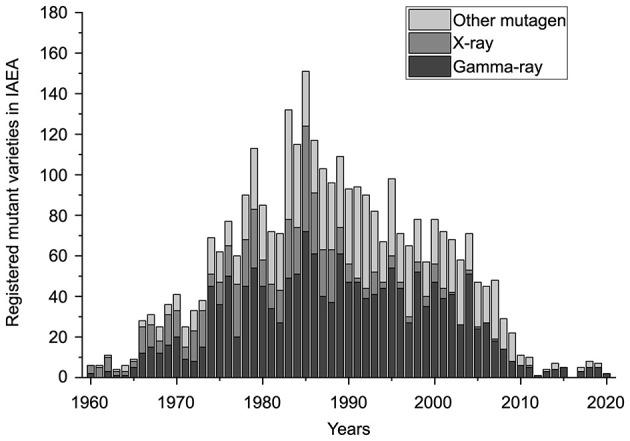
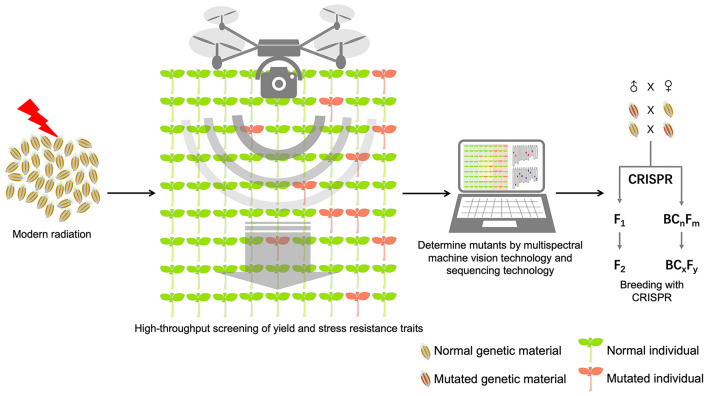
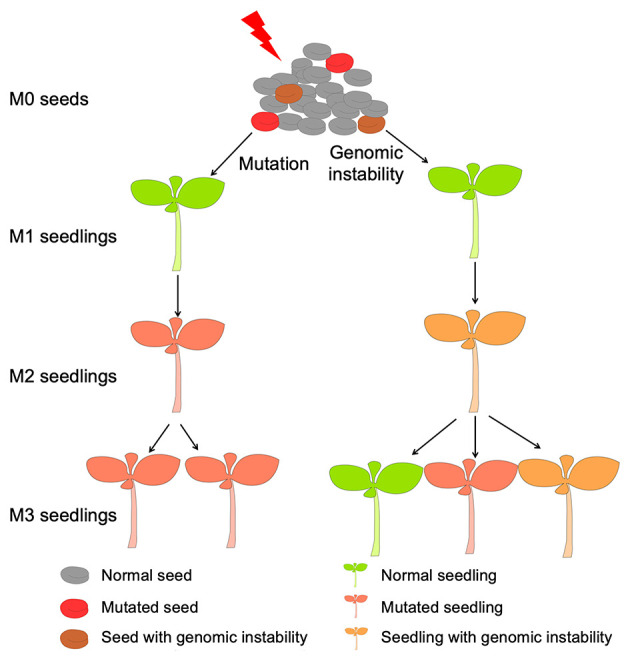
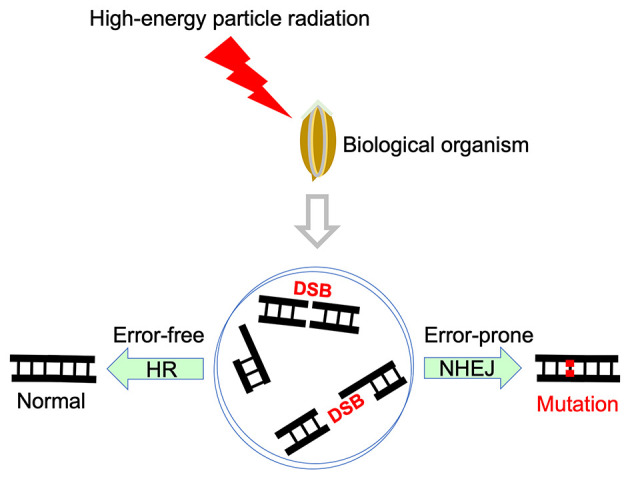
Radiation mutation breeding has been used for nearly 100 years and has successfully improved crops by increasing genetic variation. Global food production is facing a series of challenges, such as rapid population growth, environmental pollution and climate change. How to feed the world's enormous human population poses great challenges to breeders. Although advanced technologies, such as gene editing, have provided effective ways to breed varieties, by editing a single or multiple specific target genes, enhancing germplasm diversity through mutation is still indispensable in modern and classical radiation breeding because it is more likely to produce random mutations in the whole genome. In this short review, the current status of classical radiation, accelerated particle and space radiation mutation breeding is discussed, and the molecular mechanisms of radiation-induced mutation are demonstrated. This review also looks into the future development of radiation mutation breeding, hoping to deepen our understanding and provide new vitality for the further development of radiation mutation breeding.
辐射诱变育种已经使用了近 100 年,通过增加遗传变异成功地改良了作物。全球粮食生产正面临着一系列挑战,如人口快速增长、环境污染和气候变化。如何养活世界上庞大的人口给育种者带来了巨大的挑战。尽管基因编辑等先进技术为品种培育提供了有效的方法,但通过编辑单个或多个特定的目标基因,通过突变来增强种质多样性在现代和经典的辐射育种中仍然是必不可少的,因为它更有可能在整个基因组中产生随机突变。在这篇简短的综述中,讨论了经典辐射、加速粒子和空间辐射诱变育种的现状,并展示了辐射诱导突变的分子机制。本文还探讨了辐射诱变育种的未来发展,希望加深我们的理解,并为辐射诱变育种的进一步发展提供新的活力。