Epidemiology and Public Health, Swiss Tropical and Public Health Institute, 4123 Allschwil, Switzerland.
Faculty of Medicine, University of Basel, Peterplatz 1, 4003 Basel, Switzerland.
Nutrients. 2024 Aug 16;16(16):2733. doi: 10.3390/nu16162733.
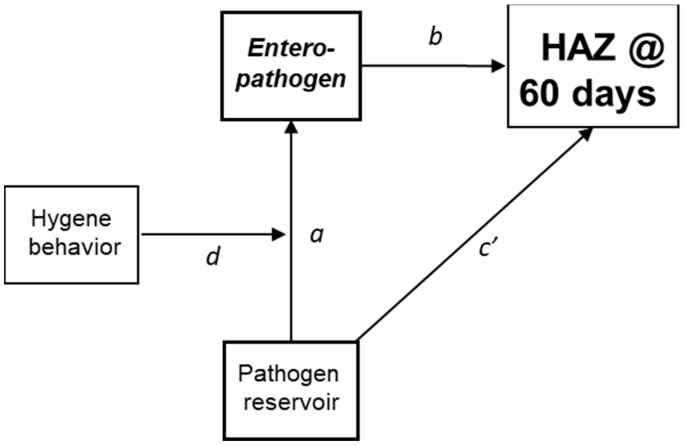
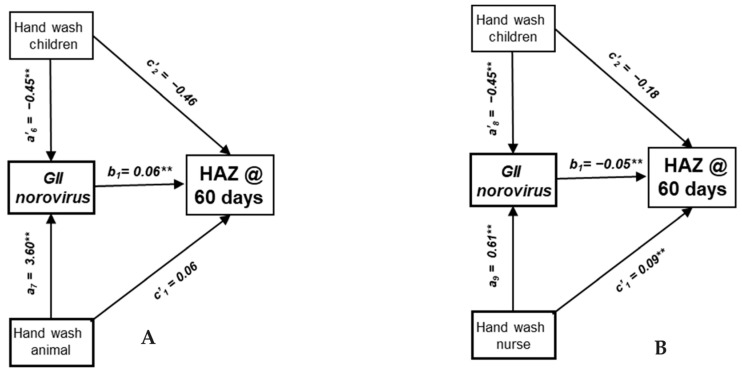
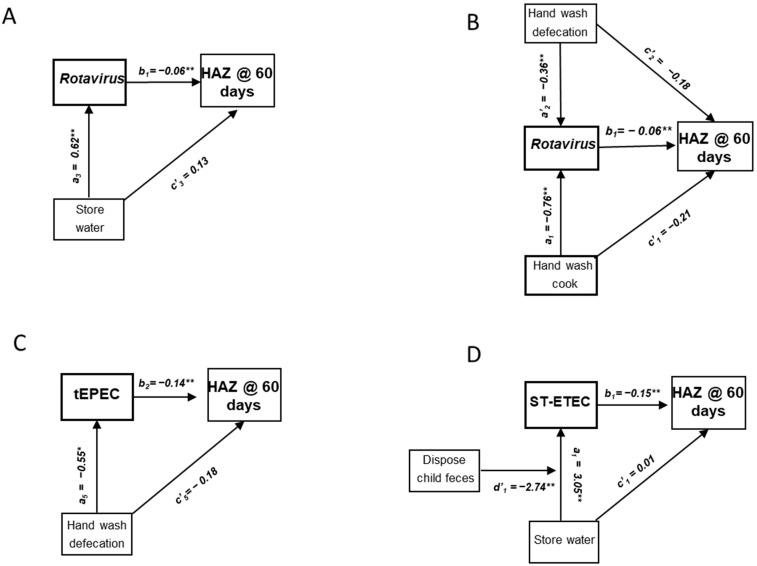
Age-stratified path analyses modeled associations between enteric pathogen reservoirs, transmission pathways and height-for-age z-scores (HAZ) to identify determinants of childhood growth in the Kolkata, India site of the Global Enteric Multicenter Study (GEMS). Models tested direct associations of potential pathogen reservoirs with HAZ at 60-day follow-up in separate moderate and severe diarrhea (MSD) case and control cohorts or indirectly when mediated by enteric infections. In the MSD cohort, rotavirus and typical EPEC (tEPEC) infections among children 0-11 months of age and ST-ETEC infections among children 12-23 months of age were associated with lower HAZ. Handwashing after defecating and before cooking reduced impaired growth through reductions in rotavirus and tEPEC infections. Water storage increased rotavirus and ST-ETEC infection risks, resulting in increased impaired growth, but was reduced with reported child feces disposal. The GII norovirus variant was inversely associated with HAZ among children 12-59 months of age in the control cohort. Reported handwashing before the handling of children reduced GII infections and impaired growth. Boiling water and the disposal of children's feces mediated by stored water were positively associated with HAZ. The targeting of pathogen-specific reservoirs and transmission pathways may more effectively improve childhood linear growth in South Asian urban communities.
对年龄分层的路径分析模型进行了研究,以确定肠道病原体储存库、传播途径与年龄别身高 Z 分数(HAZ)之间的关联,从而确定印度加尔各答全球肠道多中心研究(GEMS)现场儿童生长的决定因素。模型检验了潜在病原体储存库与 60 天随访时中度和重度腹泻(MSD)病例和对照队列中 HAZ 之间的直接关联,或当肠道感染为中介时的间接关联。在 MSD 队列中,0-11 月龄儿童中的轮状病毒和典型肠致病性大肠杆菌(tEPEC)感染以及 12-23 月龄儿童中的 ST-肠集聚性大肠杆菌(ST-ETEC)感染与较低的 HAZ 有关。便后和做饭前洗手可减少轮状病毒和 tEPEC 感染,从而降低生长受损的程度。储水增加了轮状病毒和 ST-ETEC 感染的风险,导致生长受损增加,但报告的儿童粪便处理减少了储水。在对照队列中,12-59 月龄儿童中 GII 诺如病毒变异体与 HAZ 呈负相关。报告的在接触儿童前洗手可减少 GII 感染和生长受损。储水介导的开水处理和儿童粪便处理与 HAZ 呈正相关。针对特定病原体储存库和传播途径的措施可能更有效地改善南亚城市社区儿童的线性生长。