Ren Jiwen, Xiong Yuming, Chen Xinyu, Hao Yong
School of Mechatronics and Vehicle Engineering, East China Jiaotong University, Nanchang 330013, China.
Optoelectronics Department of Changzhou Institute of Technology, Changzhou 213000, China.
Sensors (Basel). 2024 Aug 22;24(16):5438. doi: 10.3390/s24165438.
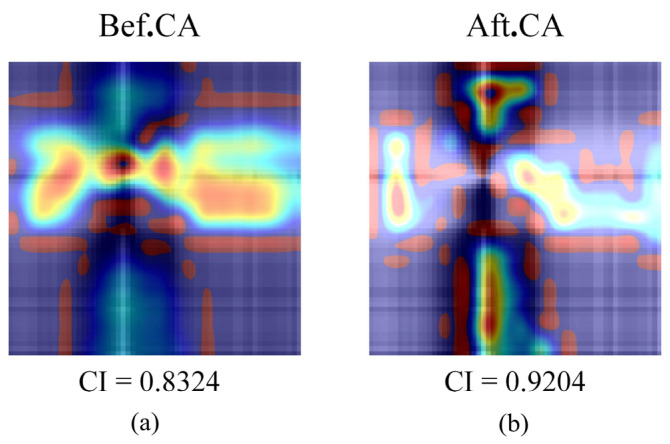
The success of near-infrared spectroscopy (NIRS) analysis hinges on the precision and robustness of the calibration model. Shallow learning (SL) algorithms like partial least squares discriminant analysis (PLS-DA) often fall short in capturing the interrelationships between adjacent spectral variables, and the analysis results are easily affected by spectral noise, which dramatically limits the breadth and depth of applications of NIRS. Deep learning (DL) methods, with their capacity to discern intricate features from limited samples, have been progressively integrated into NIRS. In this paper, two discriminant analysis problems, including wheat kernels and Yali pears as examples, and several representative calibration models were used to research the robustness and effectiveness of the model. Additionally, this article proposed a near-infrared calibration model, which was based on the Gramian angular difference field method and coordinate attention convolutional neural networks (G-CACNNs). The research results show that, compared with SL, spectral preprocessing has a smaller impact on the analysis accuracy of consensus learning (CL) and DL, and the latter has the highest analysis accuracy in the modeling results using the original spectrum. The accuracy of G-CACNNs in two discrimination tasks was 98.48% and 99.39%. Finally, this research compared the performance of various models under noise to evaluate the robustness and noise resistance of the proposed method.
近红外光谱(NIRS)分析的成功取决于校准模型的精度和稳健性。像偏最小二乘判别分析(PLS-DA)这样的浅层学习(SL)算法在捕捉相邻光谱变量之间的相互关系方面往往存在不足,并且分析结果容易受到光谱噪声的影响,这极大地限制了NIRS应用的广度和深度。深度学习(DL)方法能够从有限样本中识别复杂特征,已逐渐被整合到NIRS中。本文以小麦籽粒和鸭梨为例,针对两个判别分析问题,使用了几种具有代表性的校准模型来研究模型的稳健性和有效性。此外,本文提出了一种基于格拉姆角差场方法和坐标注意力卷积神经网络(G-CACNNs)的近红外校准模型。研究结果表明,与SL相比,光谱预处理对一致性学习(CL)和DL的分析精度影响较小,并且在使用原始光谱的建模结果中,后者具有最高的分析精度。G-CACNNs在两项判别任务中的准确率分别为98.48%和99.39%。最后,本研究比较了各种模型在噪声下的性能,以评估所提方法的稳健性和抗噪声能力。