Chiscano-Camón Luis, Ruiz-Sanmartin Adolf, Bajaña Ivan, Bastidas Juliana, Lopez-Martinez Rocio, Franco-Jarava Clara, Gonzalez Juan José, Larrosa Nieves, Riera Jordi, Nuvials-Casals Xavier, Ruiz-Rodríguez Juan Carlos, Ferrer Ricard
Intensive Care Department, Vall d'Hebron University Hospital, Vall d'Hebron Barcelona Hospital Campus, Barcelona, Spain.
Shock, Organ Dysfunction and Resuscitation Research Group, Vall d'Hebron Research Institute (VHIR), Vall d'Hebron University Hospital, Vall d'Hebron Barcelona Hospital Campus, Barcelona, Spain.
Front Med (Lausanne). 2024 Aug 15;11:1431791. doi: 10.3389/fmed.2024.1431791. eCollection 2024.
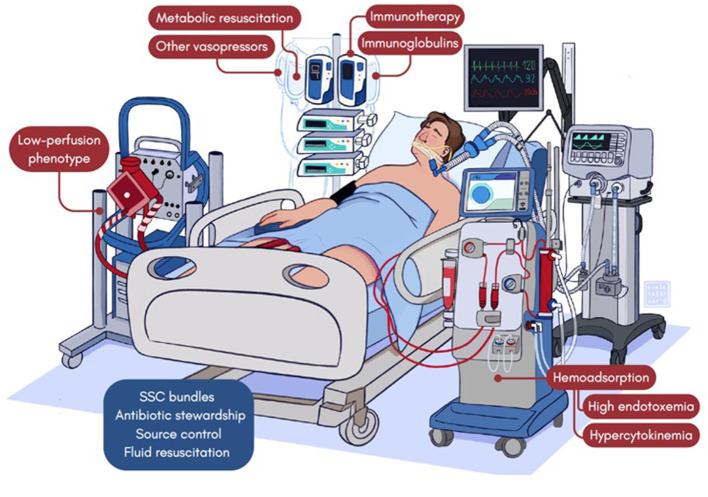
Within patients with sepsis, there exists significant heterogeneity, and while all patients should receive conventional therapy, there are subgroups of patients who may benefit from specific therapies, often referred to as rescue therapies. Therefore, the identification of these specific patient subgroups is crucial and lays the groundwork for the application of precision medicine based on the development of targeted interventions. Over the years, efforts have been made to categorize sepsis into different subtypes based on clinical characteristics, biomarkers, or underlying mechanisms. For example, sepsis can be stratified into different phenotypes based on the predominant dysregulated host response. These phenotypes can range from hyperinflammatory states to immunosuppressive states and even mixed phenotypes. Each phenotype may require different therapeutic approaches to improve patient outcomes. Rescue strategies for septic shock may encompass various interventions, such as immunomodulatory therapies, extracorporeal support (e.g., ECMO), or therapies targeted at specific molecular or cellular pathways involved in the pathophysiology of sepsis. In recent years, there has been growing interest in precision medicine approaches to sepsis and phenotype identification. Precision medicine aims to tailor treatments to each individual patient based on their unique characteristics and disease mechanisms.
在脓毒症患者中,存在显著的异质性。虽然所有患者都应接受常规治疗,但有一部分患者亚组可能从特定治疗中获益,这些治疗通常被称为挽救治疗。因此,识别这些特定的患者亚组至关重要,并且为基于靶向干预措施发展的精准医学应用奠定了基础。多年来,人们一直在努力根据临床特征、生物标志物或潜在机制将脓毒症分为不同亚型。例如,脓毒症可根据主要失调的宿主反应分为不同表型。这些表型范围从高炎症状态到免疫抑制状态,甚至是混合表型。每种表型可能需要不同的治疗方法来改善患者预后。感染性休克的挽救策略可能包括各种干预措施,如免疫调节治疗、体外支持(如体外膜肺氧合)或针对脓毒症病理生理学中特定分子或细胞途径的治疗。近年来,人们对脓毒症的精准医学方法和表型识别越来越感兴趣。精准医学旨在根据每个患者的独特特征和疾病机制为其量身定制治疗方案。