Department of Internal Medicine, Severance Hospital, Yonsei University College of Medicine, Seoul, Republic of Korea.
Department of Internal Medicine, Yongin Severance Hospital, Yonsei University College of Medicine, 363 Dongbaekjukjeon-daero, Giheung-gu, Yongin, 16995, Republic of Korea.
Sci Rep. 2024 Aug 30;14(1):20181. doi: 10.1038/s41598-024-71057-3.
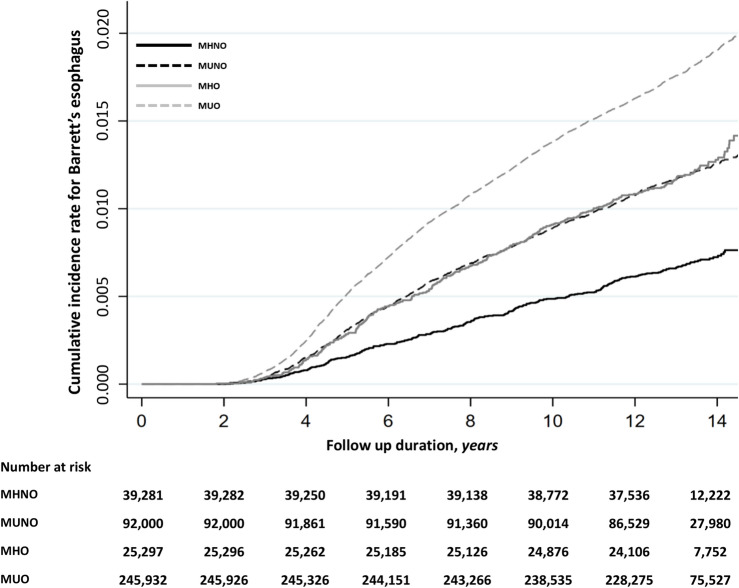
The association of overweight/obesity and metabolically unhealthy (MU) with the risk of developing Barrett's esophagus (BE) remains uncertain. We evaluated whether MU and overweight/obesity are associated with increased BE incidence and whether they have a synergistic impact on BE development. We analyzed the body mass index (BMI) and metabolic indicators at baseline of 402,510 individuals from the UK Biobank with no history of BE. Overweight/obesity and MU were defined as BMI ≥ 25.0 kg/m and presence of ≥ 1 MU indicators, respectively. Accordingly, the participants were categorized into four groups: (1) metabolically healthy non-overweight/obesity (MHNO), (2) metabolically unhealthy non-overweight/obesity (MUNO), (3) metabolically healthy overweight/obesity (MHO), and (4) metabolically unhealthy overweight/obesity (MUO). During a median follow-up of 13.5 years, 6195 (1.5%) individuals were newly diagnosed with BE. Among them, 39,281 (9.8%), 92,000 (22.9%), 25,297 (6.3%), and 245,932 (61.1%) individuals were classified as MHNO, MUNO, MHO, and MUO, respectively. In Cox regression analyses, both MU and overweight/obesity were independently associated with BE incidence. Moreover, BE incidence was significantly higher in the MUNO, MHO, and MUO groups, compared to the MHNO group. MU and overweight/obesity are independent risk factors for BE and have a synergistic effect on BE development.
超重/肥胖和代谢不健康(MU)与 Barrett 食管(BE)发病风险的关联仍不确定。我们评估了 MU 和超重/肥胖是否与 BE 发病率增加相关,以及它们是否对 BE 发展有协同影响。我们分析了英国生物银行 402510 名无 BE 病史个体的基线体重指数(BMI)和代谢指标。超重/肥胖和 MU 分别定义为 BMI≥25.0kg/m 和存在≥1 个 MU 指标。相应地,将参与者分为四组:(1)代谢健康非超重/肥胖(MHNO),(2)代谢不健康非超重/肥胖(MUNO),(3)代谢健康超重/肥胖(MHO)和(4)代谢不健康超重/肥胖(MUO)。在中位随访 13.5 年期间,有 6195 名(1.5%)个体新诊断为 BE。其中,39281 名(9.8%)、92000 名(22.9%)、25297 名(6.3%)和 245932 名(61.1%)个体分别归类为 MHNO、MUNO、MHO 和 MUO。在 Cox 回归分析中,MU 和超重/肥胖均与 BE 发病独立相关。此外,与 MHNO 组相比,MUNO、MHO 和 MUO 组的 BE 发病率明显更高。MU 和超重/肥胖是 BE 的独立危险因素,对 BE 的发展有协同作用。