Department of Advanced Science Engineering, Graduate School of Advanced Science and Engineering, Waseda University, 3-4-1 Okubo, Shinjuku-Ku, Tokyo 169-8555, Japan.
Computational Bio Big-Data Open Innovation Laboratory (CBBD-OIL), National Institute of Advanced Industrial Science and Technology, 3-4-1 Okubo, Shinjuku-Ku, Tokyo 169-8555, Japan.
Anal Chem. 2024 Sep 17;96(37):14909-14917. doi: 10.1021/acs.analchem.4c02906. Epub 2024 Aug 31.
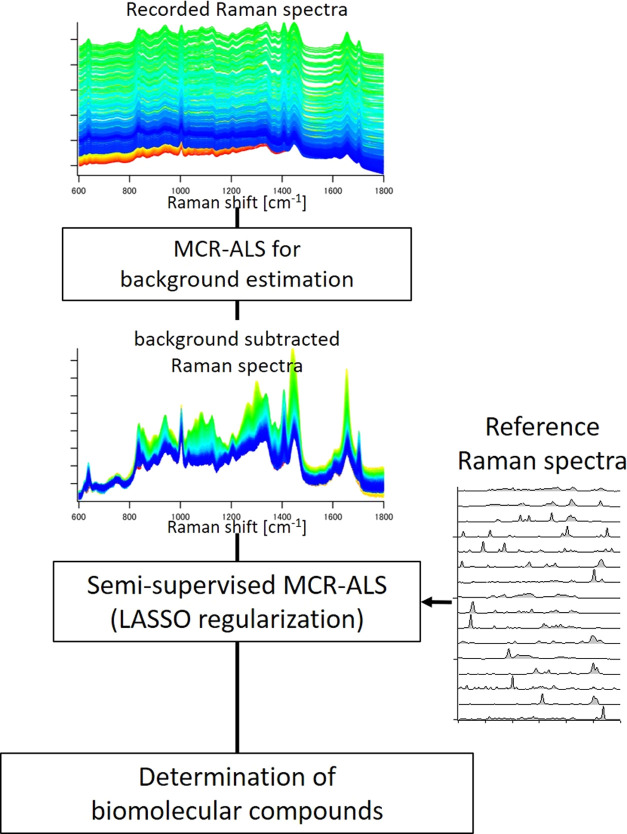
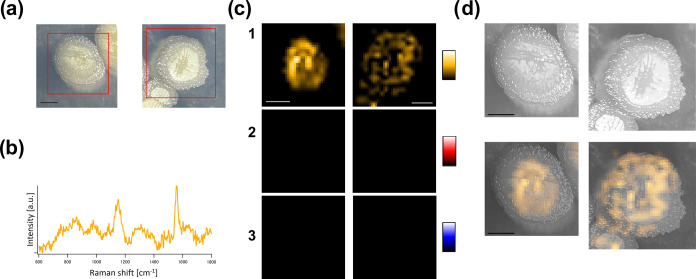
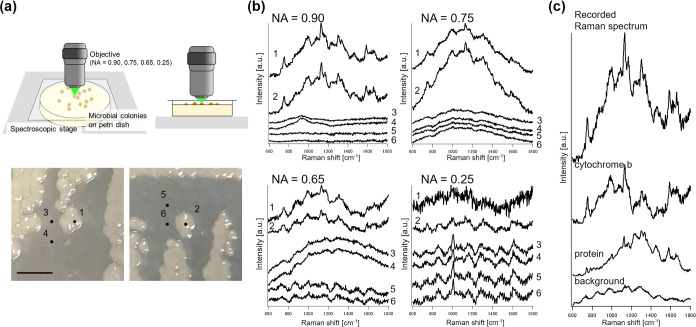
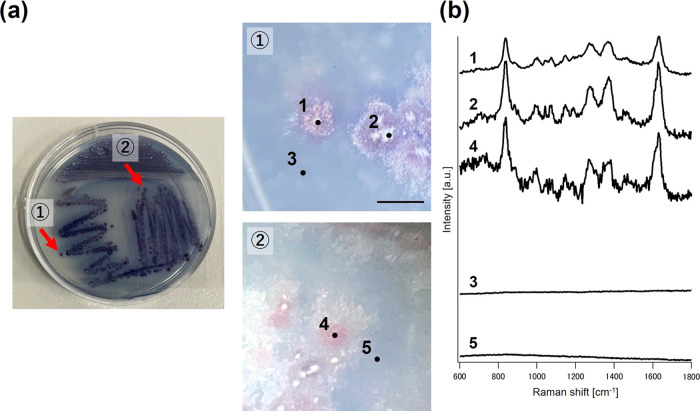
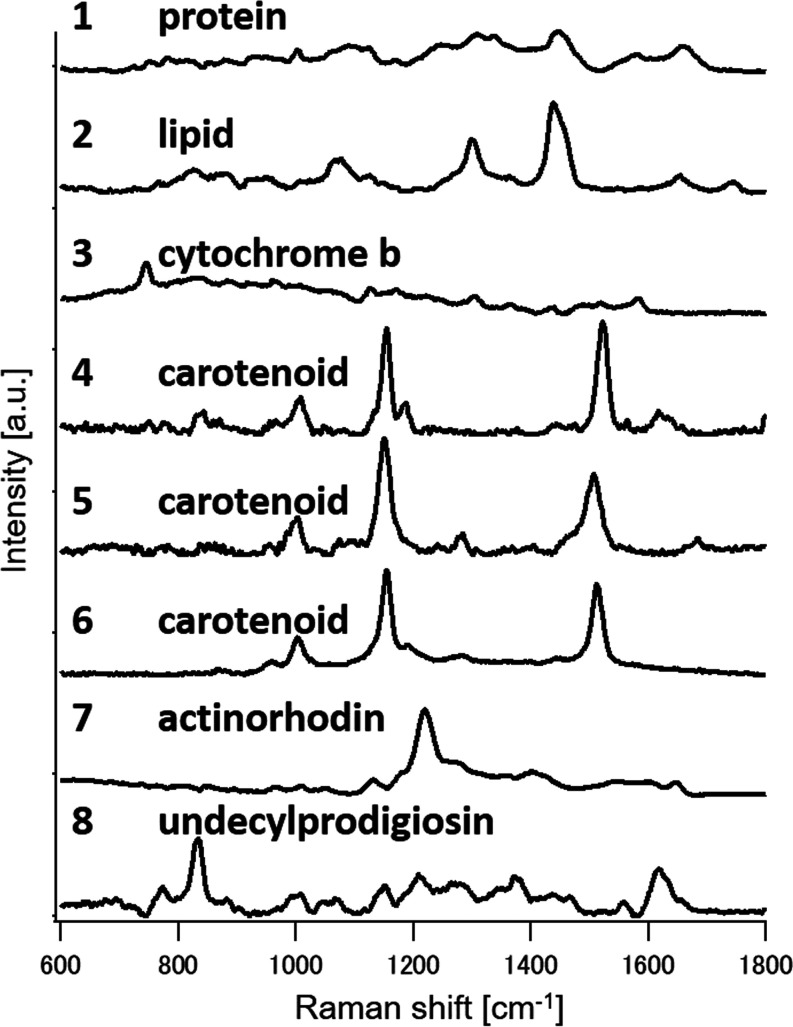
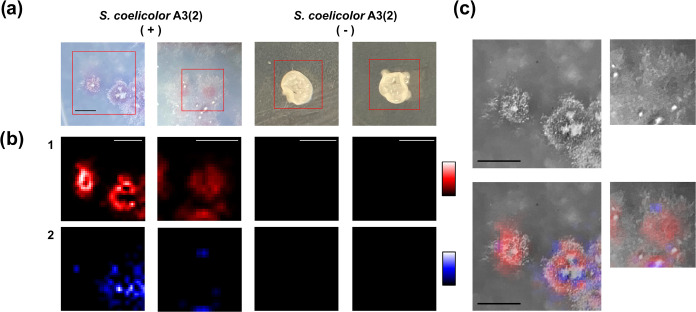
Since the discovery of penicillin, a vast array of microbial antibiotics has been identified and applied in the medical field. Globally, the search for drug candidates microbial screening is ongoing. Traditional screening methods, however, are time-consuming and require labor-intensive sample processing, significantly reducing throughput. This research introduces a Raman spectroscopy-based screening system tailored to the analysis of microbial colonies on solid culture media. Employing multivariate curve resolution-alternating least-squares (MCR-ALS) for spectral decomposition, our approach reveals the production of secondary metabolites at the single colony level. We enhanced the microbial culture method, enabling direct, high signal-to-noise (S/N) ratio Raman spectroscopic measurements of colonies of and actinomycetes species. Through semisupervised MCR analysis using the known spectra of actinorhodin and undecylprodigiosin as references, we accurately assessed the production of these compounds by A3(2). Furthermore, we herein successfully detected the production of amphotericin B by , even in the absence of prior spectral information. This demonstrates the potential of our technique in the discovery of secondary metabolites. In addition to enabling the detection of the above-mentioned compounds, this analysis revealed the heterogeneity of the spatial distribution of their production in each colony. Our technique makes a significant contribution to the advancement of microbial screening, offering a rapid, efficient alternative to conventional methods and opening avenues for secondary metabolites discovery.
自青霉素发现以来,已经鉴定出大量微生物抗生素,并在医学领域得到应用。在全球范围内,药物候选物的筛选仍在继续。然而,传统的筛选方法既耗时又需要劳动密集型的样本处理,显著降低了通量。本研究介绍了一种基于拉曼光谱的筛选系统,专门用于分析固体培养介质上的微生物菌落。我们采用多元曲线分辨交替最小二乘法(MCR-ALS)进行光谱分解,该方法在单细胞水平上揭示了次级代谢产物的产生。我们改进了微生物培养方法,能够直接对 和放线菌属物种的菌落进行高信噪比(S/N)比的拉曼光谱测量。通过使用放线红菌素和十一烷吡咯并红菌素的已知光谱作为参考的半监督 MCR 分析,我们准确评估了 A3(2) 产生这些化合物的情况。此外,我们在此成功检测到 产生的两性霉素 B,即使没有事先的光谱信息。这证明了我们的技术在发现次级代谢产物方面的潜力。除了能够检测到上述化合物外,该分析还揭示了它们在每个菌落中的产生的空间分布的异质性。我们的技术为微生物筛选的发展做出了重要贡献,提供了一种快速、高效的替代传统方法的方法,并为次级代谢产物的发现开辟了途径。