Department of Occupational Medicine and Clinical Toxicology, Beijing Chaoyang Hospital, Capital Medical University, Beijing, 100020, China.
Emergency Medicine Clinical Research Center, Beijing Chaoyang Hospital Affiliated to Capital Medical University, Beijing Key Laboratory of Cardiopulmonary Cerebral Resuscitation, Beijing, 100020, China.
Eur J Med Res. 2024 Aug 31;29(1):442. doi: 10.1186/s40001-024-02005-0.
This study aims to construct a mortality prediction model for patients with non-variceal upper gastrointestinal bleeding (NVUGIB) in the intensive care unit (ICU), employing advanced machine learning algorithms. The goal is to identify high-risk populations early, contributing to a deeper understanding of patients with NVUGIB in the ICU.
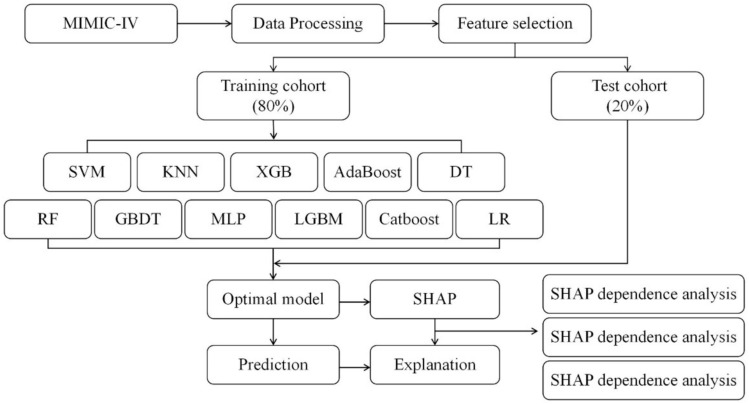
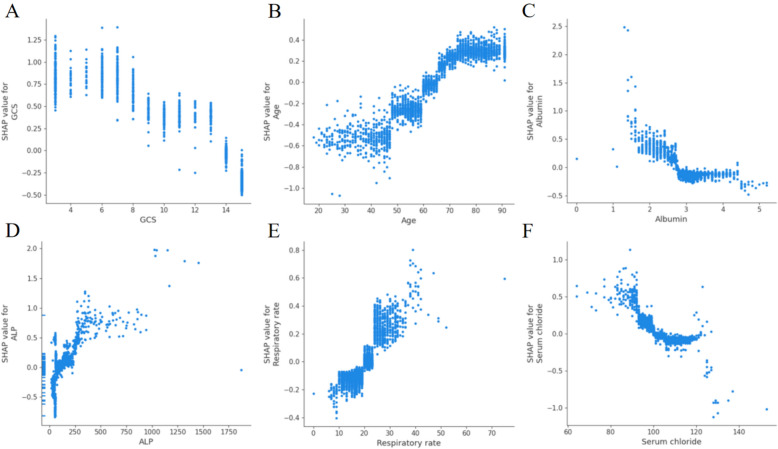
We extracted NVUGIB data from the Medical Information Mart for Intensive Care IV (MIMIC-IV, v.2.2) database spanning from 2008 to 2019. Feature selection was conducted through LASSO regression, followed by training models using 11 machine learning methods. The best model was chosen based on the area under the curve (AUC). Subsequently, Shapley additive explanations (SHAP) was employed to elucidate how each factor influenced the model. Finally, a case was randomly selected, and the model was utilized to predict its mortality, demonstrating the practical application of the developed model.
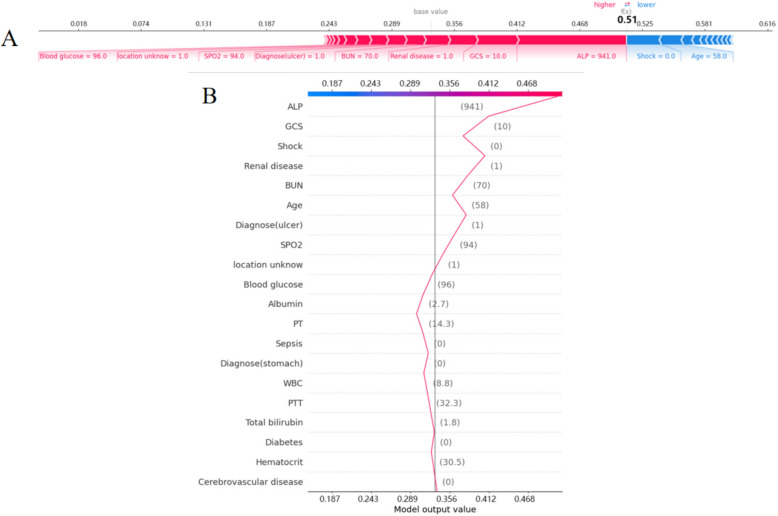
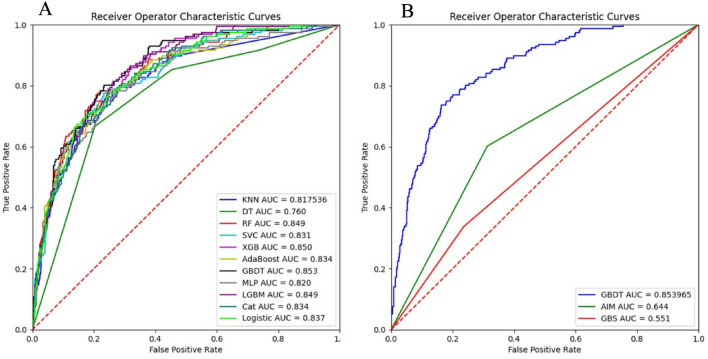
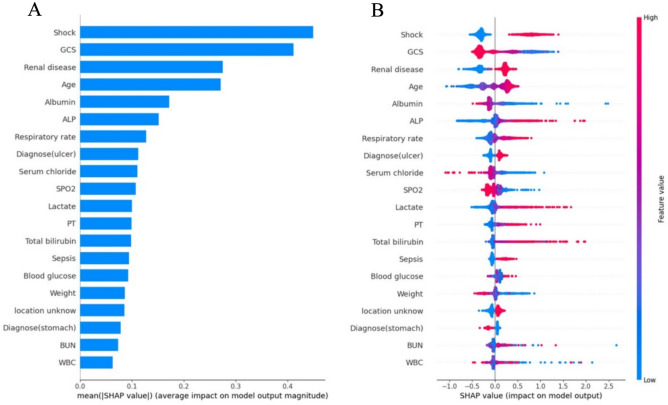
In total, 2716 patients with NVUGIB were deemed eligible for participation. Following selection, 30 out of a total of 64 clinical parameters collected on day 1 after ICU admission remained associated with prognosis and were utilized for developing machine learning models. Among the 11 constructed models, the Gradient Boosting Decision Tree (GBDT) model demonstrated the best performance, achieving an AUC of 0.853 and an accuracy of 0.839 in the validation cohort. Feature importance analysis highlighted that shock, Glasgow Coma Scale (GCS), renal disease, age, albumin, and alanine aminotransferase (ALP) were the top six features of the GBDT model with the most significant impact. Furthermore, SHAP force analysis illustrated how the constructed model visualized the individualized prediction of death.
Patient data from the MIMIC database were leveraged to develop a robust prognostic model for patients with NVUGIB in the ICU. The analysis using SHAP also assisted clinicians in gaining a deeper understanding of the disease.
本研究旨在使用先进的机器学习算法为重症监护病房(ICU)中患有非静脉曲张性上消化道出血(NVUGIB)的患者构建一种死亡率预测模型。目的是尽早识别高危人群,从而加深对 ICU 中 NVUGIB 患者的了解。
我们从 2008 年至 2019 年的医疗信息监护 IV (MIMIC-IV,v.2.2)数据库中提取 NVUGIB 数据。通过 LASSO 回归进行特征选择,然后使用 11 种机器学习方法训练模型。根据曲线下面积(AUC)选择最佳模型。随后,使用 Shapley 加法解释(SHAP)阐明每个因素如何影响模型。最后,随机选择一个病例,并使用模型预测其死亡率,展示了所开发模型的实际应用。
共有 2716 例 NVUGIB 患者符合入选条件。经过选择,在 ICU 入院后第 1 天共采集的 64 项临床参数中有 30 项与预后相关,用于开发机器学习模型。在构建的 11 个模型中,梯度提升决策树(GBDT)模型表现最佳,在验证队列中 AUC 为 0.853,准确率为 0.839。特征重要性分析突出显示,休克、格拉斯哥昏迷量表(GCS)、肾脏疾病、年龄、白蛋白和丙氨酸氨基转移酶(ALP)是 GBDT 模型中影响最大的前六个特征。此外,SHAP 力分析说明了构建的模型如何可视化死亡的个体化预测。
利用 MIMIC 数据库中的患者数据为 ICU 中 NVUGIB 患者开发了一种强大的预后模型。SHAP 的分析还帮助临床医生更深入地了解疾病。