Bürger Marcus, Münscher Johann-Christoph, Herzberg Philipp Yorck
Department of Personality Psychology and Psychological Assessment, Helmut-Schmidt-University, Hamburg, Germany.
German Aerospace Center, Hamburg, Germany.
Front Psychol. 2024 Aug 16;15:1336474. doi: 10.3389/fpsyg.2024.1336474. eCollection 2024.
Sensory-processing sensitivity (SPS) refers to interindividual differences in sensitivity to positive negative environmental stimuli and reflects the concept of differential susceptibility. The Highly Sensitive Person Scale (HSPS) has been utilized to capture the multifaceted experiences of highly sensitive individuals. The scale's total score (i.e., the sum of the subfactors) is an indicator of high sensitivity. However, it cannot differentiate between the contributions of the specific subfactors. Consequently, interpreting the total score cannot help resolve the current theoretical debate about how individuals integrate the positive negative aspects of sensitivity, whereas a multidimensional profile should be able to offer a more comprehensive understanding. Intriguingly, in variable-centered research, the subfactors' differential associations with external constructs in negative positive trait spaces have suggested heterogeneity (i.e., interindividual differences) among highly sensitive individuals. Thus, person-centered approaches should be better suited to address this heterogeneity.
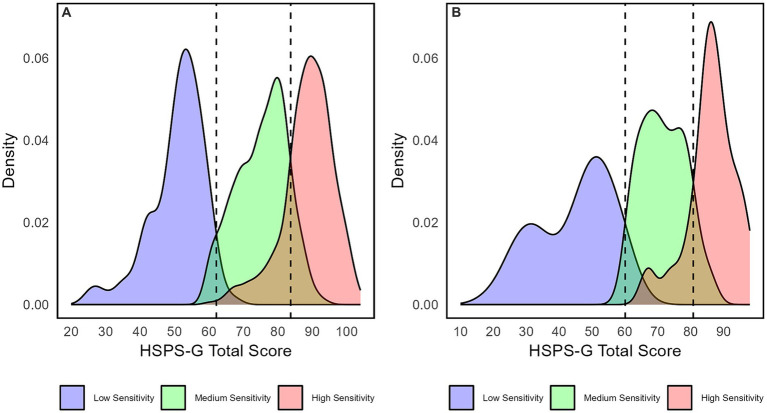
To explore heterogeneity within the highly sensitive population, we conducted a three-step Latent Profile Analysis in two independent German-speaking samples ( = 1,102; = 526). Subsequently, we employed the Five-Factor Model of personality to provide a detailed description of the latent sensitivity groups.
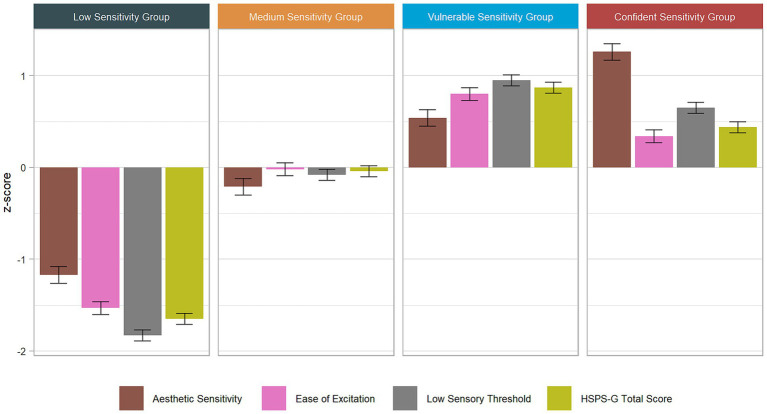
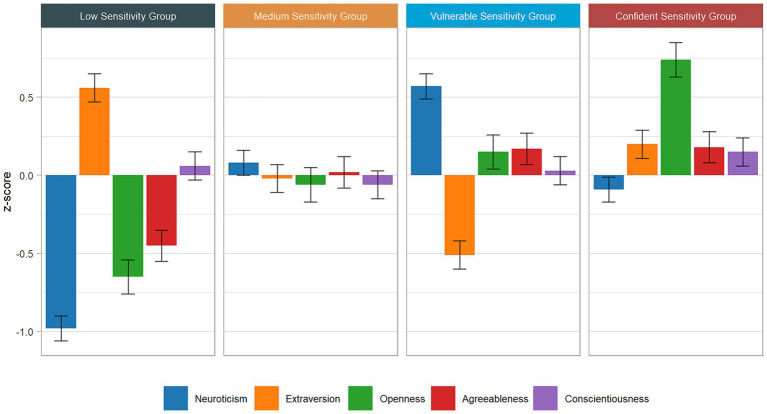
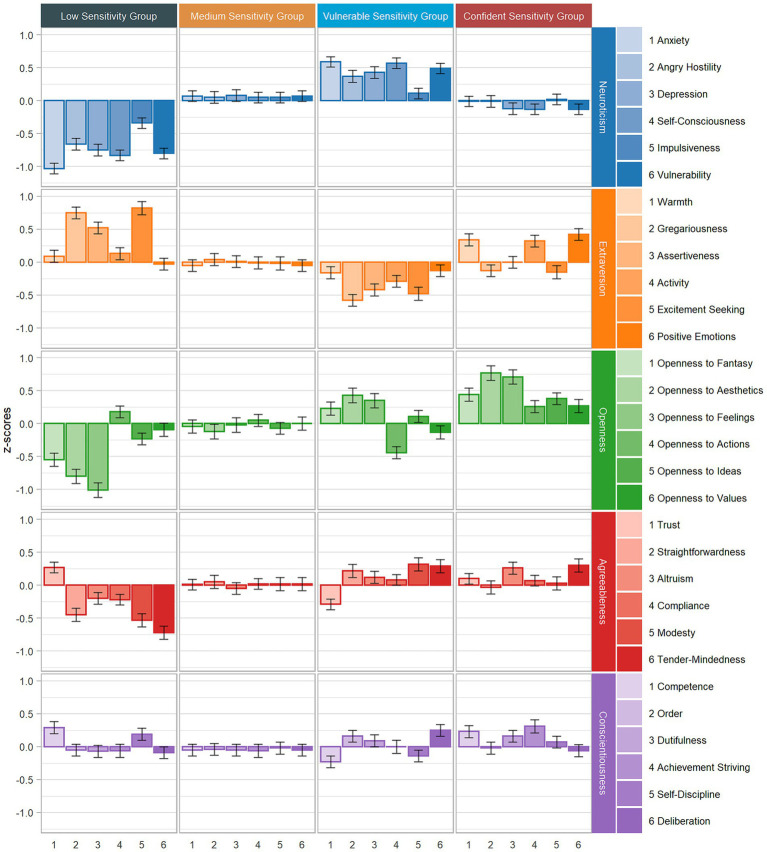
Beyond the frequently identified quantitative three-class differentiation of sensitivity groups, we obtained a four-class model that included two qualitatively different high-sensitivity groups, each displaying distinct HSPS subfactor and personality patterns that corresponded to prototypical personality profiles. Within these high sensitivity groups, (i) the Confident Sensitivity Group exhibited average Neuroticism, significantly above-average Openness, and slightly above-average Extraversion. By contrast, (ii) the Vulnerable Sensitivity Group displayed the typical personality pattern of significantly above-average Neuroticism, below-average Extraversion, and slightly above-average Openness. Personality analyses revealed that features such as passiveness, internalizing tendencies, giftedness, and aesthetics, often commonly ascribed to highly sensitive individuals, are features that differ across distinct sensitivity groups.
To avoid over- or underestimating sensitivity effects, future research should consider these interindividual differences in highly sensitive individuals. For instance, studies could focus on the different associations of sensitivity groups with abilities, health aspects, emotion regulation and intervention outcomes, taking into account the different environmental factors that shape the type of sensitivity.
感觉加工敏感性(SPS)指个体对正负环境刺激敏感性的差异,反映了差异易感性的概念。高敏感人群量表(HSPS)已被用于捕捉高敏感个体的多方面体验。该量表的总分(即各子因素得分之和)是高敏感性的一个指标。然而,它无法区分特定子因素的贡献。因此,解释总分无助于解决当前关于个体如何整合敏感性正负方面的理论争论,而多维度剖析应能提供更全面的理解。有趣的是,在以变量为中心的研究中,子因素在正负特质空间中与外部构念的差异关联表明高敏感个体之间存在异质性(即个体差异)。因此,以个体为中心的方法应更适合解决这种异质性。
为探究高敏感人群内部的异质性,我们在两个独立的德语样本(n = 1102;n = 526)中进行了三步潜在剖面分析。随后,我们采用五因素人格模型对潜在的敏感性群体进行详细描述。
除了常见的敏感性群体的定量三级区分外,我们还得到了一个四级模型,其中包括两个质性不同的高敏感群体,每个群体都表现出独特的HSPS子因素和人格模式,对应于典型的人格剖面。在这些高敏感群体中,(i)自信敏感组表现出平均水平的神经质、显著高于平均水平的开放性和略高于平均水平的外向性。相比之下,(ii)脆弱敏感组表现出典型的人格模式,即显著高于平均水平的神经质、低于平均水平的外向性和略高于平均水平的开放性。人格分析表明,通常归因于高敏感个体的诸如被动性、内化倾向(译者注:此处internalizing tendencies意思存疑,可能是一种心理学术语,大致表示个体倾向于将外部问题内化为自身心理问题的一种趋势,可根据具体研究领域调整)、天赋和审美等特征,在不同的敏感群体中存在差异。
为避免高估或低估敏感性影响,未来研究应考虑高敏感个体之间的这些个体差异。例如,研究可以关注敏感群体与能力、健康方面、情绪调节和干预结果的不同关联,同时考虑塑造敏感性类型的不同环境因素。