Queen Mary University of London, Mile End Rd, London, E14NS, UK.
Stony Brook University, Stony Brook, NY, 11794, USA.
Transl Psychiatry. 2018 Jan 22;8(1):24. doi: 10.1038/s41398-017-0090-6.
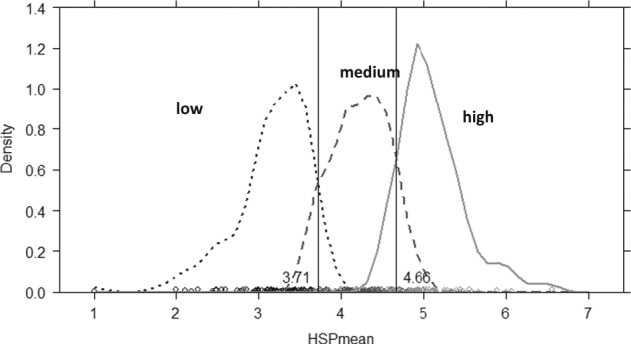
According to empirical studies and recent theories, people differ substantially in their reactivity or sensitivity to environmental influences with some being generally more affected than others. More sensitive individuals have been described as orchids and less-sensitive ones as dandelions. Applying a data-driven approach, we explored the existence of sensitivity groups in a sample of 906 adults who completed the highly sensitive person (HSP) scale. According to factor analyses, the HSP scale reflects a bifactor model with a general sensitivity factor. In contrast to prevailing theories, latent class analyses consistently suggested the existence of three rather than two groups. While we were able to identify a highly sensitive (orchids, 31%) and a low-sensitive group (dandelions, 29%), we also detected a third group (40%) characterised by medium sensitivity, which we refer to as tulips in keeping with the flower metaphor. Preliminary cut-off scores for all three groups are provided. In order to characterise the different sensitivity groups, we investigated group differences regarding the Big Five personality traits, as well as experimentally assessed emotional reactivity in an additional independent sample. According to these follow-up analyses, the three groups differed in neuroticism, extraversion and emotional reactivity to positive mood induction with orchids scoring significantly higher in neuroticism and emotional reactivity and lower in extraversion than the other two groups (dandelions also differed significantly from tulips). Findings suggest that environmental sensitivity is a continuous and normally distributed trait but that people fall into three distinct sensitive groups along a sensitivity continuum.
根据实证研究和最近的理论,人们在对外界影响的反应性或敏感性方面存在很大差异,有些人比其他人更容易受到影响。更敏感的人被描述为兰花,不那么敏感的人被描述为蒲公英。采用数据驱动的方法,我们在一个由 906 名成年人组成的样本中探索了敏感性群体的存在,这些成年人完成了高度敏感人士(HSP)量表。根据因素分析,HSP 量表反映了具有一般敏感性因素的双因素模型。与流行的理论相反,潜在类别分析一致表明存在三个而不是两个群体。虽然我们能够识别出高度敏感(兰花,31%)和低敏感群体(蒲公英,29%),但我们也检测到了第三个群体(40%),其特征是中等敏感性,我们称之为郁金香,以符合花的隐喻。我们提供了所有三个群体的初步截止分数。为了描述不同的敏感群体,我们调查了不同群体在大五人格特质方面的差异,以及在另一个独立样本中实验评估情绪反应性。根据这些后续分析,三个群体在神经质、外向性和对积极情绪诱导的情绪反应性方面存在差异,兰花在神经质和情绪反应性方面的得分明显高于其他两个群体,而外向性得分较低(蒲公英也明显不同于郁金香)。研究结果表明,环境敏感性是一种连续的、正态分布的特征,但人们在敏感性连续体上分为三个不同的敏感群体。