Al-Ibraheem Abdullah Muataz Taha, Hameed Al-Tuaama Abdullah Zeyad, Marsool Mohammed Dheyaa Marsool, Jain Hritvik, Prajjwal Priyadarshi, Khazmi Istevan, Nazzal Ridha Saad, Al-Najati Hussein Mezher Hameed, Al-Zuhairi Baqer Hadi Yusur Kharibet, Razzaq Maryam, Abd Zainab Baqir, Marsool Ali Dheyaa Marsool, Wahedaldin Abdulrahman Isam, Amir Omniat
Al-Kindy College of Medicine University of Baghdad Jadirya Baghdad Iraq.
Privolzhsky Research Medical University, Nizhny Novgorod, Nizhny Novgorod Oblast Russia.
Health Sci Rep. 2024 Aug 31;7(9):e70034. doi: 10.1002/hsr2.70034. eCollection 2024 Sep.
Obesity poses a significant global health challenge, necessitating effective prevention and treatment strategies. Exercise and diet are recognized as pivotal interventions in combating obesity. This study reviews the literature concerning the impact of exercise-induced cytokines, dietary factors, and inflammation on adipose tissue metabolism, shedding light on potential pathways for therapeutic intervention.
A comprehensive review of relevant literature was conducted to elucidate the role of exercise-induced cytokines, including interleukin-6 (IL-6), interleukin-15 (IL-15), brain-derived neurotrophic factor (BDNF), irisin, myostatin, fibroblast growth factor 21 (FGF21), follistatin (FST), and angiopoietin-like 4 (ANGPTL4), in adipose tissue metabolism. Various databases were systematically searched using predefined search terms to identify relevant studies. Articles selected for inclusion underwent thorough analysis to extract pertinent data on the mechanisms underlying the influence of these cytokines on adipose tissue metabolism.
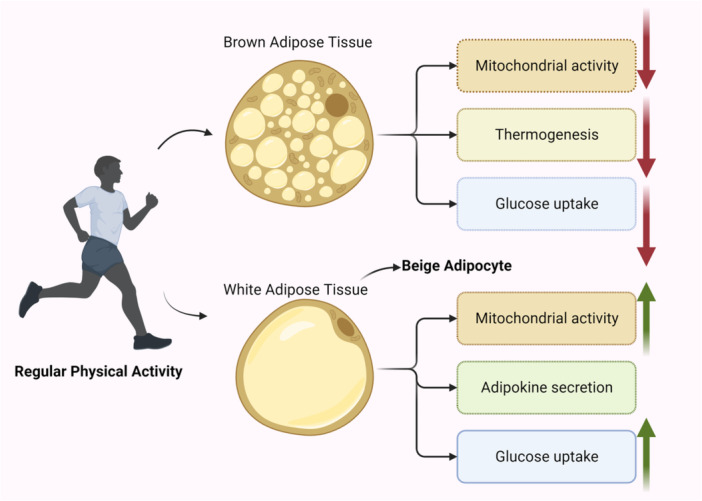
Exercise-induced cytokines exert profound effects on adipose tissue metabolism, influencing energy expenditure (EE), thermogenesis, fat loss, and adipogenesis. For instance, IL-6 activates AMP-activated protein kinase (AMPK), promoting fatty acid oxidation and reducing lipogenesis. IL-15 upregulates peroxisome proliferator-activated receptor delta (PPARδ), stimulating fatty acid catabolism and suppressing lipogenesis. BDNF enhances AMPK-dependent fat oxidation, while irisin induces the browning of white adipose tissue (WAT), augmenting thermogenesis. Moreover, myostatin, FGF21, FST, and ANGPTL4 each play distinct roles in modulating adipose tissue metabolism, impacting factors such as fatty acid oxidation, adipogenesis, and lipid uptake. The elucidation of these pathways offers valuable insights into the complex interplay between exercise, cytokines, and adipose tissue metabolism, thereby informing the development of targeted obesity management strategies.
Understanding the mechanisms by which exercise-induced cytokines regulate adipose tissue metabolism is critical for devising effective obesity prevention and treatment modalities. Harnessing the therapeutic potential of exercise-induced cytokines, in conjunction with dietary interventions, holds promise for mitigating the global burden of obesity. Further research is warranted to delineate the precise mechanisms underlying the interactions between exercise, cytokines, and adipose tissue metabolism.
肥胖是一项重大的全球健康挑战,需要有效的预防和治疗策略。运动和饮食被认为是对抗肥胖的关键干预措施。本研究回顾了有关运动诱导的细胞因子、饮食因素和炎症对脂肪组织代谢影响的文献,揭示了潜在的治疗干预途径。
对相关文献进行全面综述,以阐明运动诱导的细胞因子,包括白细胞介素-6(IL-6)、白细胞介素-15(IL-15)、脑源性神经营养因子(BDNF)、鸢尾素、肌肉生长抑制素、成纤维细胞生长因子21(FGF21)、卵泡抑素(FST)和血管生成素样4(ANGPTL4)在脂肪组织代谢中的作用。使用预定义的搜索词系统地搜索各种数据库,以识别相关研究。入选的文章经过深入分析,以提取有关这些细胞因子对脂肪组织代谢影响机制的相关数据。
运动诱导的细胞因子对脂肪组织代谢有深远影响,影响能量消耗(EE)、产热、脂肪减少和脂肪生成。例如,IL-6激活AMP激活的蛋白激酶(AMPK),促进脂肪酸氧化并减少脂肪生成。IL-15上调过氧化物酶体增殖物激活受体δ(PPARδ),刺激脂肪酸分解代谢并抑制脂肪生成。BDNF增强AMPK依赖性脂肪氧化,而鸢尾素诱导白色脂肪组织(WAT)褐变,增加产热。此外,肌肉生长抑制素、FGF21、FST和ANGPTL4在调节脂肪组织代谢中各自发挥不同作用,影响脂肪酸氧化、脂肪生成和脂质摄取等因素。对这些途径的阐明为运动、细胞因子和脂肪组织代谢之间的复杂相互作用提供了有价值的见解,从而为制定有针对性的肥胖管理策略提供依据。
了解运动诱导的细胞因子调节脂肪组织代谢的机制对于设计有效的肥胖预防和治疗方法至关重要。利用运动诱导的细胞因子的治疗潜力,结合饮食干预,有望减轻全球肥胖负担。有必要进一步研究以阐明运动、细胞因子和脂肪组织代谢之间相互作用的精确机制。