Ertekin Zehra Ceren, Köroğlu Ayşegül, Dinç Erdal
Department of Analytical Chemistry, Faculty of Pharmacy, Ankara University, Yenimahalle, Türkiye.
Department of Pharmaceutical Botany, Faculty of Pharmacy, Ankara University, Yenimahalle, Türkiye.
Phytochem Anal. 2025 Jan;36(1):279-288. doi: 10.1002/pca.3439. Epub 2024 Sep 2.
Co-elution is a common challenge in phytochemical chromatography. Full chromatographic separation often requires extensive optimization, long analysis times, and excessive solvent use. A viable alternative could be mathematical elution of analytes using three-dimensional decomposition.
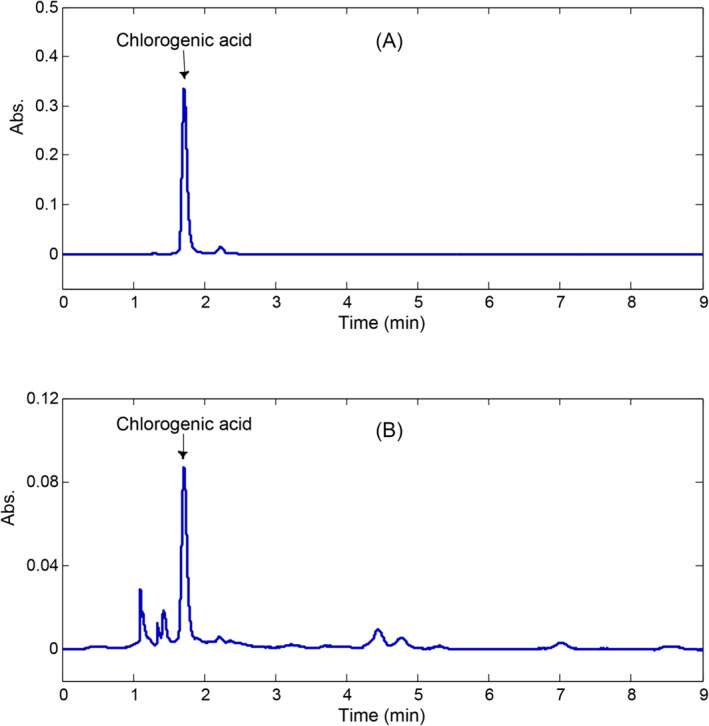
This study aimed to develop a method to determine chlorogenic acid in Melampyrum stenophyllum Boiss. extracts without complete chromatographic separation, to validate the method, and to cross-validate assay results against a classical ultra-performance liquid chromatography (UPLC) method.
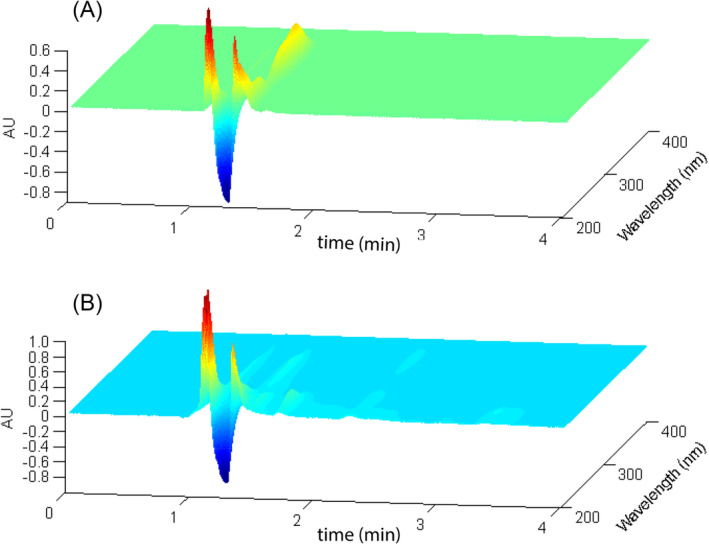
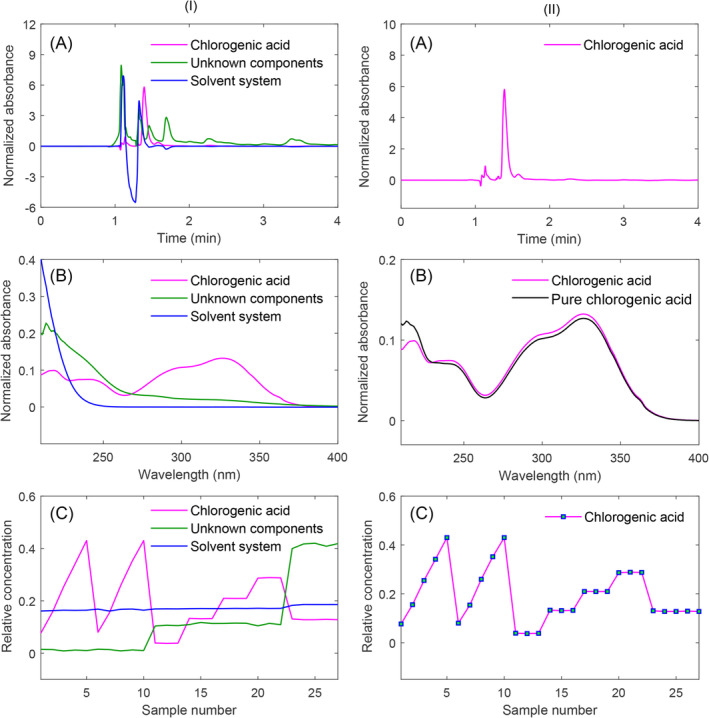
Ultra-performance liquid chromatography-photodiode array (UPLC-PDA) spectrochromatograms were arranged into a three-way data cube with dimensions of time, wavelength, and sample and then decomposed using parallel factor analysis to reveal chromatographic, spectral, and concentration profiles. The chromatographic and spectral profiles were used to identify chlorogenic acid in overlapping signals. The relative concentration profile was used to quantify it in the plant extract. The assay results were statistically compared with those from an in-house classical UPLC method.
Chlorogenic acid was co-eluted at 1.45 min and quantified as 16.11 mg per gram dry weight of Melampyrum stenophyllum extracts (SD = 0.28), despite significant interference in a 4-min runtime. The analytical validity was confirmed by recovery calculations from standard solutions and standard addition samples (RSD < 2%), and the t-test resulted in a p-value of 0.09 (α = 0.05), indicating no significant difference between the results obtained from mathematical elution and chromatographic separation.
Chlorogenic acid was quantified from plant material accurately despite the co-elution. Validation and cross-validation results support the method's applicability.
共洗脱是植物化学色谱分析中常见的挑战。完全的色谱分离通常需要大量的优化、较长的分析时间以及大量的溶剂使用。一种可行的替代方法可能是使用三维分解对分析物进行数学洗脱。
本研究旨在开发一种无需完全色谱分离即可测定狭叶毛地黄叶提取物中绿原酸的方法,对该方法进行验证,并与经典的超高效液相色谱(UPLC)方法交叉验证分析结果。
将超高效液相色谱 - 光电二极管阵列(UPLC - PDA)光谱色谱图排列成一个具有时间、波长和样品三个维度的数据立方体,然后使用平行因子分析进行分解,以揭示色谱、光谱和浓度分布。色谱和光谱分布用于在重叠信号中识别绿原酸。相对浓度分布用于在植物提取物中对其进行定量。将分析结果与内部经典UPLC方法的结果进行统计学比较。
尽管在4分钟的运行时间内存在显著干扰,但绿原酸在1.45分钟时共洗脱,并被定量为每克狭叶毛地黄叶提取物干重16.11毫克(标准差 = 0.28)。通过对标准溶液和标准加入样品的回收率计算(相对标准偏差 < 2%)证实了分析的有效性,t检验得出p值为0.09(α = 0.05),表明数学洗脱和色谱分离获得的结果之间没有显著差异。
尽管存在共洗脱现象,但仍能准确地从植物材料中定量绿原酸。验证和交叉验证结果支持该方法的适用性。