Thompson Zane, Wasser Joseph G, Vincent Kevin R, Vincent Heather K
Physical Medicine and Rehabilitation University of Florida.
Int J Sports Phys Ther. 2024 Sep 1;19(9):1088-1096. doi: 10.26603/001c.122323. eCollection 2024.
Unlike other sports, the relationship between performance deficits and pain/injury in lacrosse players has not been well-investigated.
The purposes of this study were to: 1) determine whether age and sex differences exist in dynamic physical function tests and drop jump performance among lacrosse players, and 2) determine whether pre-seasonal physical function scores predict onset of either lower extremity or low back pain over time.
Prospective observational study.
Lacrosse players (N=128) were stratified into three groups: 12-14.9 yrs, 15-18 yrs and >18 yrs. Thomas test (hip flexibility), Ober's test (iliotibial band tightness), and Ely's test (rectus femoris tightness) were performed. Landing Error Scoring System (LESS) scores were collected while players performed drop jumps. Sagittal and frontal plane movement from 2D video during single and double legged squats was assessed. Musculoskeletal pain symptoms or injury were tracked for six months. Age bracket, sex and physical function scores were entered into logistic regression models to determine risk factors that predicted onset of lower extremity pain and low back pain onset.
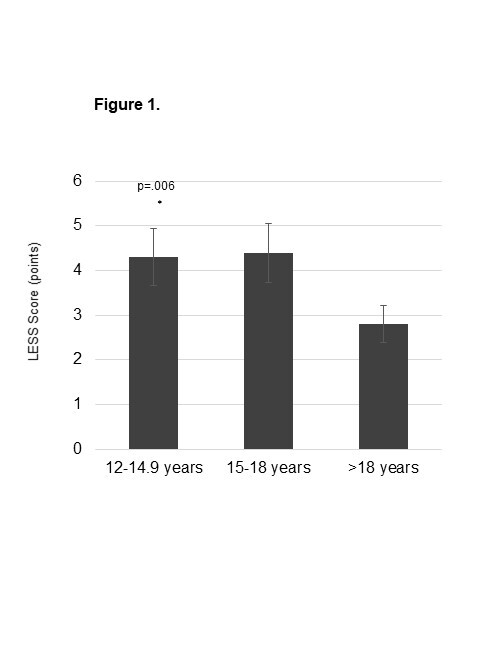
LESS scores and single-leg squat movement quality test scores were lowest in the 12-14.9 yr groups and highest in the >18 yr group (all p<0.05). Single leg squat performance score increased the odds risk (OR) for lower extremity pain (OR=2.62 [95% CI 1.06-6.48], p=.038) and LESS scores elevated risk for low back pain onset over six months (OR = 2.09 [95% CI 1.07- 4.06], p= .031).
LESS scores and single legged squat performance may help identify lacrosse players at risk for musculoskeletal pain or injury onset. Detecting these pertinent biomechanical errors and subsequently developing proper training programs could help prevent lower extremity and low back pain onset.
III.
与其他运动不同,长曲棍球运动员的运动能力缺陷与疼痛/损伤之间的关系尚未得到充分研究。
本研究的目的是:1)确定长曲棍球运动员在动态身体功能测试和纵跳性能方面是否存在年龄和性别差异,以及2)确定季前身体功能评分是否能预测随着时间推移下肢或下背部疼痛的发作。
前瞻性观察研究。
将128名长曲棍球运动员分为三组:12 - 14.9岁、15 - 18岁和大于18岁。进行托马斯试验(髋关节灵活性)、奥伯试验(髂胫束紧张度)和伊利试验(股直肌紧张度)。在运动员进行纵跳时收集落地误差评分系统(LESS)分数。评估单腿和双腿深蹲时二维视频中的矢状面和额状面运动。对肌肉骨骼疼痛症状或损伤进行为期六个月的跟踪。将年龄组、性别和身体功能评分纳入逻辑回归模型,以确定预测下肢疼痛发作和下背部疼痛发作的风险因素。
12 - 14.9岁组的LESS分数和单腿深蹲运动质量测试分数最低,大于18岁组最高(所有p<0.05)。单腿深蹲表现评分增加了下肢疼痛的几率风险(OR = 2.62 [95% CI 1.06 - 6.48],p = 0.038),LESS分数增加了六个月内下背部疼痛发作的风险(OR = 2.09 [95% CI 1.07 - 4.06],p = 0.031)。
LESS分数和单腿深蹲表现可能有助于识别有肌肉骨骼疼痛或损伤发作风险的长曲棍球运动员。检测这些相关的生物力学错误并随后制定适当的训练计划有助于预防下肢和下背部疼痛发作。
III级。