Department of Emergency Medicine, Zhejiang Hospital, Hangzhou, Zhejiang, China.
Nurs Open. 2024 Sep;11(9):e70024. doi: 10.1002/nop2.70024.
Geriatric patients are increasingly dominating the daily routine in emergency department (ED). The atypical clinical presentation of disease, multimorbidity, frailty and cognitive impairment of geriatric patients pose particular challenges for triage in the ED. Efficient and accurate emergency triage plays a key role in differentiating between geriatric patients who need timely treatment and those who can wait safely. The purpose of this study was to evaluate the performance of the modified Manchester Triage System (mMTS) in classifying geriatric patients.
An observational retrospective study.
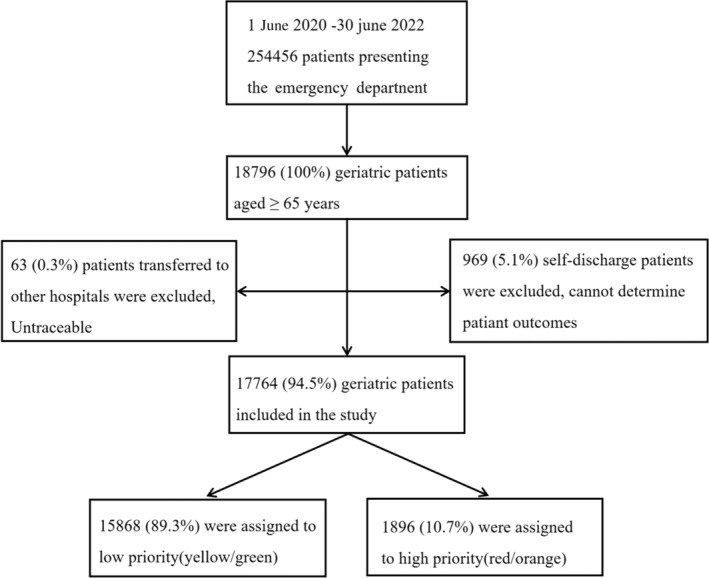
A retrospective study of 18,796 geriatric patients (≥65 years) attending the ED of a tertiary care hospital in Zhejiang province between 1 June 2020 and 30 June 2022. Baseline information on patients was collected and divided into two different study groups according to triage level: high priority (red/orange) and low priority (yellow/green). The sensitivity and specificity of the mMTS were estimated by verifying the triage classification received by the emergency geriatric patients and their survival at 7 days or the need for acute surgery within 72 h.
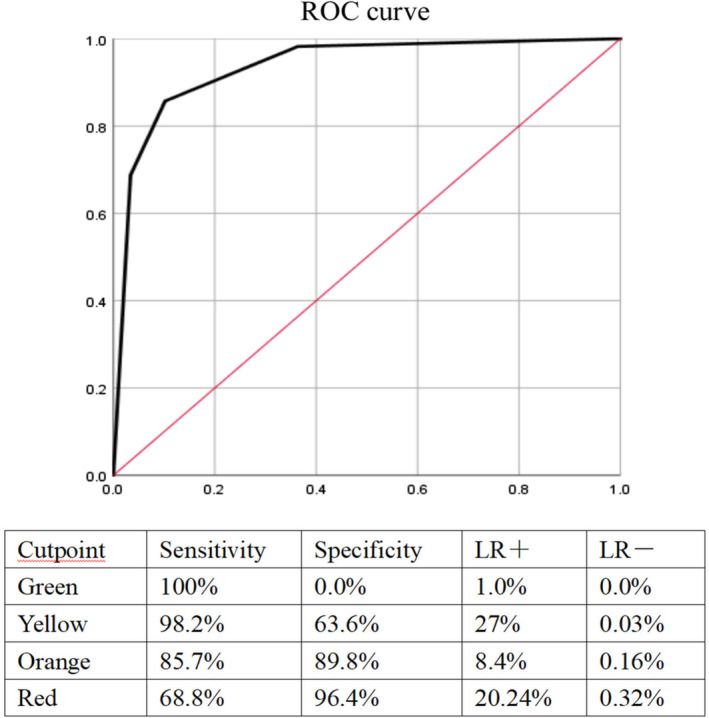
The study included a total of 17,764 geriatric patients with a median age of 72 years in ED. 10.7% (1896/17,764) of the geriatric patients were assigned to the high priority code group (red/orange) and 89.3% (15,868/17,764) were in the low priority code group (yellow/green). The sensitivity of the mMTS associated with death within 7 days was 85.7% (77.5-91.4), specificity was 89.8% (89.3-90.2), and accuracy was 89.8% (89.3-90.2). 1.8% of patients required surgery within 72 h. The sensitivity was 62.6% (57.0-67.9), specificity was 90.3% (89.8-90.7), and negative predictive value was 99.2% (99.0-99.4).
The mMTS has good specificity, accuracy and negative predictive value for geriatric patients. However, its incorrect prediction of triage in high-priority code patients results in lower sensitivity, which may serve as a protective strategy for these individuals. The current emergency triage system does not completely screen geriatric patients with severe acute illness who present to the ED, and it is necessary to add comprehensive assessment tools that match the characteristics of geriatric patients to improve triage outcomes.
老年患者在急诊科(ED)的日常工作中占比越来越大。老年患者疾病的非典型临床表现、多种合并症、虚弱和认知障碍给 ED 的分诊带来了特殊挑战。有效的、准确的急诊分诊在区分需要及时治疗的老年患者和可以安全等待的患者方面起着关键作用。本研究旨在评估改良曼彻斯特分诊系统(mMTS)在分类老年患者中的表现。
一项观察性回顾性研究。
回顾性分析 2020 年 6 月 1 日至 2022 年 6 月 30 日期间在浙江省一家三级医院 ED 就诊的 18796 例(≥65 岁)老年患者的基线信息。根据分诊级别将患者分为两组:高优先级(红色/橙色)和低优先级(黄色/绿色)。通过验证急诊老年患者接受的分诊分类及其在 7 天内的生存或 72 小时内是否需要急性手术,来估计 mMTS 的灵敏度和特异性。
该研究共纳入 17764 例 ED 老年患者,中位年龄为 72 岁。10.7%(1896/17764)的老年患者被分配到高优先级代码组(红色/橙色),89.3%(15868/17764)为低优先级代码组(黄色/绿色)。mMTS 与 7 天内死亡相关的灵敏度为 85.7%(77.5-91.4),特异性为 89.8%(89.3-90.2),准确性为 89.8%(89.3-90.2)。1.8%的患者在 72 小时内需要手术。灵敏度为 62.6%(57.0-67.9),特异性为 90.3%(89.8-90.7),阴性预测值为 99.2%(99.0-99.4)。
mMTS 对老年患者具有良好的特异性、准确性和阴性预测值。然而,它对高优先级代码患者分诊的错误预测导致灵敏度较低,这可能是对这些患者的一种保护策略。目前的急诊分诊系统并不能完全筛选出因严重急性疾病就诊 ED 的老年患者,有必要增加与老年患者特征相匹配的综合评估工具,以改善分诊结果。