Honda Kazuaki, Sata Shizuka, Komine Mizuki, Yamaguchi Satoshi, Kim SungHyek, Kashino Makio, Fujii Shinya
Graduate School of Media and Governance, Keio University, Fujisawa, Japan.
NTT Communication Science Laboratories, NTT Corporation, Atsugi, Japan.
Front Neurol. 2024 Aug 21;15:1398476. doi: 10.3389/fneur.2024.1398476. eCollection 2024.
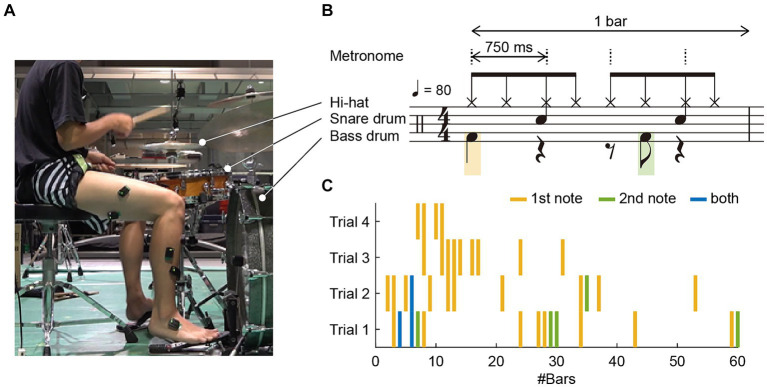
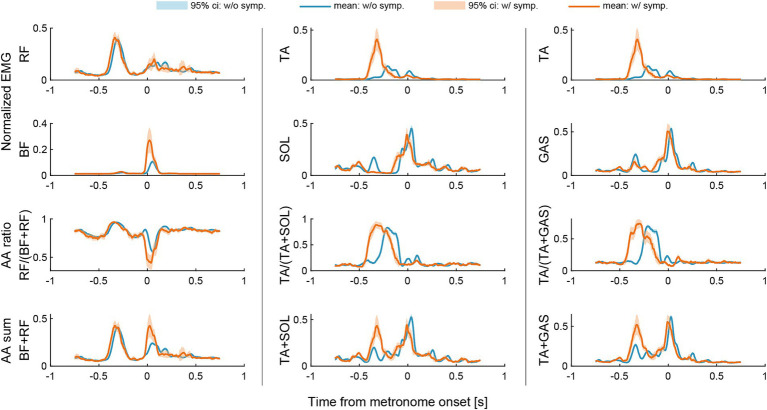
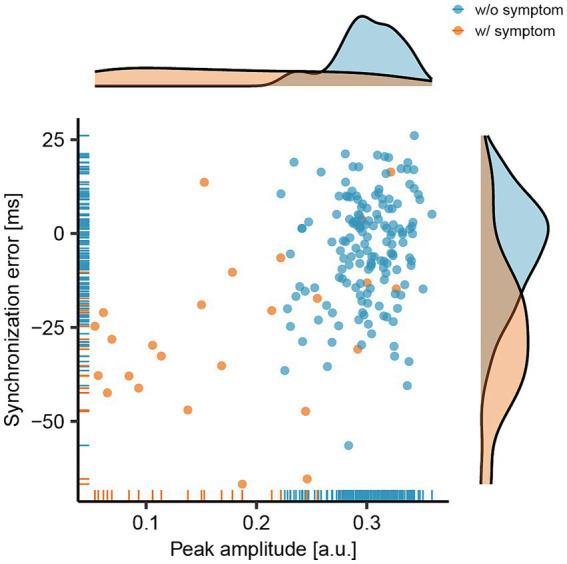
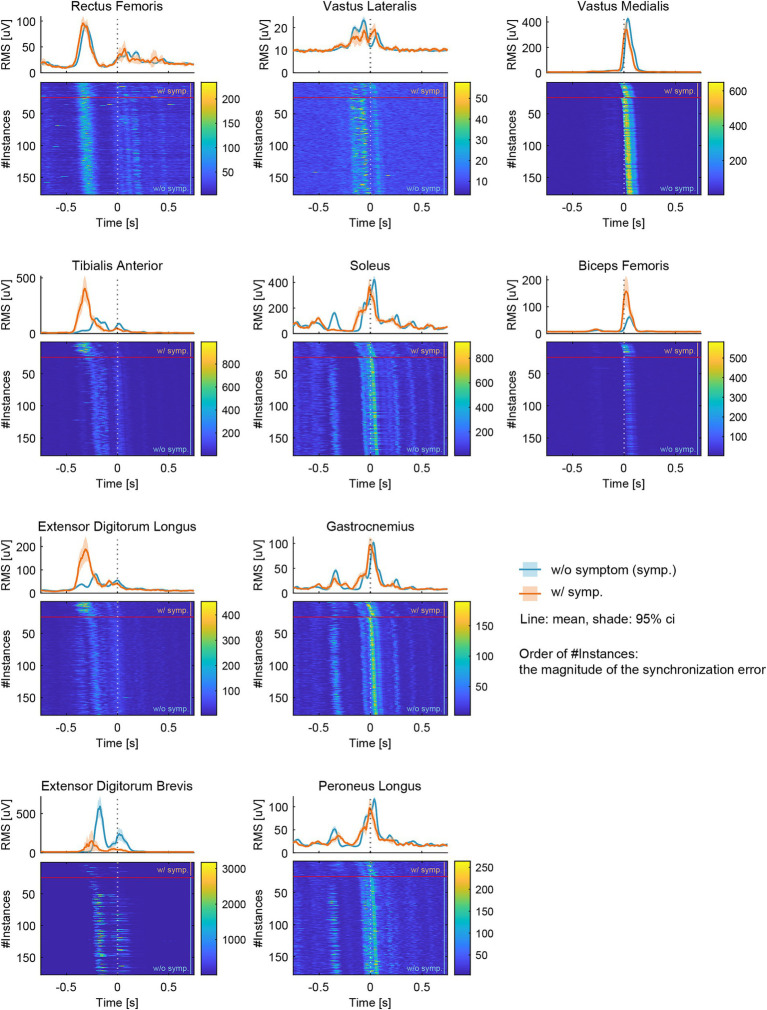
Task-specific focal dystonia (TSFD), characterized by the loss of fine motor control and coordination, affects drummers' lower-limb movements. This study explores lower-limb dystonia's impact on drumming performance and underlying muscle activity in a professional rock drummer. The drummer executed an eight-beat pattern on a drum kit. The participant reported the occurrence of symptoms when he felt the abnormality such as the loss of control related to involuntary aspects of movement. We measured the peak amplitude of the bass drumhead vibration, synchronization errors as the time elapsed between the metronome onset and the bass drum onset, and amplitude of electromyographic (EMG) recordings centered on metronome beat. Dystonia symptoms primarily manifested in the initial beat, with fewer symptoms on syncopation of the third beat. Analysis revealed decreased bass-drum peak amplitude and earlier synchronization error during the initial beat. EMG measurements of 10 muscles in the affected right lower limb showed significant changes in the Biceps Femoris (BF), Tibialis Anterior (TA), Extensor Digitorum Longus (EDL), and Extensor Digitorum Brevis (EDB) muscles during symptom onset. We observed (1) earlier overactivation of the TA and EDL muscles during the leg lift-up motion or preparatory phase of pedaling, (2) reduced activation of the EDB muscle, and (3) increased activation of the BF muscle during the final pedaling movement when symptoms occurred. These findings suggest that lower-limb dystonia symptoms are characterized by a reduction in amplitude of the bass drumhead vibration and an increase in synchronization error, potentially due to premature overactivation of the ankle dorsiflexor muscles.
特定任务性局灶性肌张力障碍(TSFD),其特征为精细运动控制和协调能力丧失,会影响鼓手的下肢运动。本研究探讨了下肢肌张力障碍对一名专业摇滚鼓手击鼓表现及潜在肌肉活动的影响。该鼓手在鼓组上演奏一个八拍节奏型。当参与者感觉到诸如与非自主运动方面相关的控制丧失等异常情况时,报告症状的发生。我们测量了低音鼓面振动的峰值幅度、节拍器启动与低音鼓启动之间的时间间隔作为同步误差,以及以节拍器节拍为中心的肌电图(EMG)记录的幅度。肌张力障碍症状主要在起始节拍中表现出来,在第三拍切分音时症状较少。分析显示,在起始节拍期间,低音鼓峰值幅度降低,同步误差提前。对受影响的右下肢10块肌肉的肌电图测量表明,在症状发作期间,股二头肌(BF)、胫骨前肌(TA)、趾长伸肌(EDL)和趾短伸肌(EDB)肌肉有显著变化。我们观察到:(1)在腿部抬起动作或踏板准备阶段,TA和EDL肌肉过早过度激活;(2)EDB肌肉激活减少;(3)在症状出现时的最终踏板动作期间,BF肌肉激活增加。这些发现表明,下肢肌张力障碍症状的特征是低音鼓面振动幅度减小和同步误差增加,这可能是由于踝背屈肌过早过度激活所致。