Department of Child Healthcare, Wenzhou People's Hospital, Wenzhou, China.
Children's Heart Center, The Second Affiliated Hospital and Yuying Children's Hospital, Institute of Cardiovascular Development and Translational Medicine, Wenzhou Medical University, Wenzhou, China.
Front Public Health. 2024 Aug 21;12:1427905. doi: 10.3389/fpubh.2024.1427905. eCollection 2024.
The association between exposure to cadmium (Cd) and cardiovascular health (CVH) has received considerable scientific interest. However, findings thus far have been inconclusive, particularly regarding sex-specific effects and dose-response relationships. The aim of our study was to investigate the relationships of blood Cd levels with the overall and component CVH scores.
We used data from the 2011-2018 NHANES to assess CVH using indicators such as BMI, blood pressure, lipid profiles, glucose levels, diet, physical activity, nicotine use, and sleep quality, each rated on a 0-100 scale. The overall CVH score was calculated as the average of these indicators. We employed both multiple linear and restricted cubic spline analyses to examine the relationship between blood Cd levels and CVH scores, including nonlinear patterns and subgroup-specific effects.
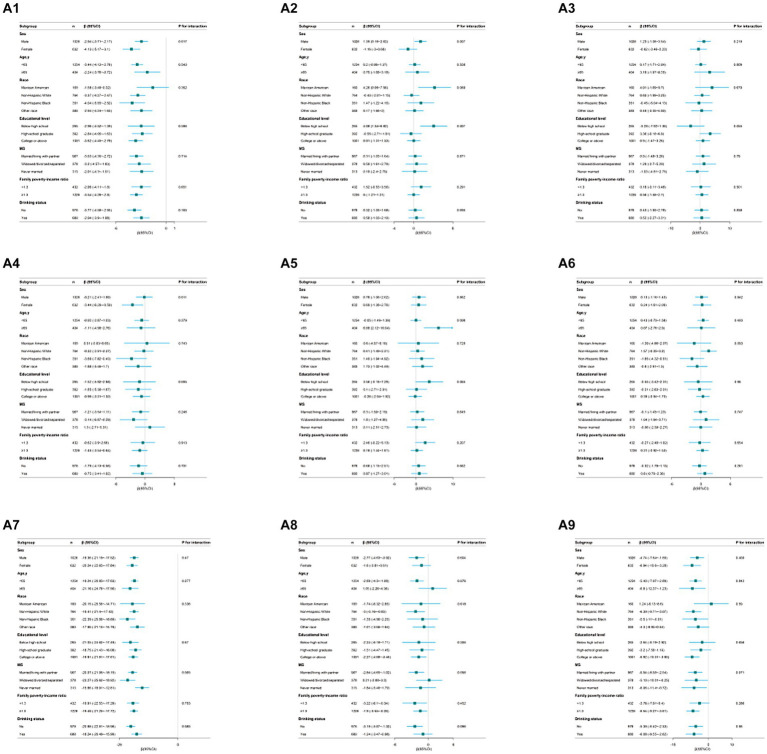
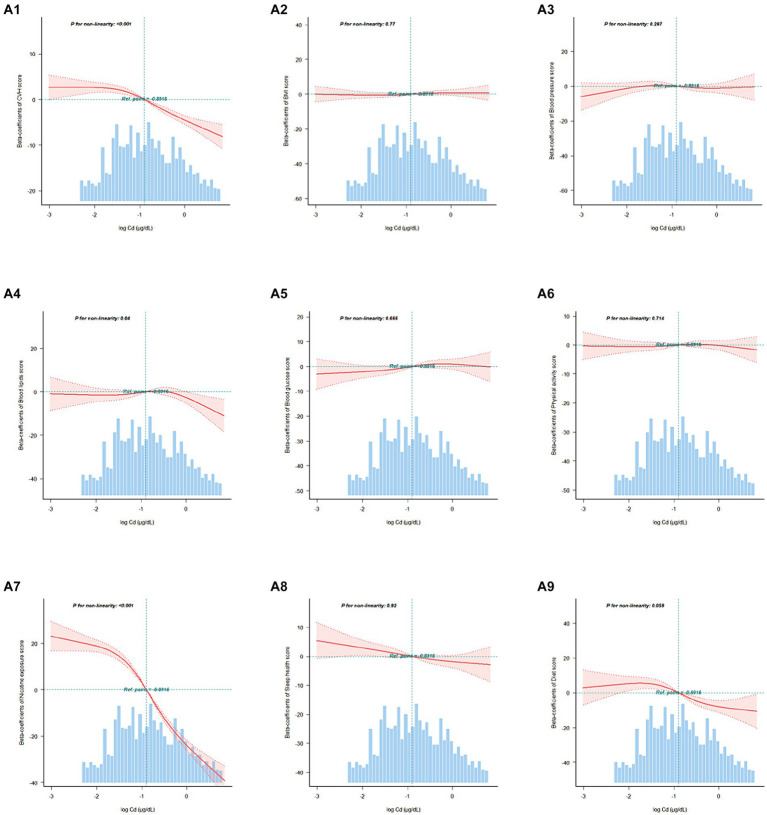
Our analysis revealed that higher blood Cd levels were associated with lower overall CVH, nicotine exposure, sleep, and diet scores, with nonlinear decreases observed in overall CVH and nicotine exposure scores at specific thresholds (-1.447 and -1.752 log μg/dL, respectively). Notably, sex differences were evident; females experienced more adverse effects of Cd on CVH and lipid scores, while in males, Cd exposure was positively correlated with BMI, a link not observed in females.
Our study highlights the complex interplay between blood Cd levels and various aspects of CVH, revealing significant dose-response relationships and sex disparities. These findings enhance our understanding of the biobehavioral mechanisms linking Cd exposure to cardiovascular risk.
镉(Cd)暴露与心血管健康(CVH)之间的关联引起了科学界的广泛关注。然而,迄今为止的研究结果尚无定论,特别是关于性别特异性影响和剂量-反应关系。我们的研究旨在探讨血液 Cd 水平与整体和各组分 CVH 评分之间的关系。
我们使用了 2011-2018 年 NHANES 数据,使用 BMI、血压、血脂谱、血糖水平、饮食、身体活动、尼古丁使用和睡眠质量等指标评估 CVH,每个指标的评分范围为 0-100。整体 CVH 评分是这些指标的平均值。我们采用了多元线性和受限立方样条分析来研究血液 Cd 水平与 CVH 评分之间的关系,包括非线性模式和亚组特异性效应。
我们的分析表明,较高的血液 Cd 水平与整体 CVH、尼古丁暴露、睡眠和饮食评分较低有关,在特定阈值处观察到整体 CVH 和尼古丁暴露评分的非线性下降(分别为-1.447 和-1.752 log μg/dL)。值得注意的是,存在性别差异;女性对 CVH 和脂质评分受到 Cd 的不利影响更大,而在男性中,Cd 暴露与 BMI 呈正相关,而女性中则没有观察到这种关联。
我们的研究强调了血液 Cd 水平与 CVH 各个方面之间的复杂相互作用,揭示了显著的剂量-反应关系和性别差异。这些发现增强了我们对 Cd 暴露与心血管风险之间的生物行为机制的理解。