Nakamura Gabriel, Soares Bruno Eleres, Pillar Valério D, Diniz-Filho José Alexandre Felizola, Duarte Leandro
National Institute of Science and Technology-Ecology, Evolution and Conservation Biology, Universidade Federal de Goiás, Goiânia, Brazil.
University of Toronto-Scarborough, Toronto, ON, Canada.
NPJ Biodivers. 2023 Aug 21;2(1):17. doi: 10.1038/s44185-023-00021-7.
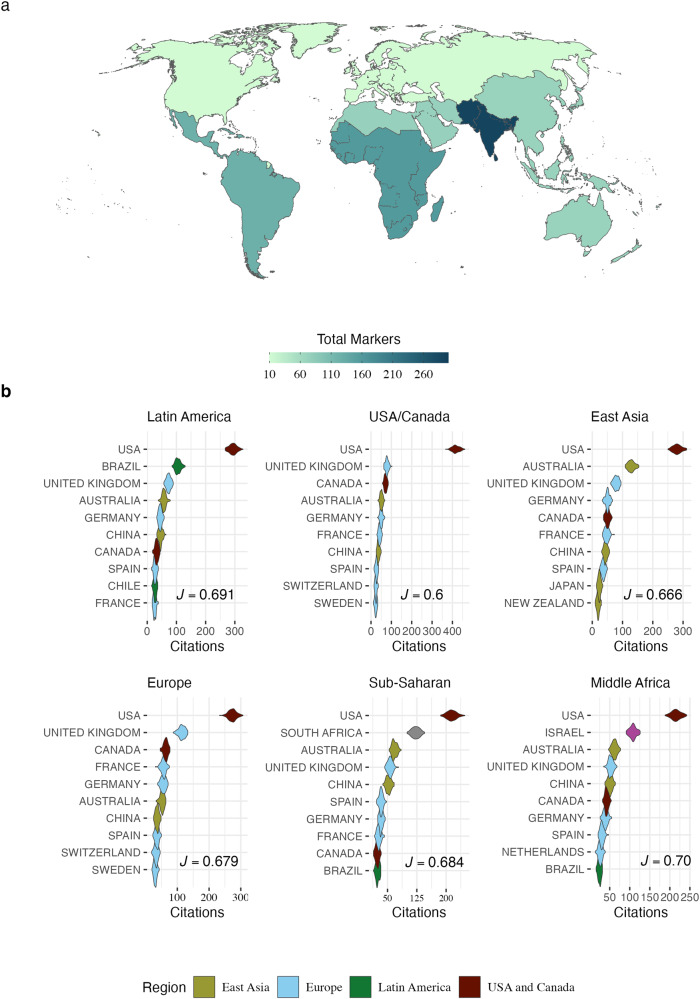
It is widely perceived how research institutes have been adopting the discourse of champions of diversity, inclusion, and equity (DEI) in recent years. Despite progress in diversity and inclusion in the academic environment, we highlight here that nothing or, at very best, little work has been done to overcome the scientific labor division in academic research that promotes neocolonial practices in academic recognition and jeopardizes equity. In this piece, we bring secondary data that reinforce biased patterns in academic recognition between Global North and South (geographical markers and citation bias), and propose three actions that should be adopted by researchers, research institutes, journals, and scientific societies from the Global North that allows for a fairer recognition of the academic expertise produced by the Global South.
近年来,研究机构如何采用多元化、包容性和公平性(DEI)倡导者的话语已广为人知。尽管学术环境在多元化和包容性方面取得了进展,但我们在此强调,在克服学术研究中的科学分工方面,几乎没有或至多只做了很少的工作,这种分工在学术认可中促进了新殖民主义做法,并危及公平性。在本文中,我们引入了辅助数据,这些数据强化了全球北方和南方在学术认可方面的偏见模式(地理标志和引用偏见),并提出了三项行动,全球北方的研究人员、研究机构、期刊和科学协会应采取这些行动,以便更公平地认可全球南方产生的学术专长。