Department of General Surgery, School of Medicine Hazrat-e Rasool General Hospital, Iran University of Medical Sciences, Tehran, Iran.
Department of Surgery, School of Medicine, Shohadaye Haft-e Tir Hospital, Iran University of Medical Sciences, Tehran, Iran.
BMC Cancer. 2024 Sep 6;24(1):1113. doi: 10.1186/s12885-024-12854-x.
This meta-analysis aims to clarify the association between the TNF-α -308G > A and - 238G > A polymorphisms and lung cancer risk.
A comprehensive search was conducted for relevant articles across databases such as PubMed, Google Scholar, Web of Science, EMBASE, and CNKI, up to September 25, 2023. Lung cancer risk was assessed by calculating odds ratios (ORs) and their 95% confidence intervals (CIs). The Z-test was used to determine the significance of combined ORs, with P < 0.05 considered statistically significant. All analyses were performed using Comprehensive Meta-Analysis (CMA) 2.0 software.
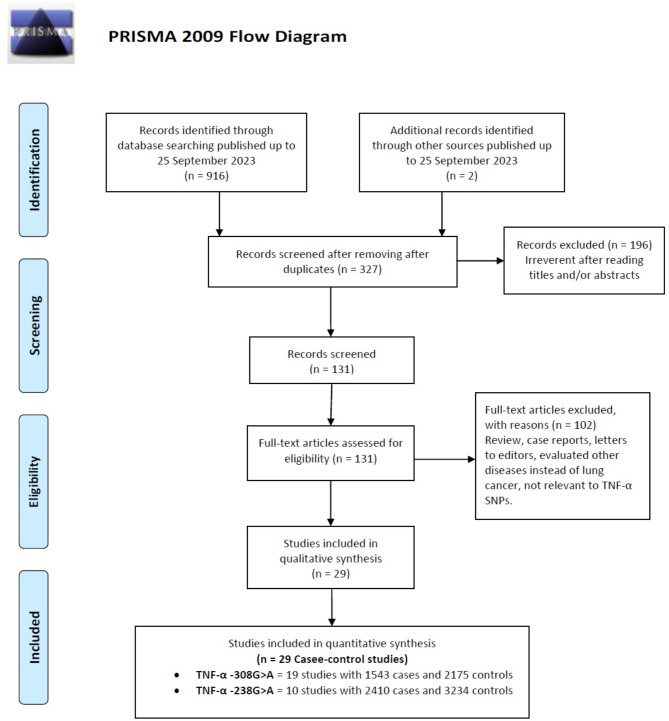
The analysis included 19 case-control studies with 3,838 cases and 5,306 controls for the TNF-α -308G > A polymorphism, along with 10 studies comprising 2,427 cases and 2,357 controls for the - 238G > A polymorphism. The - 308G > A polymorphism showed no significant overall relationships, though in the Asian subgroup, the A allele was significantly reduced compared to G (OR: 0.831, p = 0.028) and the AA genotype showed significant reductions versus GG (OR: 0.571, p = 0.021), with no significant correlation in Caucasians. In non-small cell lung cancer (NSCLC), the A allele was associated with increased risk compared to G (OR: 1.131, p = 0.049). For the - 238G > A polymorphism, the AA genotype significantly increased risk compared to GG (OR: 3.171, p = 0.014), while showing a protective effect in Caucasians (OR: 0.120, p = 0.024) and a heightened risk in Asians (OR: 7.990, p = 0.007). In small cell lung cancer (SCLC), the A allele conferred protective effects, whereas NSCLC showed increased risk for the AA genotype (OR: 11.375, p = 0.002).
The - 308G > A polymorphism has no significant overall relationships but suggests a protective role of the A allele in the Asian subgroup. Conversely, the - 238G > A polymorphism presents a complex risk profile, increasing lung cancer likelihood in Asians while protecting Caucasians. Notably, the AA genotype significantly raises risk for NSCLC, indicating its potential as a risk factor.
本荟萃分析旨在阐明 TNF-α-308G>A 和-238G>A 多态性与肺癌风险之间的关联。
通过检索 PubMed、Google Scholar、Web of Science、EMBASE 和中国知网(CNKI)等数据库,全面检索截至 2023 年 9 月 25 日与研究相关的文献。通过计算比值比(ORs)及其 95%置信区间(CIs)来评估肺癌风险。采用 Z 检验确定合并 OR 的显著性,P<0.05 认为具有统计学意义。所有分析均使用 Comprehensive Meta-Analysis(CMA)2.0 软件进行。
该分析纳入了 19 项病例对照研究,共包含 3838 例病例和 5306 例对照,用于 TNF-α-308G>A 多态性分析;同时还纳入了 10 项研究,共包含 2427 例病例和 2357 例对照,用于 TNF-α-238G>A 多态性分析。-308G>A 多态性总体上无显著相关性,但在亚组分析中,A 等位基因与 G 相比显著减少(OR:0.831,p=0.028),AA 基因型与 GG 相比显著减少(OR:0.571,p=0.021),而在高加索人群中无显著相关性。在非小细胞肺癌(NSCLC)中,A 等位基因与 G 相比与风险增加相关(OR:1.131,p=0.049)。对于-238G>A 多态性,AA 基因型与 GG 相比显著增加风险(OR:3.171,p=0.014),而在高加索人群中表现出保护作用(OR:0.120,p=0.024),在亚洲人群中则增加了风险(OR:7.990,p=0.007)。在小细胞肺癌(SCLC)中,A 等位基因具有保护作用,而 NSCLC 中 AA 基因型则增加了风险(OR:11.375,p=0.002)。
-308G>A 多态性总体上无显著相关性,但提示 A 等位基因在亚组人群中可能具有保护作用。相反,-238G>A 多态性呈现出复杂的风险模式,在亚洲人群中增加肺癌风险,而在高加索人群中则具有保护作用。值得注意的是,AA 基因型显著增加 NSCLC 的风险,表明其可能是一个风险因素。