Programa de Pós-Graduação em Biotecnologia, Universidade Federal do Amazonas (UFAM), Manaus, AM, Brazil.
Departamento de Ensino e Pesquisa, Fundação Hospitalar de Hematologia e Hemoterapia do Amazonas (HEMOAM), Manaus, AM, Brazil.
Sci Rep. 2024 Sep 9;14(1):20930. doi: 10.1038/s41598-024-71419-x.
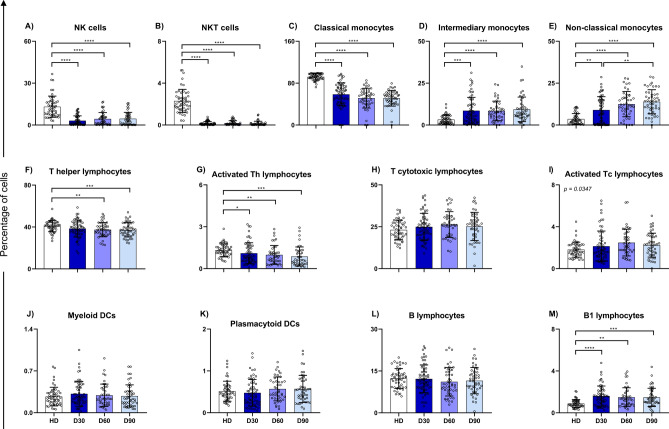
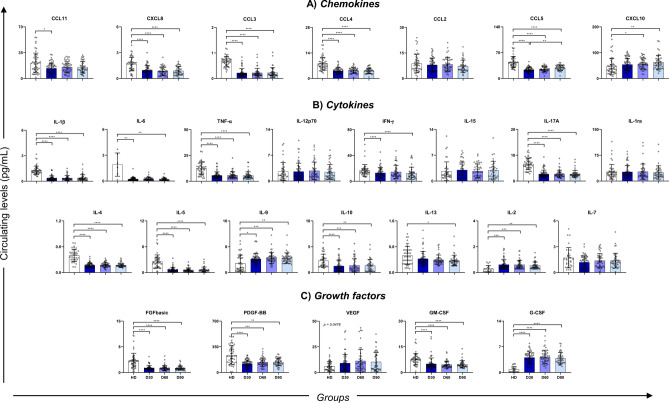
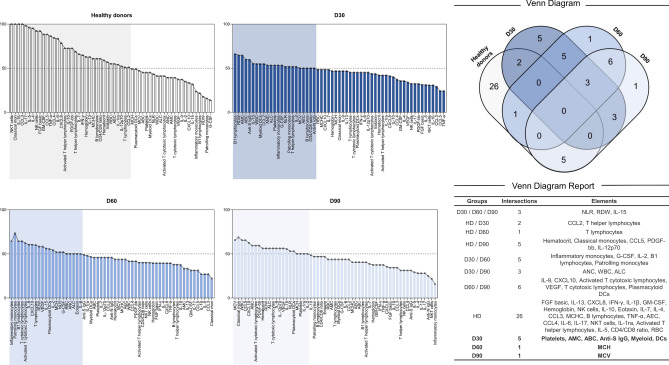
SARS-CoV-2 caused the pandemic situation experienced since the beginning of 2020, and many countries faced the rapid spread and severe form of the disease. Mechanisms of interaction between the virus and the host were observed during acute phase, but few data are available when related to immunity dynamics in convalescents. We conducted a longitudinal study, with 51 healthy donors and 62 COVID-19 convalescent patients, which these had a 2-month follow-up after symptoms recovery. Venous blood sample was obtained from all participants to measure blood count, subpopulations of monocytes, lymphocytes, natural killer cells and dendritic cells. Serum was used to measure cytokines, chemokines, growth factors, anti-N IgG and anti-S IgG/IgM antibodies. Statistic was performed by Kruskal-Wallis test, and linear regression with days post symptoms and antibody titers. All analysis had confidence interval of 95%. Less than 35% of convalescents were anti-S IgM+, while more than 80% were IgG+ in D30. Anti-N IgG decreased along time, with loss of seroreactivity of 13%. Eosinophil count played a distinct role on both antibodies during all study, and the convalescence was orchestrated by higher neutrophil-to-lymphocyte ratio and IL-15, but initial stages were marked by increase in myeloid DCs, B1 lymphocytes, inflammatory and patrolling monocytes, G-CSF and IL-2. Later convalescence seemed to change to cytotoxicity mediated by T lymphocytes, plasmacytoid DCs, VEGF, IL-9 and CXCL10. Anti-S IgG antibodies showed the longest perseverance and may be a better option for diagnosis. The inflammatory pattern is yet present on initial stage of convalescence, but quickly shifts to a reparative dynamic. Meanwhile eosinophils seem to play a role on anti-N levels in convalescence, although may not be the major causative agent. We must highlight the importance of immunological markers on acute clinical outcomes, but their comprehension to potentialize adaptive system must be explored to improve immunizations and further preventive policies.
SARS-CoV-2 导致了自 2020 年初以来经历的大流行情况,许多国家都面临着疾病的快速传播和严重形式。在急性期观察到了病毒和宿主之间的相互作用机制,但关于恢复期患者免疫动态的相关数据很少。我们进行了一项纵向研究,纳入了 51 名健康供者和 62 名 COVID-19 恢复期患者,这些患者在症状恢复后进行了 2 个月的随访。从所有参与者中采集静脉血样,以测量血细胞计数、单核细胞、淋巴细胞、自然杀伤细胞和树突状细胞亚群。采集血清以测量细胞因子、趋化因子、生长因子、抗-N IgG 和抗-S IgG/IgM 抗体。采用 Kruskal-Wallis 检验和线性回归分析了与症状出现后天数和抗体滴度的关系。所有分析的置信区间为 95%。在 D30,少于 35%的恢复期患者抗-S IgM+,而超过 80%的患者抗-S IgG+。抗-N IgG 随时间下降,丧失了 13%的血清反应性。在整个研究过程中,嗜酸性粒细胞计数对两种抗体都有明显的作用,恢复期由较高的中性粒细胞与淋巴细胞比值和 IL-15 协调,但初始阶段以髓样树突状细胞、B1 淋巴细胞、炎症和巡逻型单核细胞、G-CSF 和 IL-2 的增加为特征。后期恢复期似乎转变为 T 淋巴细胞、浆细胞样树突状细胞、VEGF、IL-9 和 CXCL10 介导的细胞毒性。抗-S IgG 抗体表现出最长的持久性,可能是诊断的更好选择。炎症模式在恢复期的初始阶段仍然存在,但很快转变为修复性动态。同时,嗜酸性粒细胞似乎在恢复期的抗-N 水平上发挥作用,尽管可能不是主要的致病因素。我们必须强调免疫标志物对急性临床结局的重要性,但必须探索对适应性系统的理解,以增强免疫接种和进一步的预防政策。