Graduate School of Biomedical Science and Engineering, University of Maine, Orono, ME 04469, USA.
The Jackson Laboratory, Bar Harbor, ME 04609, USA.
Development. 2024 Sep 1;151(17). doi: 10.1242/dev.202635. Epub 2024 Sep 10.
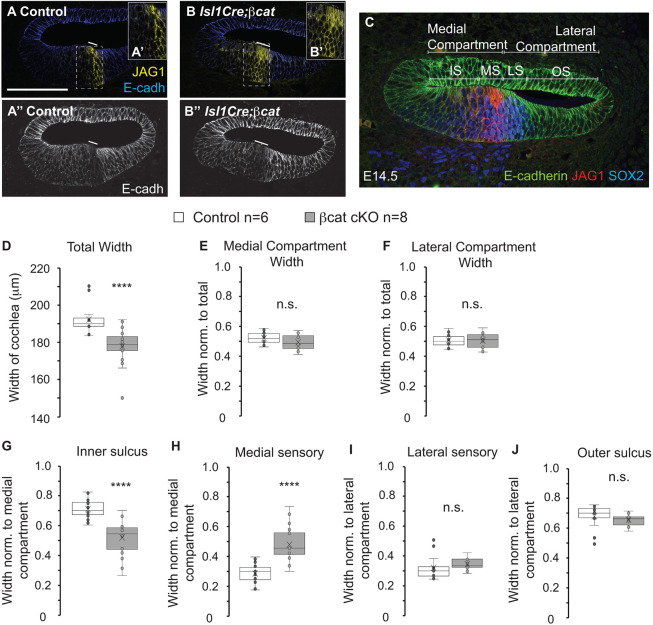
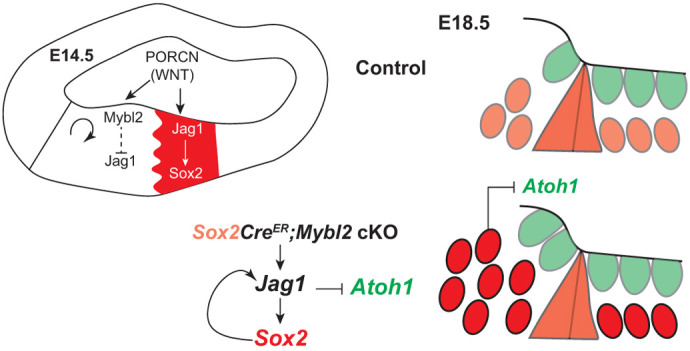
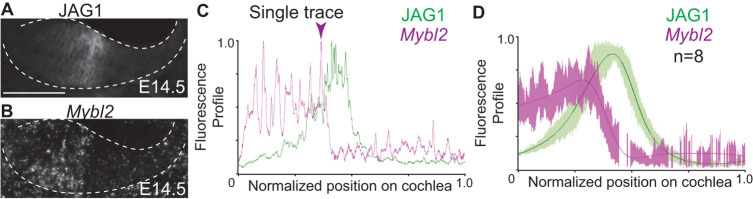
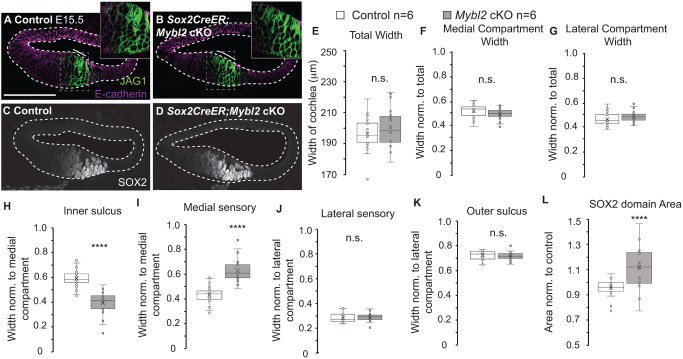
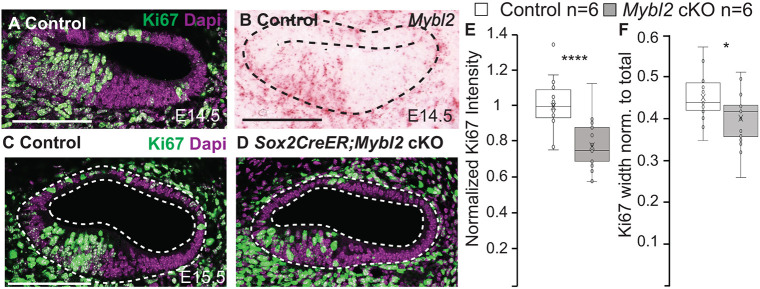
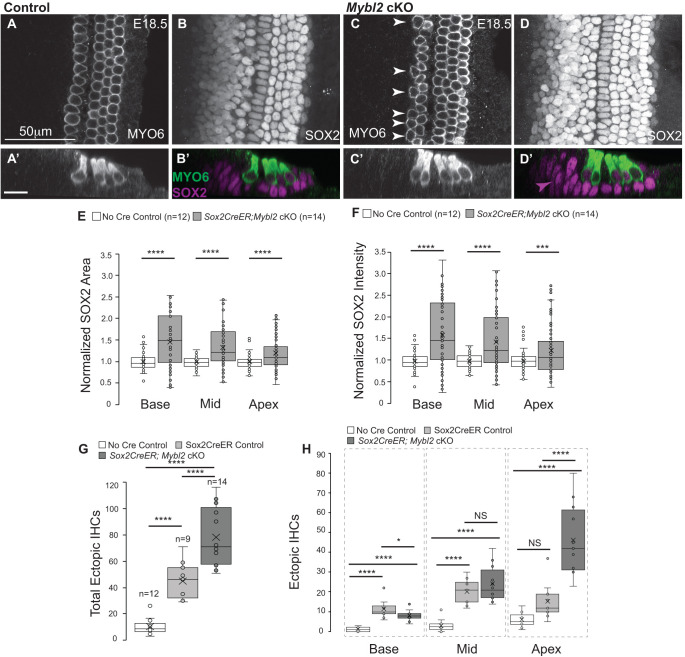
During embryonic development, Wnt signaling influences both proliferation and sensory formation in the cochlea. How this dual nature of Wnt signaling is coordinated is unknown. In this study, we define a novel role for a Wnt-regulated gene, Mybl2, which was already known to be important for proliferation, in determining the size and patterning of the sensory epithelium in the murine cochlea. Using a quantitative spatial analysis approach and analyzing Mybl2 loss-of-function, we show that Mybl2 promoted proliferation in the inner sulcus domain but limited the size of the sensory domain by influencing their adjoining boundary position via Jag1 regulation during development. Mybl2 loss-of-function simultaneously decreased proliferation in the inner sulcus and increased the size of the sensory domain, resulting in a wider sensory epithelium with ectopic inner hair cell formation during late embryonic stages. These data suggest that progenitor cells in the inner sulcus determine boundary formation and pattern the sensory epithelium via MYBL2.
在胚胎发育过程中,Wnt 信号通路既影响耳蜗的增殖,又影响其感觉形成。目前尚不清楚 Wnt 信号通路的这种双重性质是如何协调的。在这项研究中,我们定义了一个 Wnt 调控基因 Mybl2 的新作用,该基因已被证明对增殖很重要,在调节小鼠耳蜗感觉上皮的大小和模式方面发挥作用。我们使用定量空间分析方法并分析 Mybl2 功能丧失,表明 Mybl2 通过 Jag1 调节在发育过程中促进内嵴域的增殖,但通过影响其毗邻边界位置限制感觉域的大小。Mybl2 功能丧失同时减少了内嵴的增殖,并增加了感觉域的大小,导致在胚胎晚期,感觉上皮更宽,并有异位内毛细胞形成。这些数据表明,内嵴的祖细胞通过 MYBL2 决定边界的形成并塑造感觉上皮。