Zhang Qixing, Li Han, Yin Shuang, Xiao Feng, Gong Chen, Zhou Jie, Liu Kangkang, Cheng Yan
Department of Pediatrics, The Second Affiliated Hospital of Anhui Medical University, Hefei, China.
Institute of Clinical Pharmacology, Anhui Medical University, Hefei, China.
Transl Pediatr. 2024 Aug 31;13(8):1312-1326. doi: 10.21037/tp-24-128. Epub 2024 Aug 28.
Early enteral nutrition and the gut microbiota profoundly influence neonatal brain development, with short-chain fatty acids (SCFAs) from the microbiota playing a pivotal role. Understanding the relationship between dysbiosis, SCFAs, and brain development is crucial. In this study, we investigated the impact of antibiotics on the concentration of SCFAs in neonatal feces. Additionally, we developed a model of gut dysbiosis in neonatal mice to examine the potential relationship between this imbalance, SCFAs production, and brain function development.
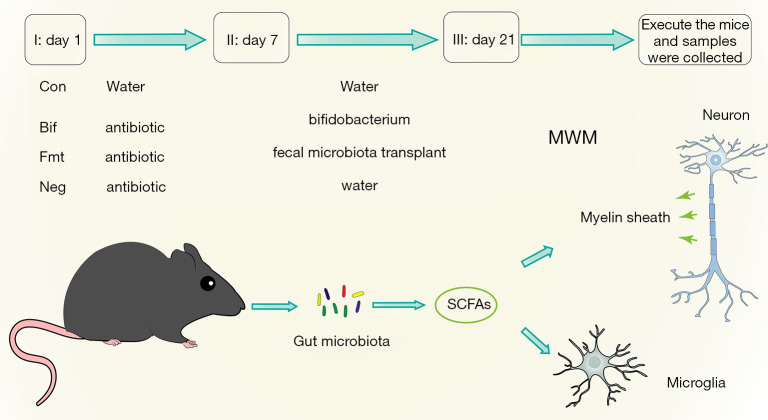
We measured the SCFAs content in the feces of two groups of neonates, categorized based on whether antibiotics were used, and conducted the Neonatal Behavioral Neurological Assessment (NBNA) test on all neonates. Then we evaluated fecal SCFAs levels in neonates and neonatal mice post-antibiotic treatment using liquid chromatography-mass spectrometry (LC-MS) analysis. Morris water maze (MWM) tests assessed behavioral performance, and western blot analysis examined brain tissue-related proteins-neuron-specific enolase (NSE), ionized calcium binding adaptor molecule-1 (IBA1), and myelin basic proteins (MBP).
The use of antibiotics did not affect the NBNA scores of the two groups of neonates, but it did reduce the SCFAs content in their feces. Antibiotic administration induced gut dysbiosis in mice, resulting in decreased IBA1 and MBP expression. Interventions to restore gut microbiota ameliorated these effects. Mice with dysbiosis displayed cognitive deficits in the MWM test. SCFAs levels decreased during dysbiosis, and increased upon microbiota recovery.
Neonatal dysbiosis affects the microbiota-gut-brain axis, impairing cognitive function and nervous system development. Reduced SCFAs may contribute significantly to these alterations.
早期肠内营养和肠道微生物群对新生儿脑发育有深远影响,微生物群产生的短链脂肪酸(SCFAs)起关键作用。了解微生物群失调、SCFAs与脑发育之间的关系至关重要。在本研究中,我们调查了抗生素对新生儿粪便中SCFAs浓度的影响。此外,我们建立了新生小鼠肠道菌群失调模型,以研究这种失衡、SCFAs产生与脑功能发育之间的潜在关系。
我们测量了两组新生儿粪便中的SCFAs含量,两组根据是否使用抗生素进行分类,并对所有新生儿进行了新生儿行为神经学评估(NBNA)测试。然后,我们使用液相色谱-质谱(LC-MS)分析评估了抗生素治疗后新生儿和新生小鼠的粪便SCFAs水平。莫里斯水迷宫(MWM)测试评估行为表现,蛋白质印迹分析检测脑组织相关蛋白——神经元特异性烯醇化酶(NSE)、离子钙结合衔接分子1(IBA1)和髓鞘碱性蛋白(MBP)。
抗生素的使用并未影响两组新生儿的NBNA评分,但确实降低了他们粪便中的SCFAs含量。抗生素给药诱导小鼠肠道菌群失调,导致IBA1和MBP表达降低。恢复肠道微生物群的干预措施改善了这些影响。菌群失调的小鼠在MWM测试中表现出认知缺陷。菌群失调期间SCFAs水平降低,微生物群恢复后升高。
新生儿菌群失调影响微生物群-肠-脑轴,损害认知功能和神经系统发育。SCFAs减少可能是这些改变的重要原因。