Gomi Tsutomu, Ishihara Kotomi, Yamada Satoko, Koibuchi Yukio
School of Allied Health Sciences, Kitasato University, Sagamihara 252-0373, Kanagawa, Japan.
Department of Radiology, NHO Takasaki General Medical Center, Takasaki 370-0829, Gunma, Japan.
Diagnostics (Basel). 2024 Sep 4;14(17):1957. doi: 10.3390/diagnostics14171957.
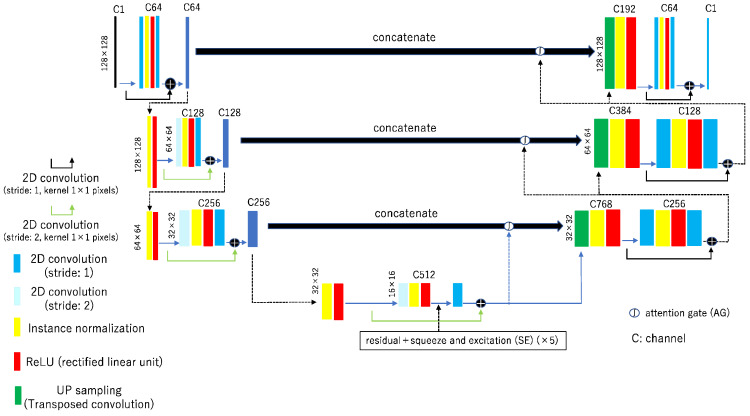
The current study proposed and evaluated "residual squeeze and excitation attention gate" (rSEAG), a novel network that can improve image quality by reducing distortion attributed to artifacts. This method was established by modifying the Cycle Generative Adversarial Network (cycleGAN)-based generator network using projection data for pre-reconstruction processing in digital breast tomosynthesis. Residual squeeze and excitation were installed in the bridge of the generator network, and the attention gate was installed in the skip connection between the encoder and decoder. Based on the radiation dose index (exposure index and division index) incident on the detector, the cases approved by the ethics committee and used for the study were classified as reference (675 projection images) and object (675 projection images). For the cases, unsupervised data containing a mixture of cases with and without masses were used. The cases were trained using cycleGAN with rSEAG and the conventional networks (ResUNet and U-Net). For testing, predictive processing was performed on cases (60 projection images) that were not used for learning. Images were generated using filtered backprojection reconstruction (kernel: Ramachandran and Lakshminarayanan) from projection data for testing data and without pre-reconstruction processing data (evaluation: in-focus plane). The distortion was evaluated using perception-based image quality evaluation (PIQE) analysis, texture analysis (feature: "Homogeneity" and "Contrast"), and a statistical model with a Gumbel distribution. PIQE has a low rSEAG value. Texture analysis showed that rSEAG and a network without cycleGAN were similar in terms of the "Contrast" feature. In dense breasts, ResUNet had the lowest "Contrast" feature and U-Net had differences between cases. The maximal variations in the Gumbel plot, rSEAG reduced the high-frequency ripple artifacts. In this study, rSEAG could improve distortion and reduce ripple artifacts.
当前的研究提出并评估了“残余挤压与激励注意力门”(rSEAG),这是一种新型网络,它可以通过减少由伪影引起的失真来提高图像质量。该方法是通过在数字乳腺断层合成中使用投影数据进行预重建处理,对基于循环生成对抗网络(cycleGAN)的生成器网络进行修改而建立的。在生成器网络的桥接部分安装了残余挤压与激励模块,在编码器和解码器之间的跳跃连接中安装了注意力门。根据入射到探测器上的辐射剂量指数(曝光指数和分割指数),伦理委员会批准并用于该研究的病例被分为参考组(675张投影图像)和对象组(675张投影图像)。对于这些病例,使用了包含有肿块和无肿块病例混合的无监督数据。使用带有rSEAG的cycleGAN和传统网络(ResUNet和U-Net)对这些病例进行训练。为了进行测试,对未用于学习的病例(60张投影图像)进行预测处理。使用滤波反投影重建(内核:拉马钱德兰和拉克什米纳拉亚南)从测试数据的投影数据生成图像,且不使用预重建处理数据(评估:聚焦平面)。使用基于感知的图像质量评估(PIQE)分析、纹理分析(特征:“均匀性”和“对比度”)以及具有耿贝尔分布的统计模型来评估失真。PIQE的rSEAG值较低。纹理分析表明,rSEAG和没有cycleGAN的网络在“对比度”特征方面相似。在致密乳腺中,ResUNet的“对比度”特征最低,U-Net在不同病例之间存在差异。在耿贝尔图中的最大变化方面,rSEAG减少了高频波纹伪影。在本研究中,rSEAG可以改善失真并减少波纹伪影。