Deng Xiao-Hui, Huang Long-Xin, Sun Qi-, Li Chan-Gu, Xie Ying-Chun, Liu Xiao-Qing, Fu Qing-Ling
Otorhinolaryngology Hospital, The First Affiliated Hospital, Sun Yat-sen University, Guangzhou, 510080, PR China.
Department of Allergy, The First Affiliated Hospital, Sun Yat-sen University, Guangzhou, 510080, PR China.
Heliyon. 2024 Aug 16;10(17):e36218. doi: 10.1016/j.heliyon.2024.e36218. eCollection 2024 Sep 15.
Low-density neutrophils are heterogeneous immune cells with immunosuppressive (such as polymorphonuclear myeloid-derived suppressor cells [PMN-MDSC]) or pro-inflammatory (such as low-density granulocytes [LDG]) properties that have been well described in multiple cancers and immune diseases. However, its role in allergic rhinitis (AR) is still unclear.
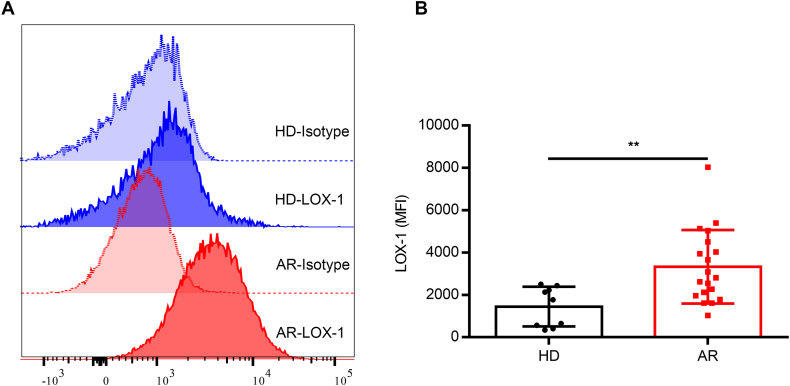
In the present study, we defined low-density neutrophils as CD14CD11BCD15LOX-1 (LOX-1 neutrophils), and their levels in the peripheral blood (PB) were evaluated and compared between patients with AR and healthy donors using flow cytometric analysis. LOX-1 expression on polymorphonuclear neutrophils was identified. Carboxyfluorescein succinimidyl ester (CFSE)-stained CD3 T cells were cultured alone or with LOX-1 neutrophils, T cell proliferation was assessed using flow cytometry, and pro-inflammatory cytokines in the supernatants were detected using enzyme-linked immunosorbent assay (ELISA). Clinicopathological analyses were performed to gain a thorough understanding of LOX-1 neutrophils.
We determined that LOX-1 neutrophils were significantly increased in the PB of patients with AR, and LOX-1 expression in neutrophils from patients with AR was elevated. Interestingly, LOX-1 neutrophils derived from patients with AR, unlike PMN-MDSC, promoted T cell proliferation and pro-inflammatory cytokine production. Moreover, clinicopathological analysis revealed that there was no any relation between circulating LOX-1 neutrophil levels and the levels of IgE, age and sex.
These findings indicate that elevated circulating LOX-1 neutrophils play a pro-inflammatory role in AR.
低密度中性粒细胞是具有免疫抑制(如多形核髓源性抑制细胞[PMN-MDSC])或促炎(如低密度粒细胞[LDG])特性的异质性免疫细胞,在多种癌症和免疫疾病中已有充分描述。然而,其在过敏性鼻炎(AR)中的作用仍不清楚。
在本研究中,我们将低密度中性粒细胞定义为CD14⁻CD11b⁺CD15⁻LOX-1(LOX-1中性粒细胞),并通过流式细胞术分析评估和比较AR患者与健康供体外周血(PB)中它们的水平。鉴定多形核中性粒细胞上的LOX-1表达。单独培养或与LOX-1中性粒细胞一起培养羧基荧光素琥珀酰亚胺酯(CFSE)染色的CD3⁺ T细胞,使用流式细胞术评估T细胞增殖,并使用酶联免疫吸附测定(ELISA)检测上清液中的促炎细胞因子。进行临床病理分析以全面了解LOX-1中性粒细胞。
我们确定AR患者PB中LOX-1中性粒细胞显著增加,且AR患者中性粒细胞中的LOX-1表达升高。有趣的是,与PMN-MDSC不同,AR患者来源的LOX-1中性粒细胞促进T细胞增殖和促炎细胞因子产生。此外,临床病理分析显示循环中LOX-1中性粒细胞水平与IgE水平、年龄和性别之间没有任何关系。
这些发现表明循环中升高的LOX-1中性粒细胞在AR中起促炎作用。