Slabe Damjan, Metelko Žiga, Šparovec Eva Dolenc
Faculty of Health Sciences, Sanitary Engineering Department, Public Health Division, University of Ljubljana, Zdravstvena pot 5, Ljubljana 1000, Slovenia.
Public Medical Centre Kranj, Emergency medical service, Gosposvetska ulica 10, 4000 Kranj, Slovenia.
Resusc Plus. 2024 Aug 28;20:100758. doi: 10.1016/j.resplu.2024.100758. eCollection 2024 Dec.
This study examined the impact of prior familiarity with automated external defibrillator (AED) models on the time of defibrillation and the emotional experiences of laypersons.
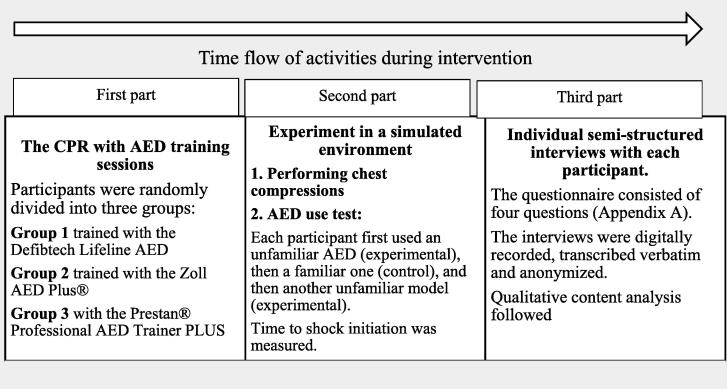
We conducted a randomized cross over simulation study with 123 participants to assess their reactions to both familiar and unfamiliar AED models. The time to first defibrillation was measured using three different AED training models, two of which were previously unknown to the participants. Additionally, semi-structured interviews were held with the participants to gather further insights.
Participants took longer to initiate defibrillation with unfamiliar ( = 34 s) AEDs compared to familiar ( = 27 s) ones. This delay was accompanied by feelings of confusion, nervousness, and anxiety. Factors such as the design of the AED covers, electrodes, and buttons were identified as sources of confusion. Nonetheless, clear instructions and similarities between devices helped facilitate their use.
The findings suggest that AED design and familiarity with different AED designs may affect performance by laypersons. To improve user confidence, it would be useful to familiarize users with a variety of AED models as part of training initiatives. Understanding the impact of AED familiarity on rescuer's response can guide CPR training strategies and improve outcomes for OHCA. As more AED models become available to the public, the user-friendliness of AEDs may also be improved. It is beneficial for AED manufacturers to consider the results of research when developing new models.
本研究探讨了先前对自动体外除颤器(AED)型号的熟悉程度对除颤时间及非专业人员情绪体验的影响。
我们对123名参与者进行了一项随机交叉模拟研究,以评估他们对熟悉和不熟悉的AED型号的反应。使用三种不同的AED训练模型测量首次除颤时间,其中两种是参与者之前未知的。此外,还对参与者进行了半结构化访谈以获取更多见解。
与熟悉的AED(=27秒)相比,参与者使用不熟悉的AED(=34秒)进行除颤的时间更长。这种延迟伴随着困惑、紧张和焦虑的情绪。AED外壳、电极和按钮的设计等因素被确定为困惑的来源。尽管如此,清晰的说明以及设备之间的相似性有助于其使用。
研究结果表明,AED设计以及对不同AED设计的熟悉程度可能会影响非专业人员的操作表现。为提高用户信心,在培训计划中让用户熟悉各种AED型号会很有用。了解AED熟悉程度对救援者反应的影响可以指导心肺复苏培训策略并改善院外心脏骤停的结果。随着更多AED型号向公众开放,AED的用户友好性也可能得到改善。AED制造商在开发新模型时考虑研究结果是有益的。