Mease Philip J, Blauvelt Andrew, Sima Adam P, Beaty Silky W, Low Robert, Gomez Braulio, Gurrola Marie, Lebwohl Mark G
Department of Rheumatology, Swedish Medical Center/Providence St. Joseph Health and University of Washington, Seattle, WA, USA.
Oregon Medical Research Center, Portland, OR, USA.
Dermatol Ther (Heidelb). 2024 Oct;14(10):2805-2825. doi: 10.1007/s13555-024-01258-1. Epub 2024 Sep 16.
Patients with psoriasis (PSO) and psoriatic arthritis (PsA) may frequently switch biologic therapies over the course of treatment because of symptom variability and individual responses. Real-world studies analyzing patient characteristics and clinical factors associated with biologic switching are limited.
This longitudinal cohort study used real-world data from the CorEvitas Psoriasis Registry to evaluate the relationship between associated disease factors and biologic switching among patients with PSO and PsA in the United States (US) and Canada following initiation of a biologic. Patients were evaluated between April 2015-August 2022. Combinations of disease severity (as measured by Psoriasis Area Severity Index [PASI]) and Dermatology Life Quality Index (DLQI) as a measure of health-related quality of life (HRQoL) were assessed, and the association with time to switching was calculated using Cox proportional hazards regression modeling.
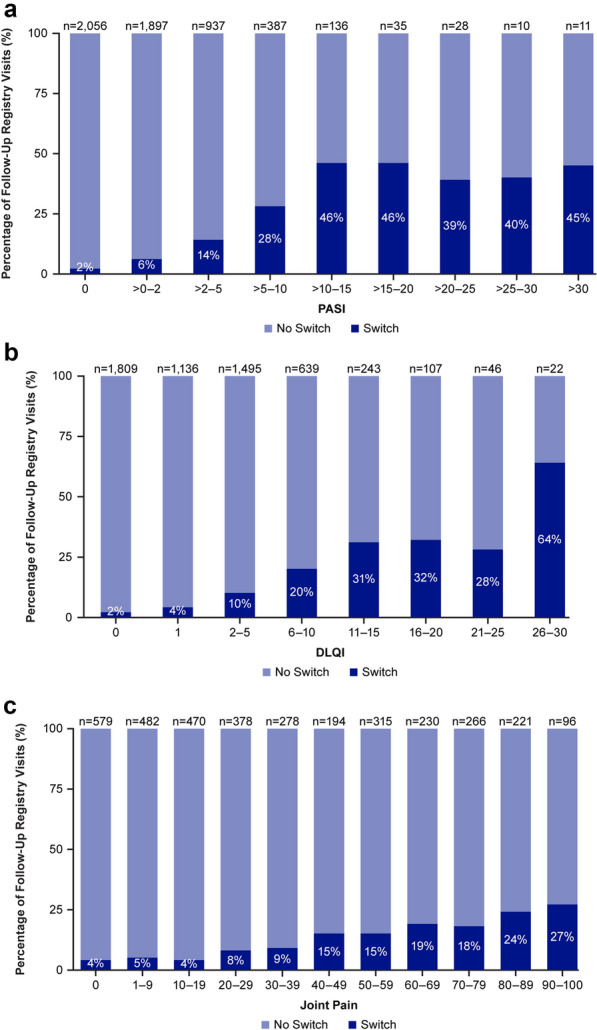
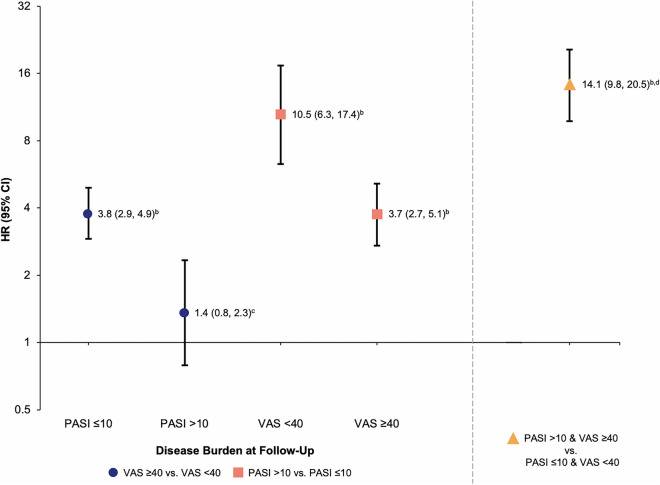
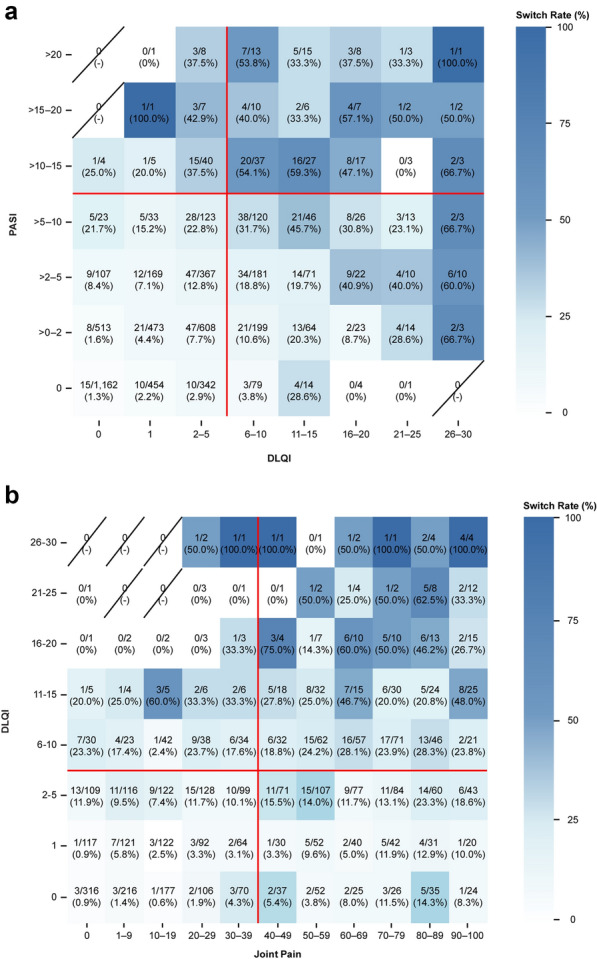
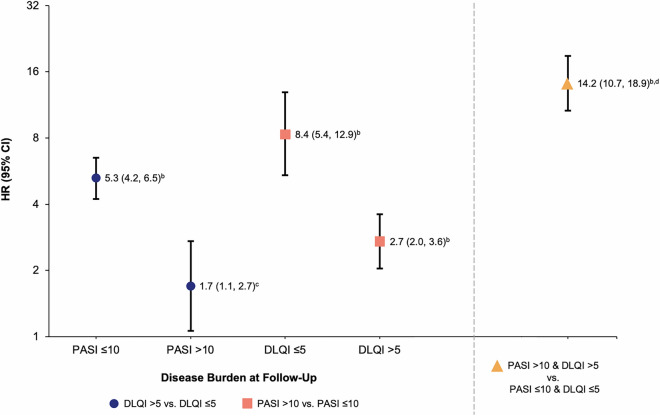
Among 2580 patient-initiations (instances of patients initiating a biologic), 504 (19.5%) switched biologics within 30 months of initiation. Switching was more frequent when either PASI > 10 or DLQI > 5 compared with PASI ≤ 10 or DLQI ≤ 5 at follow-up. Patients with higher skin involvement (PASI > 10) and impact on HRQoL (DLQI > 5) were 14 times more likely to switch (hazard ratio = 14.2, 95% confidence interval: 10.7, 18.9) than those with lower skin involvement (PASI ≤ 10) and HRQoL (DLQI ≤ 5).
Patients with PSO and PsA treated in a real-world dermatology setting with substantial disease factors following biologic initiation were more likely to switch therapies. Those with PASI > 10 and DLQI > 5 switched more frequently than those with PASI ≤ 10 and DLQI ≤ 5.
银屑病(PSO)和银屑病关节炎(PsA)患者在治疗过程中可能因症状变异性和个体反应而频繁更换生物制剂疗法。分析与生物制剂更换相关的患者特征和临床因素的真实世界研究有限。
这项纵向队列研究使用了来自CorEvitas银屑病登记处的真实世界数据,以评估美国和加拿大PSO和PsA患者在开始使用生物制剂后相关疾病因素与生物制剂更换之间的关系。研究时间为2015年4月至2022年8月。评估了疾病严重程度(以银屑病面积和严重程度指数[PASI]衡量)和作为健康相关生活质量(HRQoL)指标的皮肤病生活质量指数(DLQI)的组合,并使用Cox比例风险回归模型计算与更换时间的关联。
在2580例患者起始使用生物制剂的病例中,504例(19.5%)在起始后30个月内更换了生物制剂。与随访时PASI≤10或DLQI≤5相比,当PASI>10或DLQI>5时,更换更为频繁。皮肤受累程度较高(PASI>10)且对HRQoL影响较大(DLQI>5)的患者更换生物制剂的可能性是皮肤受累程度较低(PASI≤10)且HRQoL较低(DLQI≤5)患者的14倍(风险比=14.2,95%置信区间:10.7,18.9)。
在真实世界的皮肤科环境中接受治疗、生物制剂起始后存在大量疾病因素的PSO和PsA患者更有可能更换治疗方法。PASI>10和DLQI>5的患者比PASI≤10和DLQI≤5的患者更换更频繁。