Graduate School of Nursing, Dokkyo Medical University, Japan.
Department of Public Health, School of Medicine, Dokkyo Medical University, Japan.
Ind Health. 2024 Nov 26;62(6):402-406. doi: 10.2486/indhealth.2024-0118. Epub 2024 Sep 16.
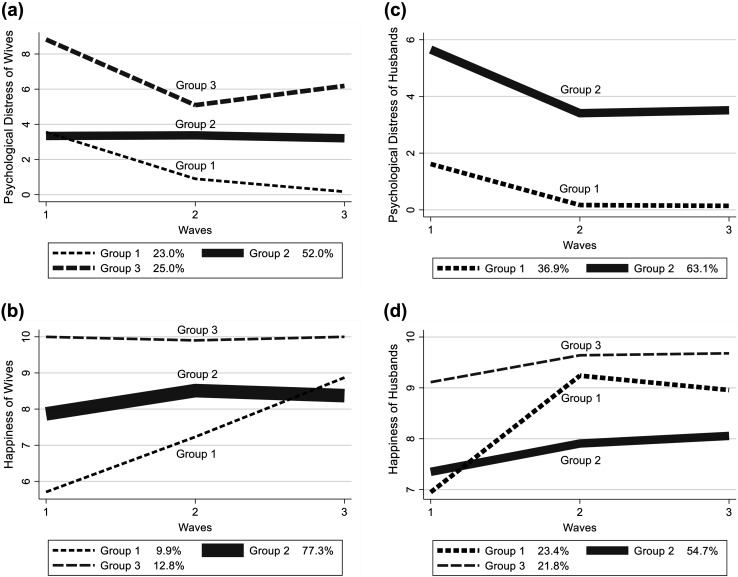
The psychological states of wives and husbands are thought to influence each other to varying degrees. However, relatively little is known from a longitudinal observation about the effects of spouses' psychological distress and well-being on their mental health. To address this question, we analyzed the TWIN Study II dataset using a three-wave annual survey of the psychological distress and happiness of 379 dual-income families. A group-based trajectory modeling analysis was conducted to identify psychological distress patterns and happiness over time, while estimating the effects of spouses' psychological distress and happiness and their own job demands, control, and support as time-varying covariates. The two- or three-group trajectory model best fit husbands' and wives' psychological distress and happiness trajectories. Husbands' trajectories of psychological distress and happiness were significantly influenced by wives' happiness as well as their own job demands and/or support, whereas wives' happiness and psychological distress were not.
夫妻双方的心理状态被认为在不同程度上相互影响。然而,从纵向观察来看,关于配偶的心理困扰和幸福感对其心理健康的影响,我们知之甚少。为了解决这个问题,我们使用 TWIN 研究 II 数据集,对 379 个双收入家庭进行了为期三年的年度心理困扰和幸福感调查,利用基于群组的轨迹建模分析来确定心理困扰模式和幸福感随时间的变化,并估计配偶的心理困扰和幸福感以及他们自己的工作需求、控制和支持作为时变协变量的影响。两群组或三群组轨迹模型最适合夫妻双方的心理困扰和幸福感轨迹。丈夫的心理困扰和幸福感轨迹受到妻子幸福感以及他们自己的工作需求和/或支持的显著影响,而妻子的幸福感和心理困扰则没有。