Emanuele Roberta, Comparini Andrea, Verrucchi Margherita, Del Pace Ivan, Meoli Arianna, Vorobyova Mariya, Giurlani Walter, Innocenti Massimo
Valmet Plating Srl, Via Erbosa 5, 50041, Calenzano (FI), Italy.
Dipartimento di Chimica, Università Degli Studi di Firenze, Via della Lastruccia 3, 50019, Sesto Fiorentino (FI), Italy.
Heliyon. 2024 Aug 29;10(17):e37125. doi: 10.1016/j.heliyon.2024.e37125. eCollection 2024 Sep 15.
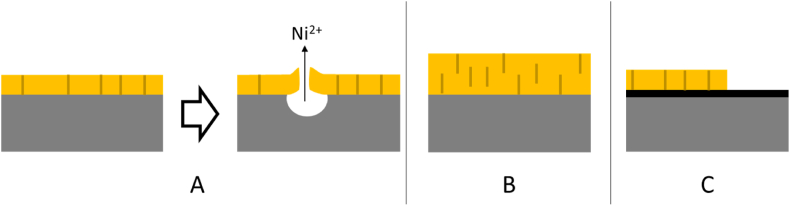
Electroplating can induce nickel release even from 316L stainless steel, typically considered safe. In this work, the influence of different electroplating processes and surface treatments on nickel release was evaluated. The nickel release was tested according to the EN 1811 standard. The impact of surface roughness on nickel release was assessed by comparing polished and unpolished samples. Results indicate that internal stresses can worsen nickel release, while increasing the thickness of the precious metal layer is beneficial. To corroborate our hypothesis, it was verified that coatings obtained through physical vapor deposition (PVD), without removing the passivation layer of the steel, did not release nickel. For these reasons, we identified the main cause of nickel release as the combined effect of the removal of the passivation layer of stainless steel and the microporosity of the electroplating process.
电镀甚至能使通常被认为安全的316L不锈钢释放镍。在这项工作中,评估了不同电镀工艺和表面处理对镍释放的影响。根据EN 1811标准测试镍释放情况。通过比较抛光和未抛光样品来评估表面粗糙度对镍释放的影响。结果表明,内应力会加剧镍释放,而增加贵金属层的厚度则有益。为了证实我们的假设,经证实,通过物理气相沉积(PVD)获得的涂层,在未去除钢的钝化层的情况下,不会释放镍。基于这些原因,我们确定镍释放的主要原因是不锈钢钝化层的去除与电镀工艺的微孔性的综合作用。