Department of Operating Room, The First Affiliated Hospital of Jinan University, Guangzhou, China.
Department of Nursing, The First Affiliated Hospital of Jinan University, Guangzhou, China.
Medicine (Baltimore). 2024 Sep 13;103(37):e39594. doi: 10.1097/MD.0000000000039594.
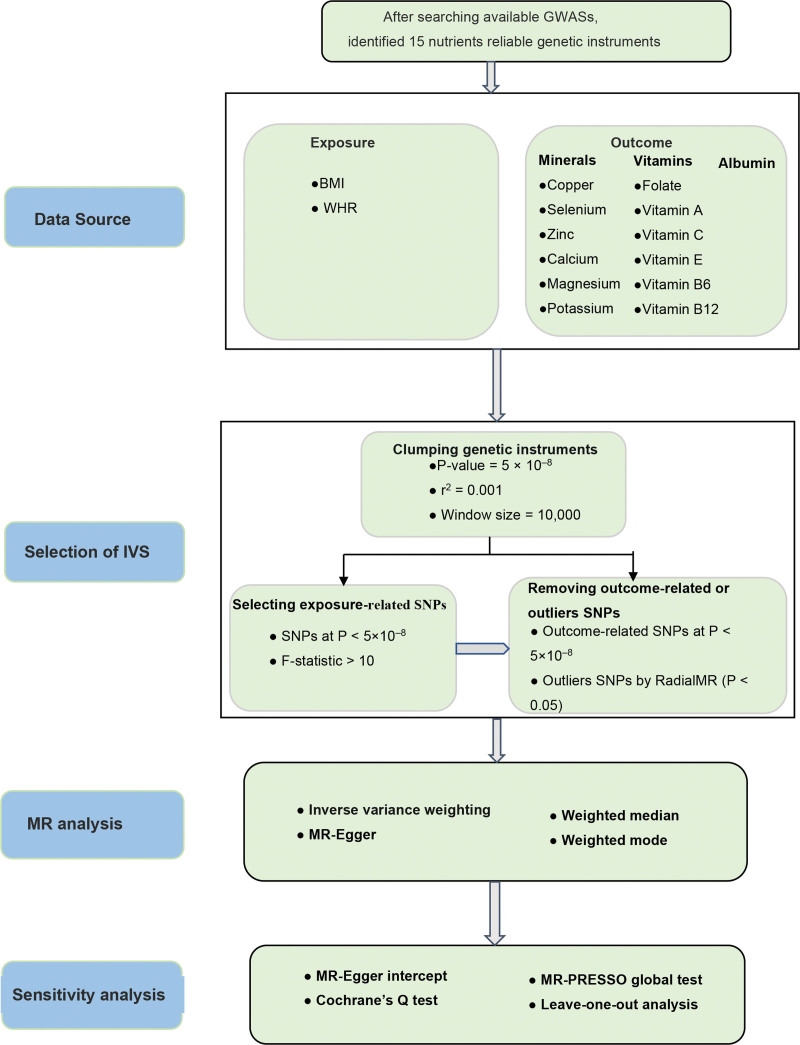
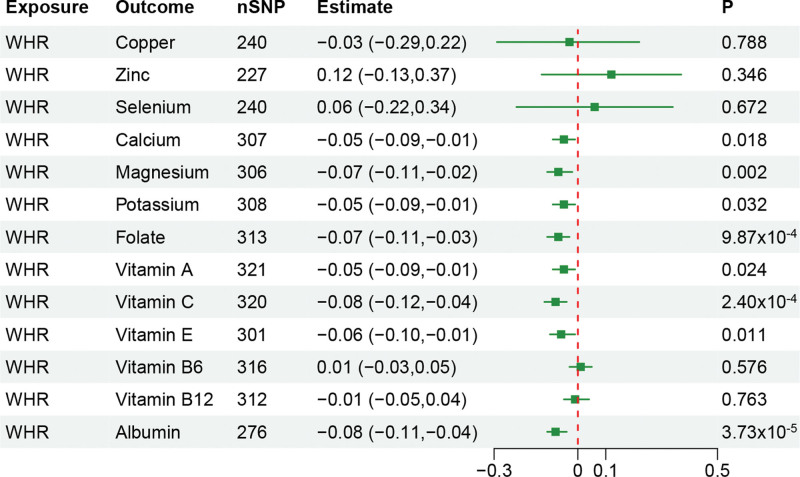
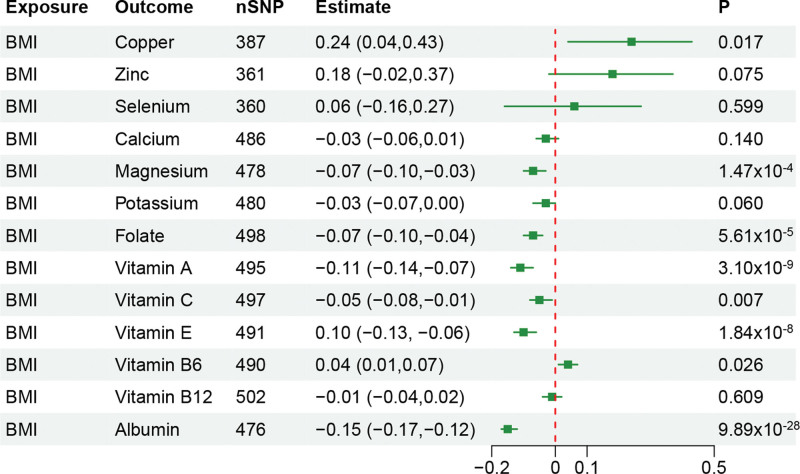
Observational studies have established that obesity is associated with nutritional deficiencies, but the exact causality remains uncertain. Thus, this Mendelian randomization (MR) study aimed to identify the causal associations between obesity and circulating levels of nutrients. Single-nucleotide polymorphisms associated with obesity (body mass index and waist-hip ratio), were extracted from a genome-wide association study of 694,649 European ancestry. Summary-level data for minerals (copper, selenium, zinc, calcium, magnesium, and potassium), and vitamins (folate, vitamins A, C, E, B6, and B12), albumin were obtained from the publicly available integrative epidemiology unit OpenGWAS database psychiatric genomics consortium. Inverse-variance weighted method several sensitivity analyses were conducted. Genetically predicted higher body mass index significantly decreased circulating levels of magnesium (β = -0.07, 95% confidence interval [CI]: -0.10 to -0.03, P = 1.47 × 10⁻⁴), folate (β = -0.07, 95% CI: -0.10 to -0.04, P = 5.61 × 10⁻⁵), vitamin A (β = -0.11, 95% CI: -0.14 to -0.07, P = 3.10 × 10⁻⁹), vitamin E (β = -0.10, 95% CI: -0.13 to -0.06, P = 1.84 × 10⁻⁸), albumin (β = -0.15, 95% CI: -0.17 to -0.12, P = 9.89 × 10⁻²⁸); whereas genetically predicted higher waist-hip ratio decreased circulating levels of magnesium (β = -0.07, 95% CI: -0.11 to -0.02, P = 1.87 × 10⁻³), folate (β = -0.07, 95% CI: -0.11 to -0.03, P = 9.87 × 10⁻⁴), vitamin C (β = -0.08, 95% CI: -0.12 to -0.04, P = 2.40 × 10⁻⁴), albumin (β = -0.08, 95% CI: -0.11 to -0.04, P = 3.72 × 10⁻⁵). The study supports a causal effect of obesity on lower circulating levels of nutrients. Our findings highlight the necessity of adjuvant nutrients in obesity management.
观察性研究已经证实,肥胖与营养缺乏有关,但确切的因果关系仍不确定。因此,本孟德尔随机化(MR)研究旨在确定肥胖与循环营养素水平之间的因果关系。从 694649 名欧洲血统个体的全基因组关联研究中提取与肥胖(体重指数和腰臀比)相关的单核苷酸多态性。从公开可得的综合流行病学单位 OpenGWAS 数据库精神病学基因组学联盟中获得矿物质(铜、硒、锌、钙、镁和钾)和维生素(叶酸、维生素 A、C、E、B6 和 B12)、白蛋白的汇总水平数据。采用逆方差加权法进行了几项敏感性分析。遗传预测的较高体重指数显著降低了镁的循环水平(β=-0.07,95%置信区间[CI]:-0.10 至-0.03,P=1.47×10⁻⁴)、叶酸(β=-0.07,95% CI:-0.10 至-0.04,P=5.61×10⁻⁵)、维生素 A(β=-0.11,95% CI:-0.14 至-0.07,P=3.10×10⁻⁹)、维生素 E(β=-0.10,95% CI:-0.13 至-0.06,P=1.84×10⁻⁸)和白蛋白(β=-0.15,95% CI:-0.17 至-0.12,P=9.89×10⁻²⁸);而遗传预测的较高腰臀比降低了镁的循环水平(β=-0.07,95% CI:-0.11 至-0.02,P=1.87×10⁻³)、叶酸(β=-0.07,95% CI:-0.11 至-0.03,P=9.87×10⁻⁴)、维生素 C(β=-0.08,95% CI:-0.12 至-0.04,P=2.40×10⁻⁴)和白蛋白(β=-0.08,95% CI:-0.11 至-0.04,P=3.72×10⁻⁵)。该研究支持肥胖对较低循环营养素水平的因果影响。我们的研究结果强调了肥胖管理中辅助营养素的必要性。