Rouche Manon, Lebacq Thérésa, Dzielska Anna, Kelly Colette, Gabhainn Saoirse Nic, Mertens Caroline, Castetbon Katia
Research Center in Epidemiology, Biostatistics and Clinical Trials, School of Public Health, Université libre de Bruxelles, Brussels, Belgium.
Department of Epidemiology and Data Science, Amsterdam UMC Location Vrije Universiteit, Amsterdam, the Netherlands.
Curr Dev Nutr. 2024 Aug 18;8(9):104445. doi: 10.1016/j.cdnut.2024.104445. eCollection 2024 Sep.
Despite its significant usefulness in adolescent health studies, the single-item "body size perception" question, developed within the Health Behaviour in School-aged Children (HBSC) survey, has yet to undergo multidimensional validation.
To assess the convergent, divergent and concurrent validity of the HBSC body size perception question among adolescents.
The single-item HBSC body size perception question is as follows: "Do you think your body is…?," with answers ranging from "much too thin" to "much too fat." Fifteen-year-old participants included in the analysis were 72,086 from 45 HBSC countries in 2017/18 (concurrent validity), and 595, 127, and 615 in 2021/22 in French-speaking Belgium, Ireland, and Poland, respectively. The convergent, divergent, and concurrent validity was assessed with body dissatisfaction, social desirability, and selfesteem, respectively. The concurrent validity was also examined with body mass index (BMI) from the 2017/18 HBSC data. All analyses were sex-stratified.
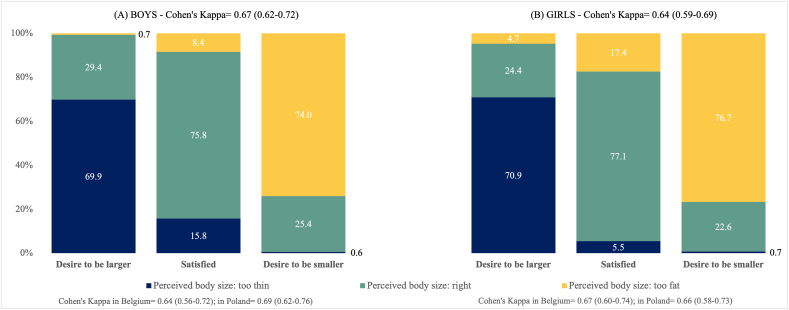
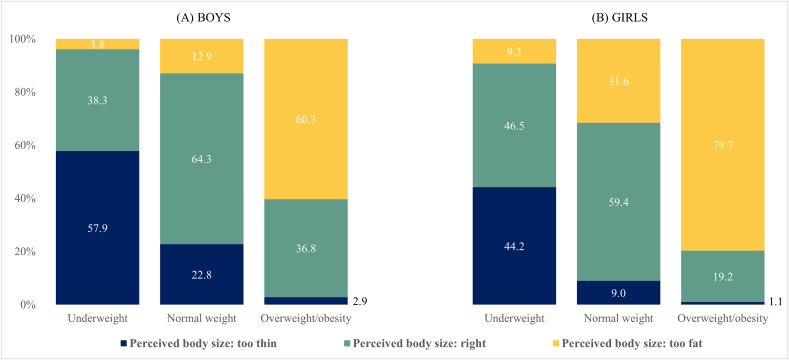
Cohen's Kappa values were 0.67 [confidence interval (CI): 95%: 0.62, 0.72] and 0.64 (0.59, 0.69) for boys and girls, respectively, in all 3 countries together. Body size perception was associated with social desirability, selfesteem, and BMI, with a stronger association in girls than that in boys. For instance, girls with higher social desirability were less likely to perceive themselves as "too thin" [Relative Risk Ratio (RRR) = 0.78 (0.69, 0.89)] rather than as the "right size." Boys with higher selfesteem were less likely to perceive themselves as "too fat" [0.93 (0.90, 0.97)] rather than the "right size." Girls with underweight were less likely to perceive themselves as "too fat" [0.38 (0.34, 043)] rather than "right size" and girls with overweight/obesity were more likely to perceive themselves as such [8.19 (7.49, 8.95)].
The single-item HBSC body size perception question demonstrated good convergent, divergent, and concurrent validity. It reflects adolescents' own perception of body size, possibly influenced by societal norms and ideals.
尽管单项“身体大小感知”问题在青少年健康研究中具有重要作用,但在学龄儿童健康行为(HBSC)调查中开发的该问题尚未经过多维度验证。
评估青少年中HBSC身体大小感知问题的收敛效度、区分效度和同时效度。
HBSC身体大小感知单项问题如下:“你认为你的身体是……?”,答案范围从“太瘦”到“太胖”。纳入分析的15岁参与者在2017/18年来自45个HBSC国家,共72,086人(同时效度),2021/22年在法语区比利时、爱尔兰和波兰分别有595人、127人和615人。分别用身体不满、社会期望和自尊来评估收敛效度、区分效度和同时效度。还根据2017/18年HBSC数据中的体重指数(BMI)来检验同时效度。所有分析按性别分层。
在所有3个国家中,男孩和女孩的科恩卡方值分别为0.67 [置信区间(CI):95%:0.62, 0.72]和0.64(0.59, 0.69)。身体大小感知与社会期望、自尊和BMI相关,女孩中的关联比男孩更强。例如,社会期望较高的女孩认为自己“太瘦”的可能性较小[相对风险比(RRR)= 0.78(0.69, 0.89)],而不是“合适的身材”。自尊较高的男孩认为自己“太胖”的可能性较小[0.93(0.90, 0.97)],而不是“合适的身材”。体重过轻的女孩认为自己“太胖”的可能性较小[0.38(0.34, 0.43)],而不是“合适的身材”,超重/肥胖的女孩更有可能这样认为[8.19(7.49, 8.95)]。
HBSC身体大小感知单项问题显示出良好的收敛效度、区分效度和同时效度。它反映了青少年对身体大小的自身感知,可能受到社会规范和理想的影响。