• 文献检索
  • 文档翻译
  • 深度研究
  • 学术资讯
  • Suppr Zotero 插件Zotero 插件
  • 邀请有礼
  • 套餐&价格
  • 历史记录
应用&插件
Suppr Zotero 插件Zotero 插件浏览器插件Mac 客户端Windows 客户端微信小程序
定价
高级版会员购买积分包购买API积分包
服务
文献检索文档翻译深度研究API 文档MCP 服务
关于我们
关于 Suppr公司介绍联系我们用户协议隐私条款
关注我们

Suppr 超能文献

核心技术专利:CN118964589B侵权必究
粤ICP备2023148730 号-1Suppr @ 2026

文献检索

告别复杂PubMed语法,用中文像聊天一样搜索,搜遍4000万医学文献。AI智能推荐,让科研检索更轻松。

立即免费搜索

文件翻译

保留排版,准确专业,支持PDF/Word/PPT等文件格式,支持 12+语言互译。

免费翻译文档

深度研究

AI帮你快速写综述,25分钟生成高质量综述,智能提取关键信息,辅助科研写作。

立即免费体验

基于 AISSO 深度概念和超参数调整过程的序列基 PPI 预测智能模型。

Intelligence model on sequence-based prediction of PPI using AISSO deep concept with hyperparameter tuning process.

机构信息

DCSA, Maharshi Dayanand University, Rohtak, Haryana, India.

Arba Minch University, Arba Minch, Ethiopia.

出版信息

Sci Rep. 2024 Sep 18;14(1):21797. doi: 10.1038/s41598-024-72558-x.

DOI:10.1038/s41598-024-72558-x
PMID:39294330
原文链接:https://pmc.ncbi.nlm.nih.gov/articles/PMC11410825/
Abstract

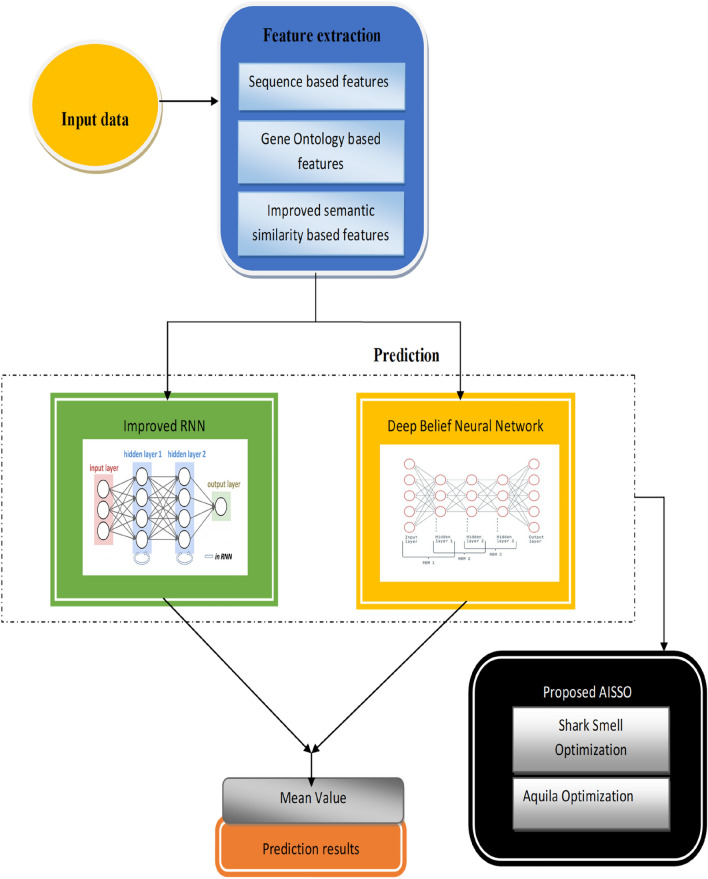
Protein-protein interaction (PPI) prediction is vital for interpreting biological activities. Even though many diverse sorts of data and machine learning approaches have been employed in PPI prediction, performance still has to be enhanced. As a result, we adopted an Aquilla Influenced Shark Smell (AISSO)-based hybrid prediction technique to construct a sequence-dependent PPI prediction model. This model has two stages of operation: feature extraction and prediction. Along with sequence-based and Gene Ontology features, unique features were produced in the feature extraction stage utilizing the improved semantic similarity technique, which may deliver reliable findings. These collected characteristics were then sent to the prediction step, and hybrid neural networks, such as the Improved Recurrent Neural Network and Deep Belief Networks, were used to predict the PPI using modified score level fusion. These neural networks' weight variables were adjusted utilizing a unique optimal methodology called Aquila Influenced Shark Smell (AISSO), and the outcomes showed that the developed model had attained an accuracy of around 88%, which is much better than the traditional methods; this model AISSO-based PPI prediction can provide precise and effective predictions.

摘要

蛋白质-蛋白质相互作用(PPI)预测对于解释生物活性至关重要。尽管已经采用了许多不同类型的数据和机器学习方法进行 PPI 预测,但仍需要提高性能。因此,我们采用了基于 Aquilla Influenced Shark Smell(AISSO)的混合预测技术来构建基于序列的 PPI 预测模型。该模型有两个操作阶段:特征提取和预测。在特征提取阶段,除了基于序列和基因本体的特征外,还利用改进的语义相似性技术生成了独特的特征,这可能会提供可靠的发现。然后,将这些收集到的特征发送到预测步骤,使用改进的递归神经网络和深度置信网络等混合神经网络来预测 PPI,并使用改进的评分级融合方法进行预测。利用一种名为 Aquilla Influenced Shark Smell(AISSO)的独特优化方法调整这些神经网络的权重变量,结果表明,所开发的模型的准确率约为 88%,明显优于传统方法;该模型基于 AISSO 的 PPI 预测可以提供精确有效的预测。
https://cdn.ncbi.nlm.nih.gov/pmc/blobs/d33b/11410825/1f6b29b56ca6/41598_2024_72558_Fig8_HTML.jpg
https://cdn.ncbi.nlm.nih.gov/pmc/blobs/d33b/11410825/b87847f79c5b/41598_2024_72558_Fig1_HTML.jpg
https://cdn.ncbi.nlm.nih.gov/pmc/blobs/d33b/11410825/d82521544413/41598_2024_72558_Fig2_HTML.jpg
https://cdn.ncbi.nlm.nih.gov/pmc/blobs/d33b/11410825/7be8da286019/41598_2024_72558_Fig3_HTML.jpg
https://cdn.ncbi.nlm.nih.gov/pmc/blobs/d33b/11410825/64bf2f1d58e7/41598_2024_72558_Fig4_HTML.jpg
https://cdn.ncbi.nlm.nih.gov/pmc/blobs/d33b/11410825/227c15bb75bb/41598_2024_72558_Fig5_HTML.jpg
https://cdn.ncbi.nlm.nih.gov/pmc/blobs/d33b/11410825/ada8931fa6f7/41598_2024_72558_Fig6_HTML.jpg
https://cdn.ncbi.nlm.nih.gov/pmc/blobs/d33b/11410825/18f1739acddf/41598_2024_72558_Fig7_HTML.jpg
https://cdn.ncbi.nlm.nih.gov/pmc/blobs/d33b/11410825/1f6b29b56ca6/41598_2024_72558_Fig8_HTML.jpg
https://cdn.ncbi.nlm.nih.gov/pmc/blobs/d33b/11410825/b87847f79c5b/41598_2024_72558_Fig1_HTML.jpg
https://cdn.ncbi.nlm.nih.gov/pmc/blobs/d33b/11410825/d82521544413/41598_2024_72558_Fig2_HTML.jpg
https://cdn.ncbi.nlm.nih.gov/pmc/blobs/d33b/11410825/7be8da286019/41598_2024_72558_Fig3_HTML.jpg
https://cdn.ncbi.nlm.nih.gov/pmc/blobs/d33b/11410825/64bf2f1d58e7/41598_2024_72558_Fig4_HTML.jpg
https://cdn.ncbi.nlm.nih.gov/pmc/blobs/d33b/11410825/227c15bb75bb/41598_2024_72558_Fig5_HTML.jpg
https://cdn.ncbi.nlm.nih.gov/pmc/blobs/d33b/11410825/ada8931fa6f7/41598_2024_72558_Fig6_HTML.jpg
https://cdn.ncbi.nlm.nih.gov/pmc/blobs/d33b/11410825/18f1739acddf/41598_2024_72558_Fig7_HTML.jpg
https://cdn.ncbi.nlm.nih.gov/pmc/blobs/d33b/11410825/1f6b29b56ca6/41598_2024_72558_Fig8_HTML.jpg

相似文献

1
Intelligence model on sequence-based prediction of PPI using AISSO deep concept with hyperparameter tuning process.基于 AISSO 深度概念和超参数调整过程的序列基 PPI 预测智能模型。
Sci Rep. 2024 Sep 18;14(1):21797. doi: 10.1038/s41598-024-72558-x.
2
SDNN-PPI: self-attention with deep neural network effect on protein-protein interaction prediction.SDNN-PPI:基于深度神经网络的自注意力在蛋白质-蛋白质相互作用预测中的应用。
BMC Genomics. 2022 Jun 27;23(1):474. doi: 10.1186/s12864-022-08687-2.
3
DL-PPI: a method on prediction of sequenced protein-protein interaction based on deep learning.DL-PPI:一种基于深度学习的预测序列蛋白质相互作用的方法。
BMC Bioinformatics. 2023 Dec 14;24(1):473. doi: 10.1186/s12859-023-05594-5.
4
Improved prediction of protein-protein interaction using a hybrid of functional-link Siamese neural network and gradient boosting machines.利用功能链接暹罗神经网络和梯度提升机的混合体改进蛋白质-蛋白质相互作用的预测。
Brief Bioinform. 2021 Nov 5;22(6). doi: 10.1093/bib/bbab255.
5
Improving protein-protein interaction prediction using protein language model and protein network features.利用蛋白质语言模型和蛋白质网络特征改进蛋白质-蛋白质相互作用预测。
Anal Biochem. 2024 Oct;693:115550. doi: 10.1016/j.ab.2024.115550. Epub 2024 Apr 26.
6
DGCPPISP: a PPI site prediction model based on dynamic graph convolutional network and two-stage transfer learning.DGCPPISP:一种基于动态图卷积网络和两阶段迁移学习的蛋白质-蛋白质相互作用位点预测模型。
BMC Bioinformatics. 2024 Jul 31;25(1):252. doi: 10.1186/s12859-024-05864-w.
7
Integration of anatomy ontology data with protein-protein interaction networks improves the candidate gene prediction accuracy for anatomical entities.解剖学本体数据与蛋白质-蛋白质相互作用网络的整合提高了解剖实体候选基因预测的准确性。
BMC Bioinformatics. 2020 Oct 7;21(1):442. doi: 10.1186/s12859-020-03773-2.
8
DCSE:Double-Channel-Siamese-Ensemble model for protein protein interaction prediction.DCSE:用于蛋白质相互作用预测的双通道暹罗集成模型。
BMC Genomics. 2022 Aug 4;23(1):555. doi: 10.1186/s12864-022-08772-6.
9
MaTPIP: A deep-learning architecture with eXplainable AI for sequence-driven, feature mixed protein-protein interaction prediction.MaTPIP:一种具有可解释 AI 的深度学习架构,用于序列驱动、特征混合的蛋白质-蛋白质相互作用预测。
Comput Methods Programs Biomed. 2024 Feb;244:107955. doi: 10.1016/j.cmpb.2023.107955. Epub 2023 Nov 30.
10
DSSGNN-PPI: A Protein-Protein Interactions prediction model based on Double Structure and Sequence graph neural networks.DSSGNN-PPI:一种基于双结构和序列图神经网络的蛋白质-蛋白质相互作用预测模型。
Comput Biol Med. 2024 Jul;177:108669. doi: 10.1016/j.compbiomed.2024.108669. Epub 2024 May 29.

引用本文的文献

1
Proteins Combined Score Prediction Based on Improved Gene Expression Programming Algorithm and Protein-Protein Interaction Network Characterization.基于改进基因表达编程算法和蛋白质-蛋白质相互作用网络特征的蛋白质综合评分预测
IET Syst Biol. 2025 Jan-Dec;19(1):e70024. doi: 10.1049/syb2.70024.

本文引用的文献

1
A precise model for skin cancer diagnosis using hybrid U-Net and improved MobileNet-V3 with hyperparameters optimization.基于混合 U-Net 和改进的 MobileNet-V3 并结合超参数优化的皮肤癌诊断精确模型。
Sci Rep. 2024 Feb 21;14(1):4299. doi: 10.1038/s41598-024-54212-8.
2
DL-PPI: a method on prediction of sequenced protein-protein interaction based on deep learning.DL-PPI:一种基于深度学习的预测序列蛋白质相互作用的方法。
BMC Bioinformatics. 2023 Dec 14;24(1):473. doi: 10.1186/s12859-023-05594-5.
3
HIDM: Hybrid Intrusion Detection Model for Industry 4.0 Networks Using an Optimized CNN-LSTM with Transfer Learning.
HIDM:使用优化的卷积神经网络-长短期记忆网络(CNN-LSTM)和迁移学习的工业4.0网络混合入侵检测模型
Sensors (Basel). 2023 Sep 13;23(18):7856. doi: 10.3390/s23187856.
4
Hybrid CNN-LSTM model with efficient hyperparameter tuning for prediction of Parkinson's disease.基于高效超参数调整的混合 CNN-LSTM 模型用于帕金森病预测。
Sci Rep. 2023 Sep 5;13(1):14605. doi: 10.1038/s41598-023-41314-y.
5
Druggable protein prediction using a multi-canal deep convolutional neural network based on autocovariance method.基于自协方差方法的多通道深度卷积神经网络的可用药蛋白预测。
Comput Biol Med. 2022 Dec;151(Pt A):106276. doi: 10.1016/j.compbiomed.2022.106276. Epub 2022 Nov 8.
6
SDNN-PPI: self-attention with deep neural network effect on protein-protein interaction prediction.SDNN-PPI:基于深度神经网络的自注意力在蛋白质-蛋白质相互作用预测中的应用。
BMC Genomics. 2022 Jun 27;23(1):474. doi: 10.1186/s12864-022-08687-2.
7
Prediction of protein-protein interaction using graph neural networks.基于图神经网络的蛋白质-蛋白质相互作用预测。
Sci Rep. 2022 May 19;12(1):8360. doi: 10.1038/s41598-022-12201-9.
8
Improved prediction of protein-protein interactions using AlphaFold2.利用 AlphaFold2 提高蛋白质-蛋白质相互作用预测的准确性。
Nat Commun. 2022 Mar 10;13(1):1265. doi: 10.1038/s41467-022-28865-w.
9
Exploring protein-protein interactions at the proteome level.探索蛋白质组水平的蛋白质-蛋白质相互作用。
Structure. 2022 Apr 7;30(4):462-475. doi: 10.1016/j.str.2022.02.004. Epub 2022 Feb 25.
10
Prediction and Modeling of Protein-Protein Interactions Using "Spotted" Peptides with a Template-Based Approach.基于模板的“点样”肽预测和建模蛋白质-蛋白质相互作用。
Biomolecules. 2022 Jan 25;12(2):201. doi: 10.3390/biom12020201.