Lares-Michel Mariana, Reyes-Castillo Zyanya, Housni Fatima Ezzahra
Institute of Nutrition and Food Technology "José Mataix Verdú", Biomedical Research Center, University of Granada, Avenida del Conocimiento S/N, Parque Tecnológico de la Salud, Armilla, 18071 Granada, Spain.
Instituto de Investigaciones en Comportamiento Alimentario y Nutrición (IICAN), Centro Universitario del Sur, Universidad de Guadalajara, Av. Enrique Arreola Silva 883, Col. Centro. 49000, Cd. Guzmán, Jalisco, México.
Gut Microbiome (Camb). 2023 Sep 11;4:e15. doi: 10.1017/gmb.2023.13. eCollection 2023.
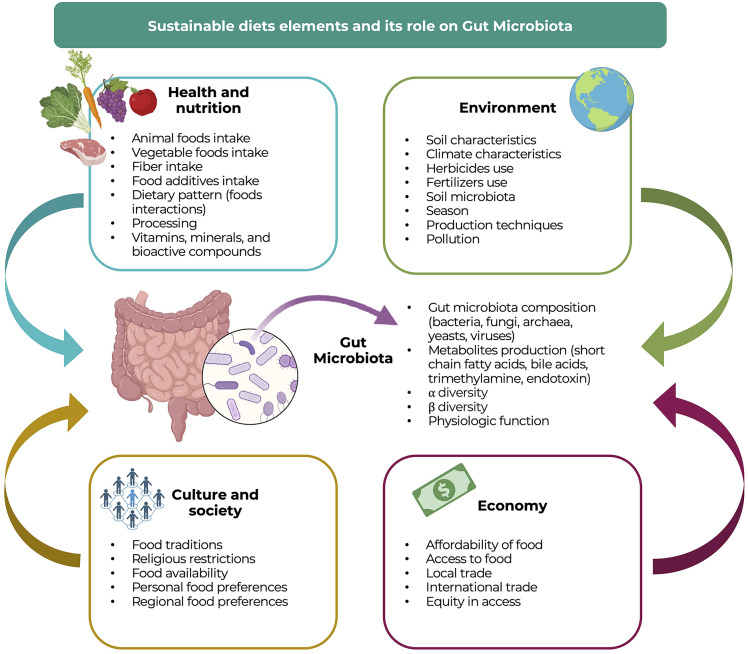
The gut microbiome is a key element for health preservation and disease prevention. Nevertheless, defining a healthy gut microbiome is complex since it is modulated by several factors, such as host genetics, sex, age, geographical zone, drug use, and, especially, diet. Although a healthy diet has proven to increase microbial alpha and beta diversity and to promote the proliferation of health-related bacteria, considering the current environmental and nutritional crisis, such as climate change, water shortage, loss of diversity, and the obesity pandemic, it should be highlighted that a healthy diet is not always sustainable. Sustainable diets are dietary patterns that promote all dimensions of people's health and well-being while exerting low pressure on the environment, and being accessible, affordable, safe, equitable, and culturally acceptable. Examples of diets that tend to be sustainable are the Planetary Health Diet of the EAT-Lancet Commission or territorial diets such as the Mediterranean and the Traditional Mexican diet (milpa diet), adapted to specific contexts. These diets are principally plant-based but include small or moderate amounts of animal-based foods. Characterising the effects of sustainable diets on gut microbiota is urgent to ensure that the benefits for human health are aligned with environmental preservation and respect the sociocultural aspects of individuals.
肠道微生物群是维持健康和预防疾病的关键因素。然而,定义健康的肠道微生物群很复杂,因为它受到多种因素的调节,如宿主基因、性别、年龄、地理区域、药物使用,尤其是饮食。尽管健康饮食已被证明能增加微生物的α和β多样性,并促进与健康相关细菌的增殖,但考虑到当前的环境和营养危机,如气候变化、水资源短缺、生物多样性丧失和肥胖症流行,应该强调的是,健康饮食并不总是可持续的。可持续饮食是指那些在促进人们健康和幸福的各个方面的同时,对环境施加低压力,并且可获取、价格合理、安全、公平且在文化上可接受的饮食模式。倾向于可持续的饮食例子有EAT-柳叶刀委员会的行星健康饮食,或适用于特定环境的地域饮食,如地中海饮食和传统墨西哥饮食(玉米地饮食)。这些饮食主要以植物为基础,但也包括少量或适量的动物性食物。迫切需要明确可持续饮食对肠道微生物群的影响,以确保对人类健康的益处与环境保护相一致,并尊重个人的社会文化方面。