Laboratory of Molecular Neuroendocrinology, Institute of Experimental Medicine, Hungarian Research Network, Budapest, Hungary.
János Szentágothai School of Neurosciences, Semmelweis University, Budapest, Hungary.
Sci Rep. 2024 Sep 19;14(1):21864. doi: 10.1038/s41598-024-73216-y.
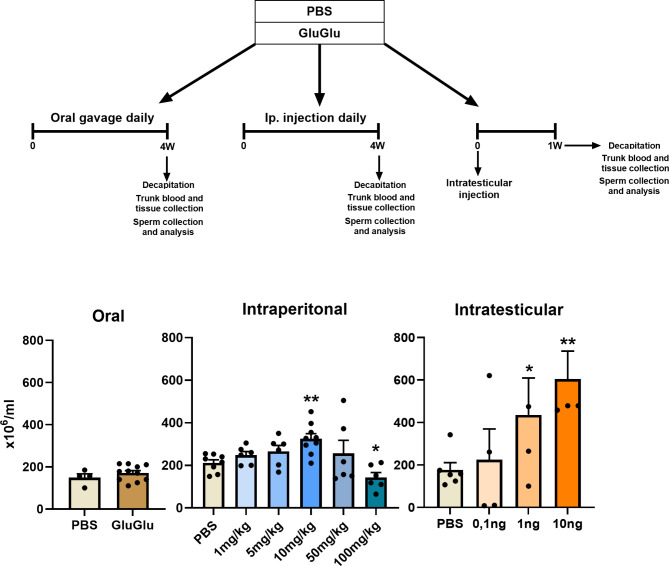
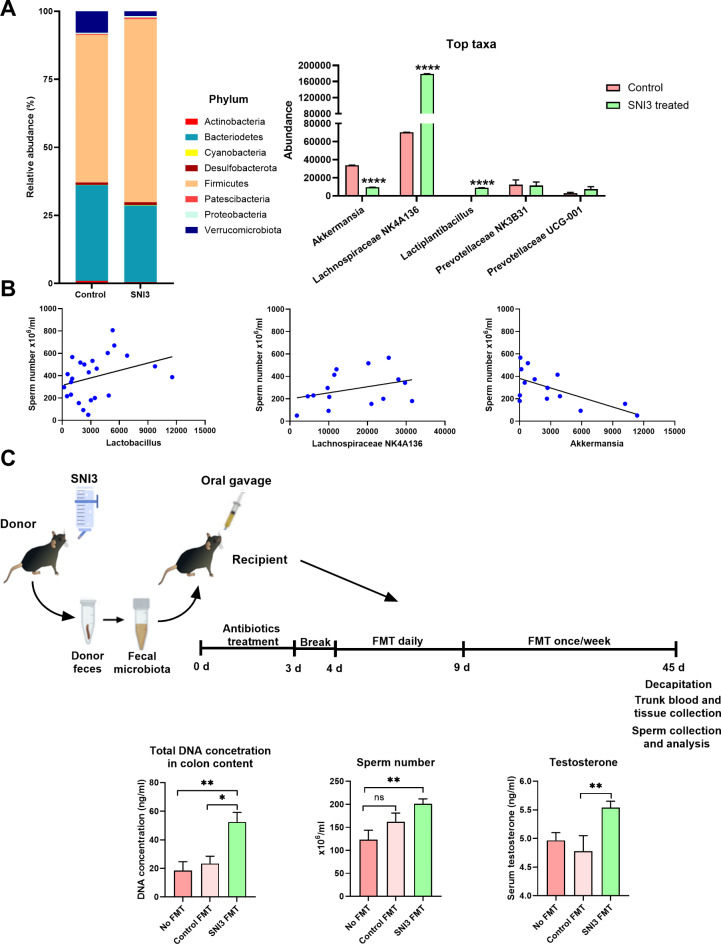
The decrease in sperm count and infertility is a global issue that remains unresolved. By screening environmental bacterial isolates, we have found that a novel lactic acid bacterium, Lactiplantibacillus plantarum SNI3, increased testis size, testosterone levels, sperm count, sexual activity and fertility in mice that have consumed the bacteria for four weeks. The abundance of L. plantarum in the colon microbiome was positively associated with sperm count. Fecal microbiota transplantation (FMT) from L. plantarum SNI3-dosed mice improved testicular functions in microbiome-attenuated recipient animals. To identify mediators that confer pro-reproductive effects on the host, untargeted in situ mass spectrometry metabolomics was performed on testis samples of L. plantarum SNI3-treated and control mice. Enrichment pathway analysis revealed several perturbed metabolic pathways in the testis of treated mice. Within the testis, a dipeptide, glutamyl-glutamate (GluGlu) was the most upregulated metabolite following L. plantarum SNI3 administration. To validate the pro-reproductive feature of GluGlu, systemic and local injections of the dipeptide have been performed. γ-GluGlu increased sperm count but had no effect on testosterone. These findings highlight the role of γ-GluGlu in mediating spermatogenetic effects of L. plantarum on the male mouse host and -following relevant human clinical trials- may provide future tools for treating certain forms of male infertility.
精子数量减少和不育是一个全球性问题,仍未得到解决。通过筛选环境细菌分离物,我们发现一种新型的植物乳杆菌 SNI3 可增加睾丸大小、睾丸酮水平、精子数量、性行为和生育能力,而食用该细菌的小鼠持续四周。结肠微生物组中植物乳杆菌的丰度与精子数量呈正相关。来自植物乳杆菌 SNI3 处理过的小鼠的粪便微生物群移植(FMT)改善了微生物组减弱的受者动物的睾丸功能。为了确定赋予宿主生殖促进作用的介质,对植物乳杆菌 SNI3 处理和对照小鼠的睾丸样本进行了非靶向原位质谱代谢组学分析。富集途径分析显示,处理组小鼠睾丸中存在几个失调的代谢途径。在睾丸内,二肽谷氨酸-谷氨酸(GluGlu)是植物乳杆菌 SNI3 给药后上调最明显的代谢物。为了验证 GluGlu 的生殖促进作用,对该二肽进行了全身和局部注射。γ-GluGlu 增加了精子数量,但对睾丸酮没有影响。这些发现强调了 γ-GluGlu 在介导植物乳杆菌对雄性小鼠宿主的生精作用中的作用,并且在进行相关的人类临床试验后,可能为治疗某些形式的男性不育提供未来的工具。