Sorajja Natali, Chung Joon, Alcántara Carmela, Wassertheil-Smoller Sylvia, Penedo Frank J, Ramos Alberto R, Perreira Krista M, Daviglus Martha L, Suglia Shakira F, Gallo Linda C, Liu Peter Y, Redline Susan, Isasi Carmen R, Sofer Tamar
Department of Biostatistics, Harvard T.H. Chan School of Public Health, Boston, MA, USA.
Division of Sleep and Circadian Disorders, Department of Medicine, Brigham and Women's Hospital, Boston, MA, USA.
Sleep Adv. 2024 Aug 30;5(1):zpae064. doi: 10.1093/sleepadvances/zpae064. eCollection 2024.
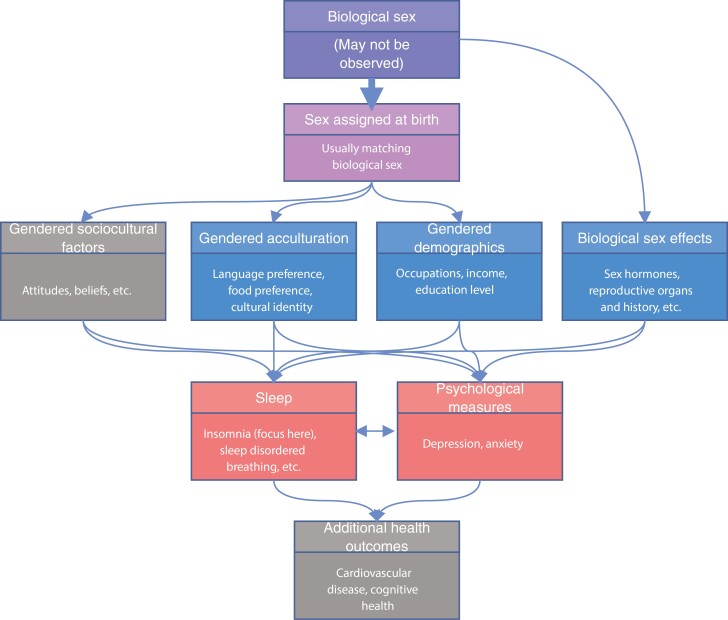
Sex differences are related to both biological factors and the gendered environment. We constructed measures to model sex-related differences beyond binary sex.
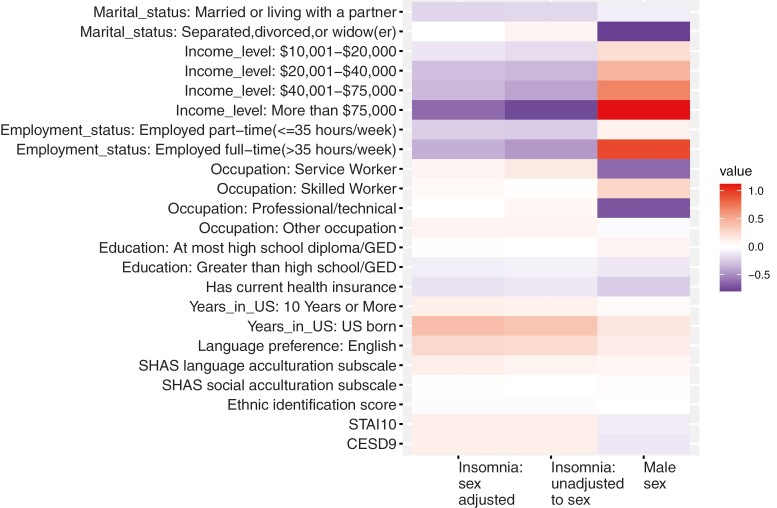
Data came from the baseline visit of the Hispanic Community Health Study/Study of Latinos (HCHS/SOL). We applied the least absolute shrinkage and selection operator penalized logistic regression of male versus female sex over sociodemographic, acculturation, and psychological factors jointly. Two "gendered indices," the gendered index of sociodemographic environment (GISE) and gendered index of psychological and sociodemographic environment, summarizing the sociodemographic environment (GISE) and psychosocial and sociodemographic environment (GIPSE) associated with sex, were calculated by summing these variables, weighted by their regression coefficients. We examined the association of these indices with insomnia, a phenotype with strong sex differences, in sex-adjusted and sex-stratified analyses.
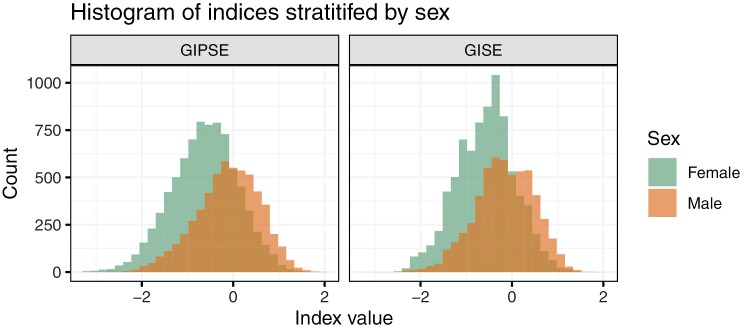
The distribution of GISE and GIPSE differed by sex with higher values in male individuals. In an association model with insomnia, male sex was associated with a lower likelihood of insomnia (odds ratio [OR] = 0.60, 95% CI [0.53, 0.67]). Including GISE in the model, the association was slightly weaker (OR = 0.63, 95% CI [0.56, 0.70]), and weaker when including instead GIPSE in the association model (OR = 0.78, 95% CI [0.69, 0.88]). Higher values of GISE and of GIPSE, more common in the male sex, were associated with a lower likelihood of insomnia, in analyses adjusted for sex (per 1 standard deviation of the index, GISE OR = 0.92, 95% CI [0.87, 0.99], GIPSE OR = 0.65, 95% CI [0.61, 0.70]).
New measures such as GISE and GIPSE capture sex-related differences beyond binary sex and have the potential to better model and inform research studies of sleep health.
性别差异与生物因素和性别化环境均相关。我们构建了一些测量方法,以对二元性别之外与性别相关的差异进行建模。
数据来自西班牙裔社区健康研究/拉丁裔研究(HCHS/SOL)的基线访视。我们对社会人口统计学、文化适应和心理因素联合应用了最小绝对收缩和选择算子惩罚逻辑回归,以分析男性与女性的性别差异。通过将这些变量与其回归系数加权后求和,计算了两个“性别化指数”,即社会人口统计学环境性别化指数(GISE)和心理与社会人口统计学环境性别化指数(GIPSE),分别总结与性别相关的社会人口统计学环境和心理社会与社会人口统计学环境。我们在性别调整分析和性别分层分析中,研究了这些指数与失眠(一种具有强烈性别差异的表型)之间的关联。
GISE和GIPSE的分布因性别而异,男性个体的值更高。在一个与失眠相关的模型中,男性患失眠的可能性较低(优势比[OR]=0.60,95%置信区间[0.53,0.67])。在模型中纳入GISE后,这种关联稍弱(OR=0.63,95%置信区间[0.56,0.70]),而在关联模型中纳入GIPSE时则更弱(OR=0.78,95%置信区间[0.69,0.88])。在性别调整分析中,GISE和GIPSE值越高(在男性中更常见),与失眠可能性越低相关(指数每增加1个标准差,GISE的OR=0.92,95%置信区间[0.87,0.99],GIPSE的OR=0.65,95%置信区间[0.61,0.70])。
诸如GISE和GIPSE等新的测量方法能够捕捉二元性别之外与性别相关的差异,并且有潜力更好地对睡眠健康研究进行建模并为其提供信息。