Social Justice in Mental Health Research Lab, School of Occupational Therapy, Western University, London, Ontario, Canada.
School of Rehabilitation Science, McMaster University, Hamilton, Ontario, Canada.
PLoS One. 2024 Sep 26;19(9):e0310701. doi: 10.1371/journal.pone.0310701. eCollection 2024.
Belonging is closely associated with well-being, yet individuals with experiences of being unhoused are likely to experience social exclusion and challenges with developing a sense of belonging. Engagement in meaningful activity has been linked to belonging; however, there are no focused studies exploring experiences of how engaging in meaningful activities influences belonging. Meaningful activities are things we do that bring value to our lives.
To explore how engaging in meaningful activities may influence experiences of belonging following homelessness through a secondary analysis of qualitative interviews.
Using interviews conducted in a community-based participatory action study exploring the transition to housing following homelessness (n = 19), we conducted a thematic analysis using the method described by Braun and Clarke. Participants were recruited through communication with local organizations supporting individuals with lived and living experiences of being unhoused as well as through presentations at drop-in organizations. An intentional effort was made to recruit diverse participants regarding housing status, age, and gender. Inductive analysis was used to conduct initial coding, focusing on belonging and engaging in meaningful activities. We then analyzed the codes abductively, using Bourdieu's Social Capital Theory to inform this analysis.
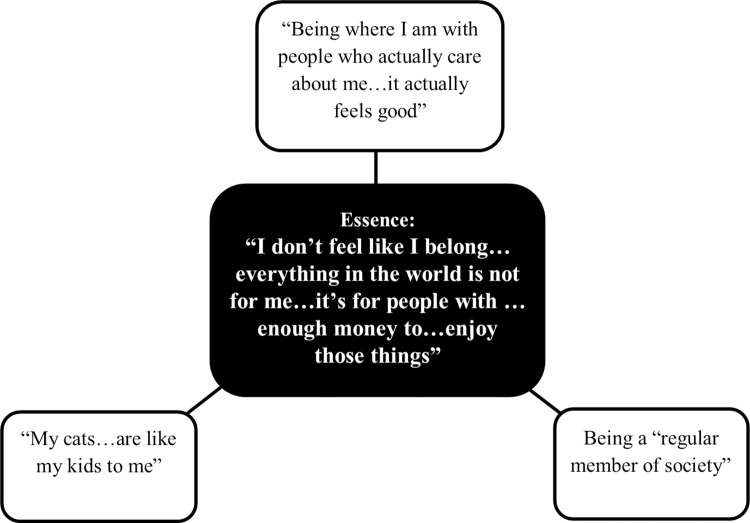
The overarching essence generated in our analysis was: "I don't feel like I belong…everything in the world is not for me…it's for people with…enough money to…enjoy those things". Within this overall essence, we generated three themes: 1) Human connection: "being where I am with people who care about me, I actually feel good"; 2) Social exclusion: being a "regular member of society"; and 3) Non-human connection: "my cats…are like my kids to me." Participants described numerous contextual factors that challenged them as they sought belonging following homelessness, including financial limitations and other societal factors.
Our findings suggest that meaningful activity was an important pathway to belonging for participants in this study.
归属感与幸福感密切相关,但无家可归者可能会经历社会排斥,难以建立归属感。有意义的活动与归属感有关;然而,目前尚无集中研究探讨参与有意义的活动如何影响归属感。有意义的活动是指我们做的那些给我们的生活带来价值的事情。
通过对参与有意义的活动如何影响无家可归者归属感的二次分析,探讨这一问题。
使用在一项基于社区的参与式行动研究中进行的访谈(n=19),我们使用 Braun 和 Clarke 描述的方法进行了主题分析。参与者是通过与支持无家可归者生活和居住经历的当地组织沟通以及在临时机构的演讲招募的。我们有意努力招募住房状况、年龄和性别多样化的参与者。使用归纳分析进行初步编码,重点关注归属感和参与有意义的活动。然后,我们使用布迪厄的社会资本理论进行了推断分析,以指导这一分析。
我们分析产生的总体本质是:“我觉得自己不属于这里……世界上的一切都不属于我……只有有足够钱的人才能……享受那些东西”。在这个总体本质中,我们生成了三个主题:1)人际联系:“和关心我的人在一起,我真的感觉很好”;2)社会排斥:“成为社会的‘正式成员’”;3)非人际联系:“我的猫……对我来说就像我的孩子一样”。参与者描述了许多挑战他们归属感的背景因素,包括经济限制和其他社会因素。
我们的研究结果表明,对本研究中的参与者来说,有意义的活动是归属感的重要途径。