Institute of Hygiene and Environmental Medicine, Charité - Universitätsmedizin Berlin, Berlin, Germany.
Institute of Microbiology and Epizootics, School of Veterinary Medicine, Freie Universität Berlin, Berlin, Germany.
Euro Surveill. 2024 Sep;29(39). doi: 10.2807/1560-7917.ES.2024.29.39.2300714.
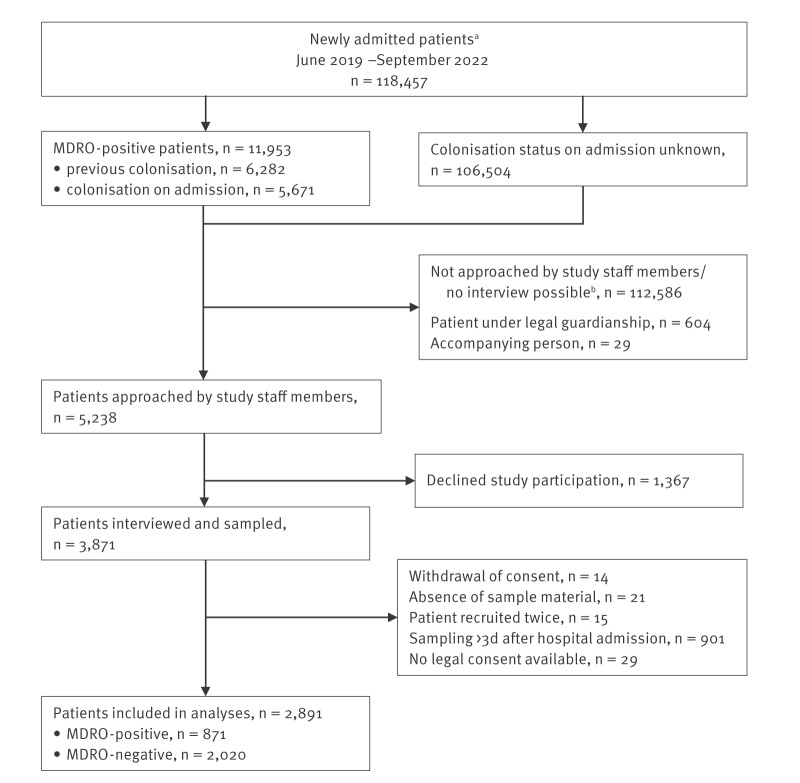
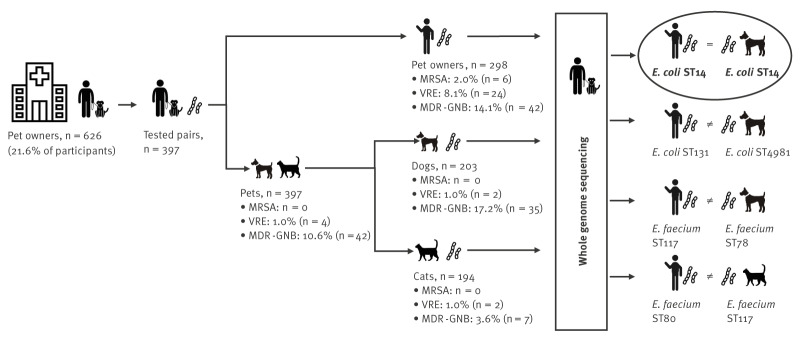
BackgroundCarriage of multidrug-resistant organisms (MDROs) in humans constitutes an important public health concern. Cross-transmission of bacteria between animals and humans has been demonstrated before.AimOur aim was to quantify the risk factor 'pet ownership' for MDRO colonisation in hospital patients.MethodsWe performed a matched case-control study from 2019 to 2022 in Berlin, Germany and compared MDRO-positive and MDRO-negative patients in terms of contact with pets and other risk factors for MDRO acquisition. Patients completed a questionnaire-based interview and provided nasal and rectal swabs. Pet owners provided swab samples from the throat and stool of their pets (dogs and cats). Phenotypically matching samples of owners and pets were analysed via whole genome sequencing.ResultsThe analyses included 2,891 patients. Reported pet ownership was 17.7% in MDRO-positives (154/871) and 23.4% in MDRO-negatives (472/2,020). Among 397 owner-pet pairs, we identified one pair sharing genotypically indistinguishable pathogens (0.3%). A risk factor analysis of pet ownership was performed for carriers of meticillin-resistant (MRSA) (OR = 0.662; 95% CI: 0.343-1.277), vancomycin-resistant enterococci (VRE) (OR = 0.764; 95% CI: 0.522-1.118) and multidrug-resistant Gram-negative bacteria (MDR-GNB) (OR = 0.819; 95% CI: 0.620-1.082). Colonisation with MDRO was rare in pets, and dogs were more often colonised than cats (MRSA: 0% vs 0%, VRE: 1.5% vs 1.0%, MDR-GNB: 17.2% vs 3.6%).ConclusionTransmission of MDROs between humans and pets is possible though rare. In an urban living space, neither cat nor dog ownership appears as a relevant risk factor for MDRO carriage in hospital patients.
背景
携带多药耐药菌(MDROs)的人类构成了重要的公共卫生问题。动物和人类之间的细菌交叉传播已经得到证实。
目的
我们的目的是量化“宠物拥有”这一风险因素对医院患者 MDRO 定植的影响。
方法
我们在德国柏林进行了一项 2019 年至 2022 年的病例对照研究,比较了 MDRO 阳性和 MDRO 阴性患者在接触宠物和其他 MDRO 获得风险因素方面的差异。患者完成了基于问卷的访谈,并提供了鼻腔和直肠拭子。宠物主人提供了他们的宠物(狗和猫)的咽喉和粪便拭子。对主人和宠物的表型匹配样本进行全基因组测序分析。
结果
分析纳入了 2891 名患者。MDRO 阳性患者中报告的宠物拥有率为 17.7%(154/871),MDRO 阴性患者中为 23.4%(472/2020)。在 397 对主人-宠物对中,我们发现了一对共享基因型相同病原体的样本(0.3%)。对耐甲氧西林金黄色葡萄球菌(MRSA)(OR=0.662;95%CI:0.343-1.277)、耐万古霉素肠球菌(VRE)(OR=0.764;95%CI:0.522-1.118)和多药耐药革兰氏阴性菌(MDR-GNB)(OR=0.819;95%CI:0.620-1.082)携带者的宠物拥有风险因素进行了分析。宠物中 MDRO 定植很少见,狗比猫更常见(MRSA:0%比 0%,VRE:1.5%比 1.0%,MDR-GNB:17.2%比 3.6%)。
结论
人类和宠物之间 MDRO 的传播是可能的,尽管很少见。在城市居住空间中,猫或狗的拥有都不是医院患者 MDRO 携带的相关风险因素。