Institute of Medical Microbiology, University Hospital Münster, Münster, Germany.
Institute for Animal Hygiene and Environmental Health, FU Berlin, Department of Veterinary Medicine, Berlin, Germany.
PLoS One. 2018 Dec 7;13(12):e0208364. doi: 10.1371/journal.pone.0208364. eCollection 2018.
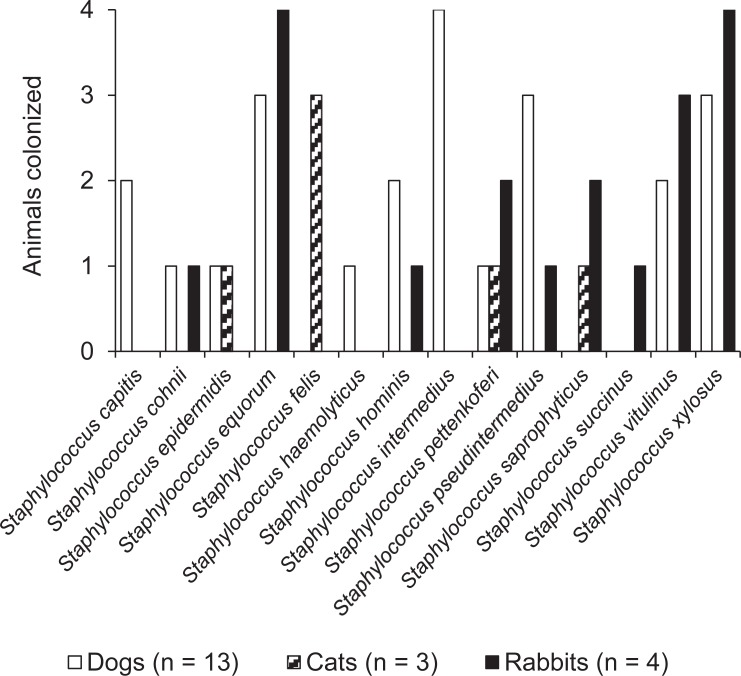
Antimicrobial multidrug-resistant microorganisms (MDRO) can be transmitted between companion animals and their human owners. Aim of this study was to determine the prevalence of extended spectrum beta-lactamase-producing Enterobacteriaceae (ESBL-E) and Staphylococcus aureus including methicillin-resistant S. aureus (MRSA) in different companion animal species. Dogs (n = 192), cats (n = 74), and rabbits (n = 17), treated in a veterinary practice and hospital or living in an animal shelter and private households, were sampled. All facilities were located in a region characterized by a high density of pig production. Nasal, buccal and perianal swabs were enriched and cultured on solid chromogenic selective media. A subgroup of 20 animals (13 dogs, 3 cats, 4 rabbits) was analyzed for the presence of staphylococci other than S. aureus. Amongst all animals (n = 283), twenty dogs (10.4%) and six cats (8.1%) carried S. aureus. MRSA was found in five dogs (2.6%) and two cats (2.7%). Isolates were of spa types t011, t034, t108 (all mecA-positive, ST398), and t843 (mecC-positive, ST130), typical for livestock-associated (LA)-MRSA. Except for one dog, MRSA-positive animals did not have direct contact to husbandry. ESBL-Escherichia coli (blaCTX-M/blaTEM/blaSHV genes) were present in seven dogs (3.6%), one cat (1.4%) possessed a cefotaxime-resistant Citrobacter freundii isolate (blaTEM/blaCMY-2 genes). MDRO carriage was associated with animals from veterinary medical settings (p<0.05). One dog and one rabbit carried methicillin-resistant coagulase-negative staphylococci. The exclusive occurrence of MRSA lineages typically described for livestock stresses the impact of MDRO strain dissemination across species barriers in regional settings. Presence of ESBL-E and LA-MRSA among pets and probable dissemination in clinical settings support the necessity of a "One Health" approach to address the potential threats due to MDRO-carrying companion animals.
抗菌多药耐药微生物(MDRO)可在伴侣动物与其人类主人之间传播。本研究旨在确定不同伴侣动物物种中产生扩展谱β-内酰胺酶的肠杆菌科(ESBL-E)和金黄色葡萄球菌(包括耐甲氧西林金黄色葡萄球菌(MRSA))的流行率。在兽医诊所和医院接受治疗或居住在动物收容所和私人家庭中的 192 只狗、74 只猫和 17 只兔子进行了采样。所有设施均位于猪生产密度较高的地区。鼻、口腔和肛周拭子在固体显色选择性培养基中进行富集和培养。对 20 只动物(13 只狗、3 只猫、4 只兔子)进行了除金黄色葡萄球菌以外的葡萄球菌分析。在所有动物(n = 283)中,有 20 只狗(10.4%)和 6 只猫(8.1%)携带金黄色葡萄球菌。在 5 只狗(2.6%)和 2 只猫(2.7%)中发现了 MRSA。分离株的 spa 型为 t011、t034、t108(均 mecA-阳性,ST398)和 t843(mecC-阳性,ST130),与牲畜相关(LA)-MRSA 典型。除一只狗外,MRSA 阳性动物与畜牧业没有直接接触。在 7 只狗(3.6%)中存在 blaCTX-M/blaTEM/blaSHV 基因的 ESBL-Escherichia coli,1 只猫(1.4%)携带头孢噻肟耐药柠檬酸杆菌分离株(blaTEM/blaCMY-2 基因)。MDRO 携带与兽医医疗环境中的动物有关(p<0.05)。1 只狗和 1 只兔子携带耐甲氧西林凝固酶阴性葡萄球菌。MRSA 谱系仅在牲畜中发现,强调了区域环境中 MDRO 菌株跨越物种屏障传播的影响。宠物中存在 ESBL-E 和 LA-MRSA 以及临床环境中可能的传播支持采取“同一健康”方法来应对携带 MDRO 的伴侣动物带来的潜在威胁。