Institute of Hygiene and Environmental Medicine, Charité University Medicine Berlin, Berlin, Germany.
Berlin School of Public Health, Charité University Medicine Berlin, Berlin, Germany.
Antimicrob Resist Infect Control. 2024 Sep 20;13(1):107. doi: 10.1186/s13756-024-01457-7.
The global increase of multidrug-resistant organisms (MDROs) is one of the most urgent public health threats affecting both humans and animals. The One Health concept emphasizes the interconnectedness of human, animal and environmental health and highlights the need for integrated approaches to combat antimicrobial resistance (AMR). Although the sharing of environments and antimicrobial agents between companion animals and humans poses a risk for MDRO transmission, companion animals have been studied to a lesser extent than livestock animals. This study therefore used core genome multilocus sequence typing (cgMLST) to investigate the genetic relationships and putative transmission of MDROs between humans and pets.
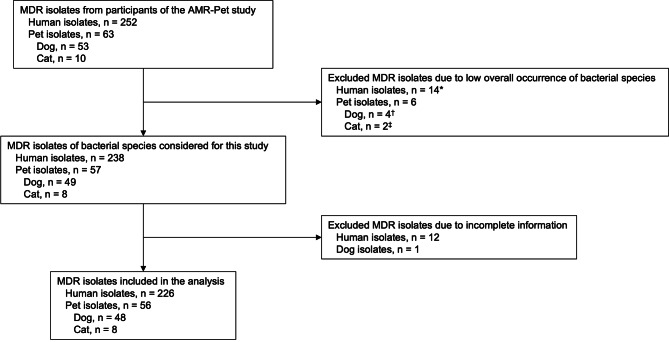
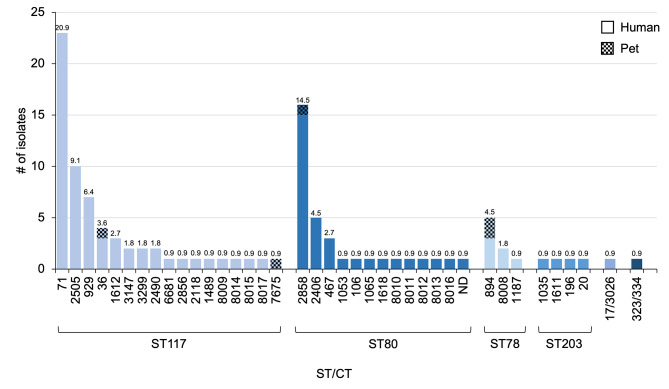
This descriptive integrated typing study included 252 human isolates, 53 dog isolates and 10 cat isolates collected from 2019 to 2022 at the Charité University Hospital in Berlin, Germany. CgMLST was performed to characterize methicillin-resistant Staphylococcus aureus, vancomycin-resistant enterococci and multidrug-resistant gram-negative bacteria. The genetic diversity of the MDROs of the different host populations was determined and compared based on sequence type and core genome complex type.
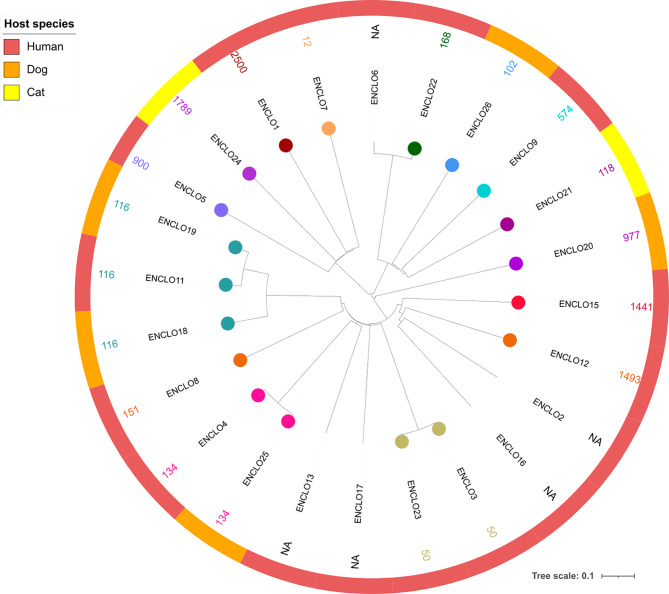
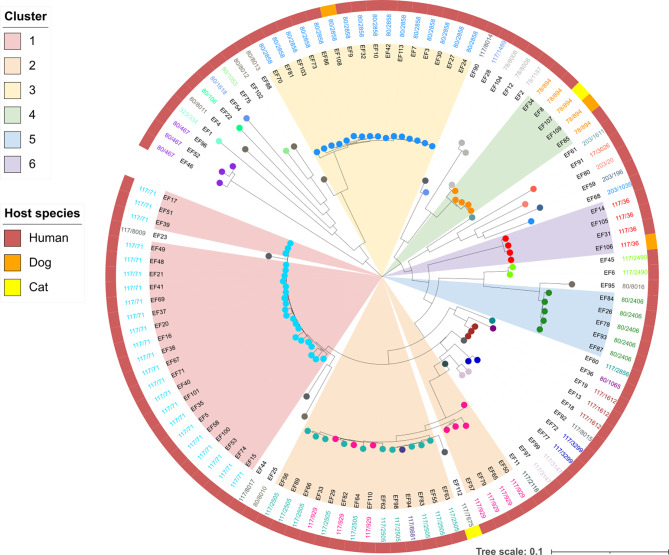
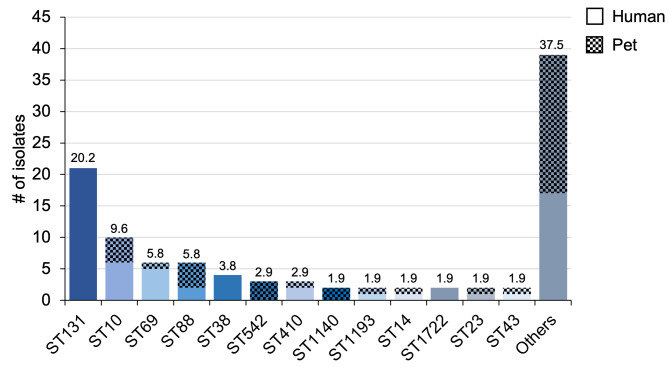
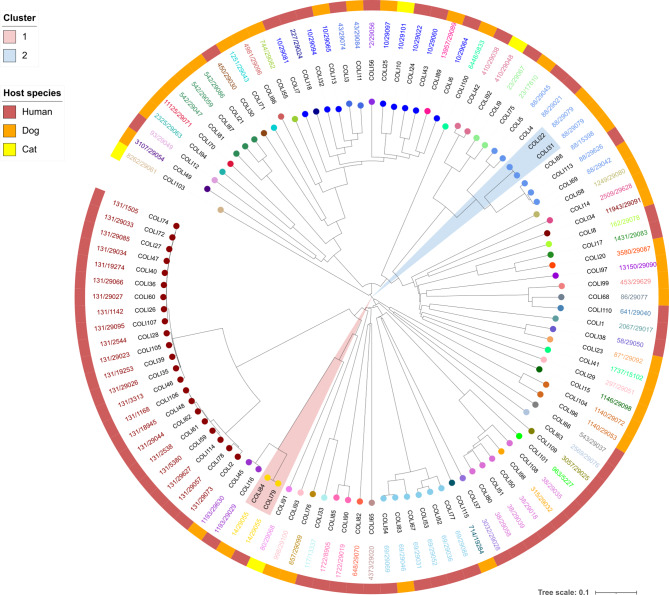
Within this study the majority of samples from pets and humans was genetically distinct. However, for some isolates, the number of allelic differences identified by cgMLST was low. Two cases of putative household transmission or shared source of VR E. faecium and MDR E. coli between humans and pets were documented.
The interaction between humans and their pets appears to play a minor role in the spread of the MDROs studied. However, further research is needed. This study emphasizes the importance of comprehensive molecular surveillance and a multidisciplinary One Health approach to understand and contain the spread of MDROs in human and animal populations.
The study is registered with the German Clinical Trials Register (DRKS00030009).
全球多药耐药菌(MDROs)的增加是影响人类和动物健康的最紧迫的公共卫生威胁之一。One Health 概念强调了人类、动物和环境健康的相互关联,强调需要采取综合方法来对抗抗微生物药物耐药性(AMR)。尽管伴侣动物和人类之间共享环境和抗菌剂会增加 MDRO 传播的风险,但与家畜动物相比,伴侣动物的研究较少。因此,本研究使用核心基因组多位点序列分型(cgMLST)来研究人类和宠物之间 MDRO 的遗传关系和潜在传播。
本描述性综合分型研究包括 2019 年至 2022 年期间在德国柏林 Charité 大学医院收集的 252 个人类分离株、53 个狗分离株和 10 个猫分离株。进行 cgMLST 以表征耐甲氧西林金黄色葡萄球菌、万古霉素耐药肠球菌和多药耐药革兰氏阴性菌。根据序列类型和核心基因组复杂类型,确定和比较不同宿主群体中 MDRO 的遗传多样性。
在本研究中,宠物和人类的大多数样本在遗传上是不同的。然而,对于一些分离株,cgMLST 鉴定的等位基因差异数量较少。记录了 2 例人与人之间和人与宠物之间 VR E. faecium 和 MDR E. coli 假定的家庭传播或共同来源的病例。
人类与宠物之间的相互作用似乎在研究的 MDRO 传播中作用较小。然而,需要进一步的研究。本研究强调了全面的分子监测和多学科 One Health 方法的重要性,以了解和控制 MDRO 在人类和动物群体中的传播。
该研究在德国临床试验注册处(DRKS00030009)注册。