Crizer David M, Rice Julie R, Smeltz Marci G, Lavrich Katelyn S, Ravindra Krishna, Wambaugh John F, DeVito Michael, Wetmore Barbara A
Division of Translational Toxicology, National Institute of Environmental Health Sciences, Research Triangle Park, NC 27711, USA.
Center for Public Health and Environmental Assessment, Office of Research and Development, US Environmental Protection Agency, Research Triangle Park, NC 27711, USA.
Toxics. 2024 Sep 14;12(9):672. doi: 10.3390/toxics12090672.
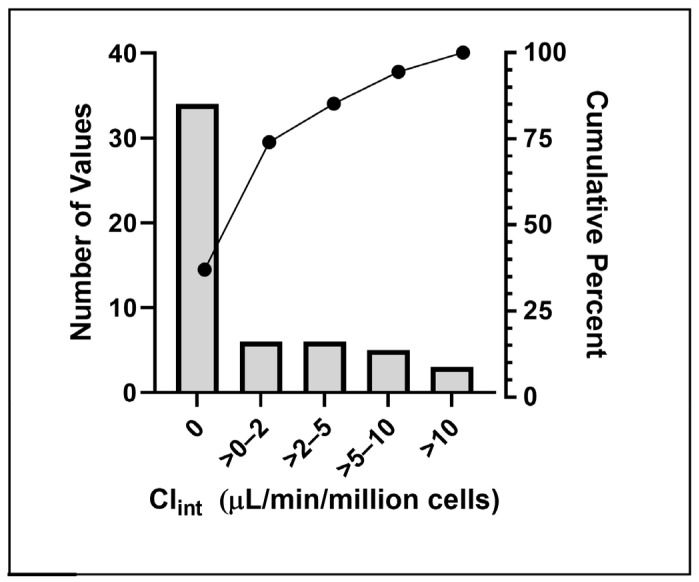
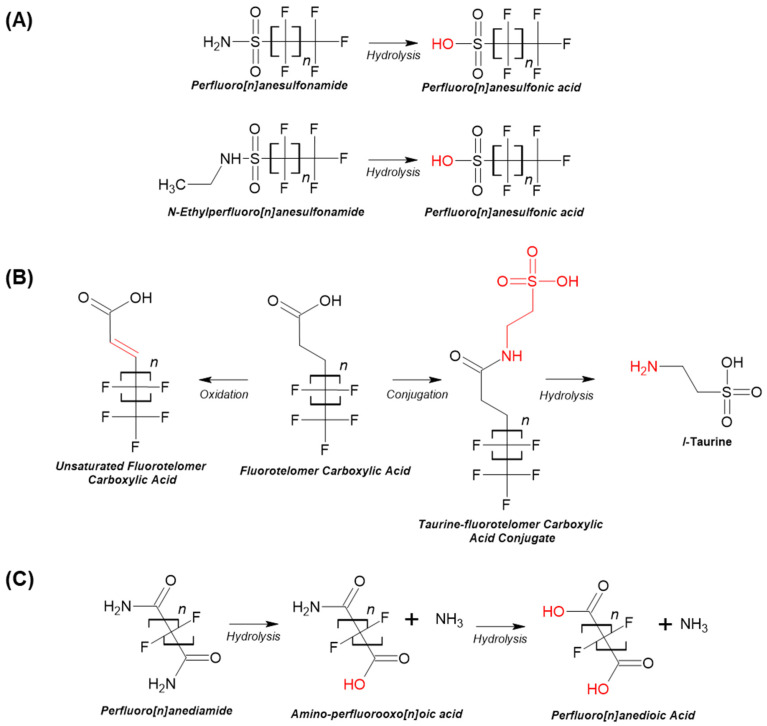
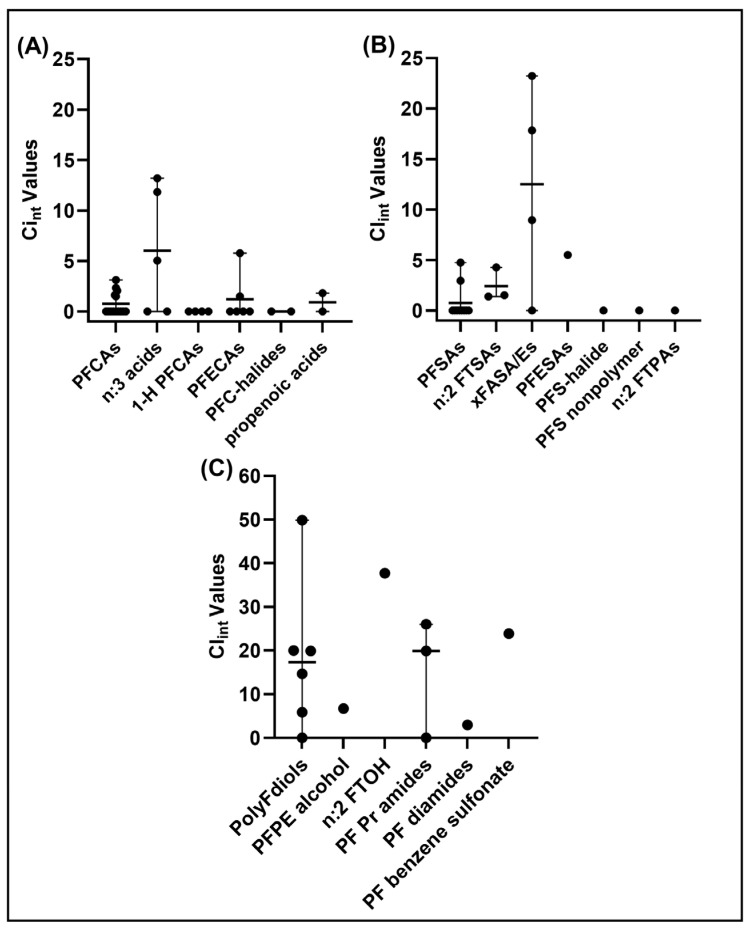
Toxicokinetic (TK) assays and in vitro-in vivo extrapolation (IVIVE) models are New Approach Methods (NAMs) used to translate in vitro points of departure to exposure estimates required to reach equivalent blood concentrations. Per- and polyfluoroalkyl substances (PFAS) are a large chemical class with wide-ranging industrial applications for which only limited toxicity data are available for human health evaluation. To address the lack of TK data, a pooled primary human hepatocyte suspension model was used with targeted liquid chromatography-mass spectrometry to investigate substrate depletion for 54 PFAS. A median value of 4.52 μL/(min x million cells) was observed across those that showed significant clearance, with 35 displaying no substrate depletion. Bayesian modeling propagated uncertainty around clearance values for use in IVIVE models. Structural evaluations showed the fluorotelomer carboxylic acids were the only PFAS carboxylates showing appreciable clearance, and per- and polyfluorosulfonamides were more readily metabolized than other PFAS sulfonates. Biotransformation product prediction, using the chemical transformation simulator, suggested hydrolysis of PFAS sulfonamides to more stable sulfonic acids, which is an important consideration for exposure modeling. This effort greatly expands the PFAS in vitro toxicokinetic dataset, enabling refined TK modeling, in silico tool development, and NAM-based human health evaluations across this important set of emerging contaminants.
毒代动力学(TK)分析和体外-体内外推(IVIVE)模型是用于将体外起始点转化为达到等效血药浓度所需暴露估计值的新方法(NAMs)。全氟和多氟烷基物质(PFAS)是一大类化学物质,具有广泛的工业应用,但目前仅有有限的毒性数据可用于人类健康评估。为解决TK数据的缺乏问题,采用了汇集的原代人肝细胞悬浮模型,并结合靶向液相色谱-质谱法,研究了54种PFAS的底物消耗情况。在显示出显著清除的物质中,观察到的中位数为4.52 μL/(分钟×百万细胞),有35种未显示底物消耗。贝叶斯模型传播了清除值周围的不确定性,以供IVIVE模型使用。结构评估表明,氟调聚物羧酸是唯一显示出明显清除的PFAS羧酸盐,全氟和多氟磺酰胺比其他PFAS磺酸盐更容易代谢。使用化学转化模拟器进行的生物转化产物预测表明,PFAS磺酰胺会水解为更稳定的磺酸,这是暴露建模的一个重要考虑因素。这项工作极大地扩展了PFAS的体外毒代动力学数据集,有助于进行精细的TK建模、计算机工具开发以及基于NAMs的对这组重要新兴污染物的人类健康评估。