Le Guillou Horn Xavier Maximin, Lecellier François, Giraud Clement, Naudin Mathieu, Fayolle Pierre, Thomarat Céline, Fernandez-Maloigne Christine, Guillevin Rémy
Laboratoire de Mathématique Appliquées LMA, Labcom i3M, Université de Poitiers, CNRS UMR 7348, F-86000 Poitiers, France.
Service de Génétique Médicale, CHU de Poitiers, F-86000 Poitiers, France.
Biomedicines. 2024 Sep 23;12(9):2156. doi: 10.3390/biomedicines12092156.
Gliomas, including the most severe form known as glioblastomas, are primary brain tumors arising from glial cells, with significant impact on adults, particularly men aged 45 to 70. Recent advancements in the WHO (World Health Organization) classification now correlate genetic markers with glioma phenotypes, enhancing diagnostic precision and therapeutic strategies.
This scoping review aims to evaluate the current state of deep learning (DL) applications in the genetic characterization of adult gliomas, addressing the potential of these technologies for a reliable virtual biopsy.
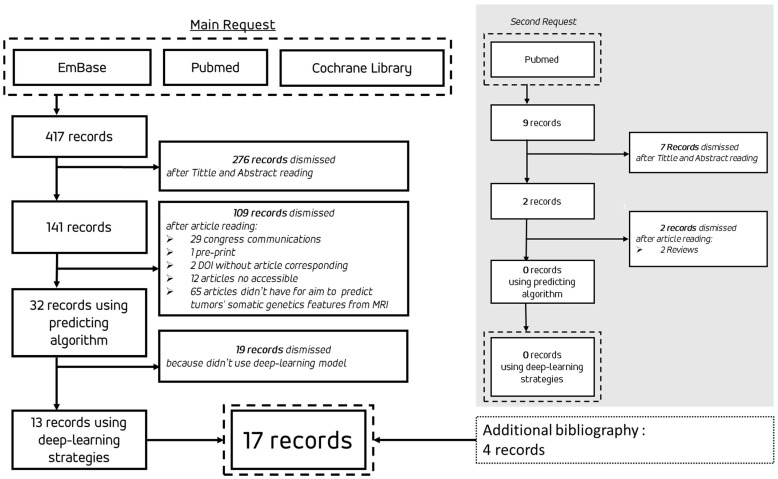
We reviewed 17 studies, analyzing the evolution of DL algorithms from fully convolutional networks to more advanced architectures (ResNet and DenseNet). The methods involved various validation techniques, including k-fold cross-validation and external dataset validation.
Our findings highlight significant variability in reported performance, largely due to small, homogeneous datasets and inconsistent validation methods. Despite promising results, particularly in predicting individual genetic traits, the lack of robust external validation limits the generalizability of these models. Future efforts should focus on developing larger, more diverse datasets and integrating multidisciplinary collaboration to enhance model reliability. This review underscores the potential of DL in advancing glioma characterization, paving the way for more precise, non-invasive diagnostic tools. The development of a robust algorithm capable of predicting the somatic genetics of gliomas or glioblastomas could accelerate the diagnostic process and inform therapeutic decisions more quickly, while maintaining the same level of accuracy as the traditional diagnostic pathway, which involves invasive tumor biopsies.
胶质瘤,包括最严重的胶质母细胞瘤,是起源于神经胶质细胞的原发性脑肿瘤,对成年人,尤其是45至70岁的男性有重大影响。世界卫生组织(WHO)分类的最新进展现在将基因标记与胶质瘤表型相关联,提高了诊断准确性和治疗策略。
本综述旨在评估深度学习(DL)在成人胶质瘤基因特征分析中的应用现状,探讨这些技术进行可靠虚拟活检的潜力。
我们回顾了17项研究,分析了DL算法从全卷积网络到更先进架构(ResNet和DenseNet)的演变。这些方法涉及各种验证技术,包括k折交叉验证和外部数据集验证。
我们的研究结果突出了报告性能的显著差异,这主要归因于小的、同质的数据集和不一致的验证方法。尽管取得了有前景的结果,特别是在预测个体基因特征方面,但缺乏有力的外部验证限制了这些模型的通用性。未来的工作应侧重于开发更大、更多样化的数据集,并整合多学科合作以提高模型的可靠性。本综述强调了DL在推进胶质瘤特征分析方面的潜力,为更精确、非侵入性的诊断工具铺平了道路。开发一种能够预测胶质瘤或胶质母细胞瘤体细胞遗传学的强大算法,可以加快诊断过程,并更快地为治疗决策提供信息,同时保持与传统诊断途径相同的准确性水平,传统诊断途径涉及侵入性肿瘤活检。