Brani Panagiota, Iliadou Maria, Andersson Ewa, Daskalakis Georgios, Drakakis Peter, Dagla Maria
Department of Midwifery, School of Health & Care Sciences, University of West Attica, 12243 Athens, Greece.
Department of Women's and Children's Health, Division of Reproductive Health, Karolinska Institutet, 17177 Stockholm, Sweden.
Healthcare (Basel). 2024 Sep 21;12(18):1896. doi: 10.3390/healthcare12181896.
Breastfeeding provides vital nutrients and fosters maternal-infant bonding, benefiting both mother and child. However, breastfeeding duration is influenced by various factors, especially in women of high-risk pregnancy. This study aims to identify predictors of breastfeeding duration among women of high-risk and low-risk pregnancy, focusing on exclusive and mixed feeding practices.
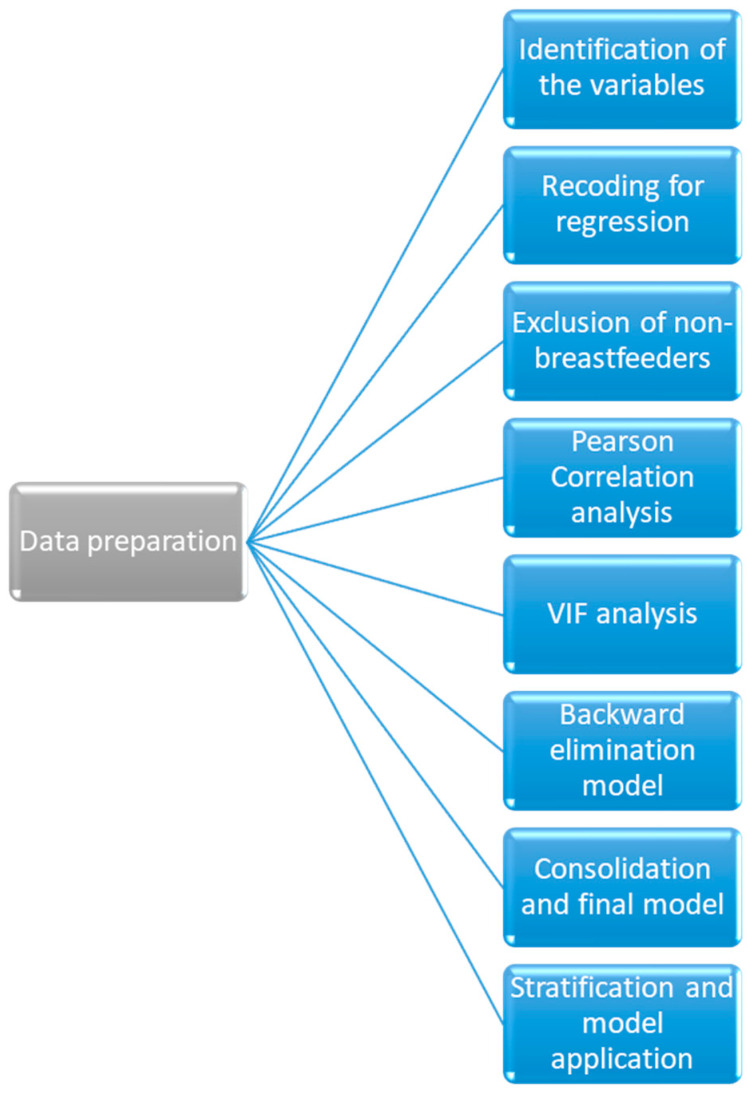
Conducted at a public hospital in Attica, Greece, this 20-month prospective cohort study (May 2020-January 2022) included 380 pregnant women, divided into high-risk and low-risk groups. The final sample of 157 women, after excluding non-breastfeeding participants, was assessed across five phases from prenatal to six months postpartum using interviews, calls, and surveys. Multiple linear regression identified key predictors, with statistical methods applied.
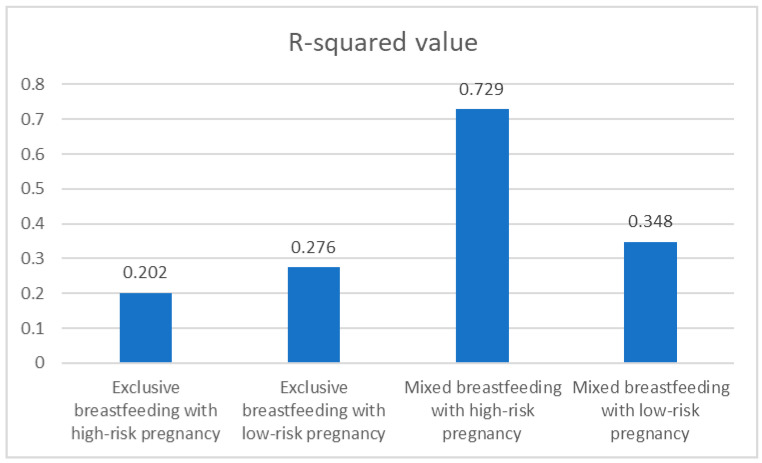
Results revealed birth weight as a consistent significant predictor of breastfeeding duration. For women with high-risk pregnancy, additional factors like infant gender, jaundice, and early introduction of solid foods influenced breastfeeding duration. The mixed breastfeeding model for women with high-risk pregnancy explained 72.9% of the variance. Exclusive and mixed breastfeeding models for women with low-risk pregnancy also highlighted birth weight's influence.
The findings highlight the important role of birth weight and other specific factors in determining breastfeeding duration among women of high-risk and low-risk pregnancy. Further research is needed to validate these findings across diverse populations.
母乳喂养提供重要营养并促进母婴亲密关系,对母亲和孩子都有益。然而,母乳喂养持续时间受多种因素影响,尤其是高危妊娠女性。本研究旨在确定高危和低危妊娠女性母乳喂养持续时间的预测因素,重点关注纯母乳喂养和混合喂养方式。
这项在希腊阿提卡的一家公立医院进行的为期20个月的前瞻性队列研究(2020年5月至2022年1月)纳入了380名孕妇,分为高危组和低危组。在排除非母乳喂养参与者后,对157名女性的最终样本在产前至产后六个月的五个阶段通过访谈、电话和调查进行评估。运用多元线性回归确定关键预测因素,并应用了统计方法。
结果显示出生体重是母乳喂养持续时间的一致显著预测因素。对于高危妊娠女性,婴儿性别、黄疸和过早添加固体食物等其他因素也会影响母乳喂养持续时间。高危妊娠女性的混合母乳喂养模型解释了72.9%的方差。低危妊娠女性的纯母乳喂养和混合母乳喂养模型也突出了出生体重的影响。
研究结果凸显了出生体重和其他特定因素在确定高危和低危妊娠女性母乳喂养持续时间方面的重要作用。需要进一步研究以在不同人群中验证这些发现。