USDA, Agricultural Research Service, National Center for Agricultural Utilization Research, Mycotoxin Prevention and Applied Microbiology Research Unit, 1815 N University St, Peoria, IL, 61604, USA.
Grupo Universitario de Investigación en Ingeniería y Agricultura Sostenible (GUIIAS), Área de Microbiología, Universidad de León, 24400, Ponferrada, Spain.
Appl Microbiol Biotechnol. 2024 Sep 28;108(1):475. doi: 10.1007/s00253-024-13297-x.
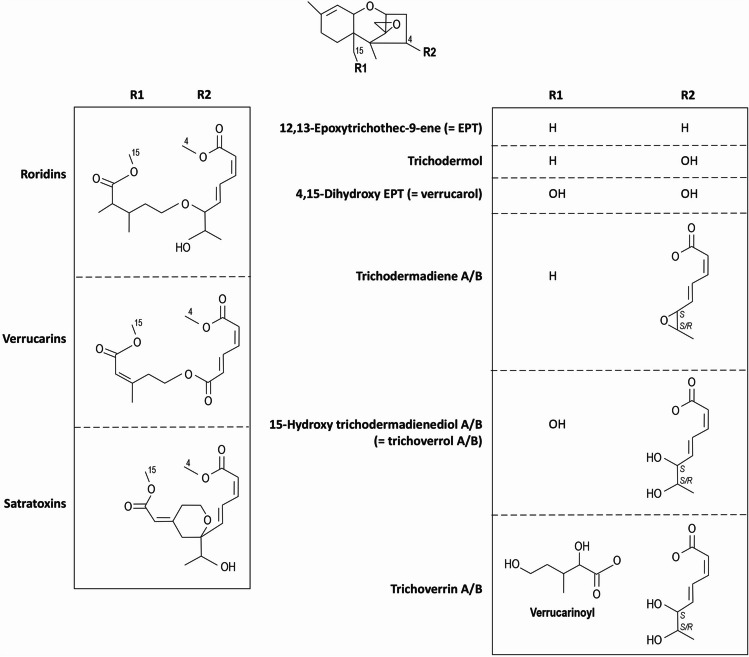
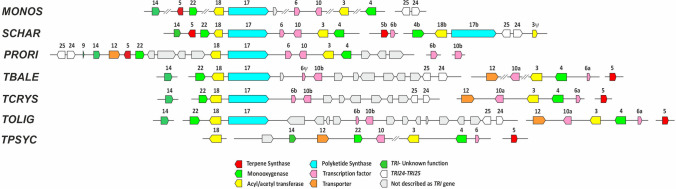
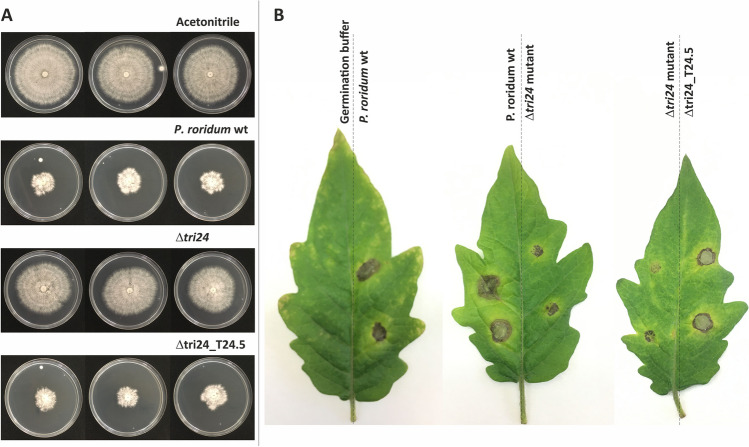
Trichothecenes are toxins produced by certain species from several fungal genera, including Aspergillus, Fusarium, Isaria, Paramyrothecium, Stachybotrys, Trichoderma, and Trichothecium. These toxins are of interest because they contribute to the toxigenicity, plant pathogenicity, and/or biological control activities of some fungi. All trichothecenes have the same core (12,13-epoxytrichothec-9-ene or EPT) structure but can differ from one another by the presence or absence of a macrocyclic ring formed from polyketide and isoprenoid substituents esterified to carbon atoms 4 and 15 of EPT, respectively. Genes required for formation and some modifications of EPT have been elucidated, but almost nothing is known about genes specific to the formation of the macrocyclic ring. Therefore, we used genomic, transcriptomic, metabolomic, and gene deletion analyses to identify genes that are required specifically for the formation of the macrocyclic ring. These analyses identified one gene, TRI24, that is predicted to encode an acyltransferase and that is required for macrocyclic ring formation during biosynthesis of macrocyclic trichothecenes by the fungus Paramyrothecium roridum. In addition, a TRI24 deletion mutant of P. roridum caused less severe disease symptoms on common bean and had less antifungal activity than its wild-type progenitor strain. We propose that the reduced aggressiveness and antifungal activity of the mutant resulted from its inability to produce trichothecenes with a macrocyclic ring. To our knowledge, this is the first report of a gene required specifically for the formation of the macrocyclic ring of trichothecenes and that loss of the macrocyclic ring of trichothecenes can alter the biological activities of a fungus. KEY POINTS: • TRI24 gene is found in all known macrocyclic trichothecene-producing fungi. • A tri24-deletion mutant exhibits a reduction in antifungal and plant disease activities. • TRI24 is the first described gene specific to macrocyclic trichothecene biosynthesis.
三萜烯是某些真菌属的某些物种产生的毒素,包括曲霉属、镰刀菌属、拟青霉属、石耳属、木霉属和木霉属。这些毒素之所以受到关注,是因为它们有助于一些真菌的产毒、植物致病性和/或生物防治活性。所有三萜烯都具有相同的核心(12,13-环氧三萜-9-烯或 EPT)结构,但彼此之间的差异在于是否存在由聚酮和异戊二烯取代物形成的大环环,分别酯化到 EPT 的碳原子 4 和 15。已经阐明了形成 EPT 和一些修饰所需的基因,但几乎不知道特定于大环环形成的基因。因此,我们使用基因组学、转录组学、代谢组学和基因缺失分析来鉴定专门用于形成大环环的基因。这些分析鉴定了一个基因 TRI24,该基因预测编码酰基转移酶,并且是真菌拟青霉形成大环三萜烯时大环环形成所必需的。此外,与野生型亲本菌株相比,拟青霉的 TRI24 缺失突变体在普通豆上引起的疾病症状较轻,且抗真菌活性较低。我们提出,突变体的侵袭性和抗真菌活性降低是由于其无法产生具有大环环的三萜烯。据我们所知,这是第一个专门用于三萜烯大环环形成的基因的报告,并且三萜烯大环环的缺失可以改变真菌的生物学活性。要点: • TRI24 基因存在于所有已知的大环三萜烯产生真菌中。 • tri24 缺失突变体表现出抗真菌和植物病害活性降低。 • TRI24 是第一个描述的特定于大环三萜烯生物合成的基因。