Department of Orthopedics, Peking University Third Hospital, Beijing, China.
Engineering Research Center of Bone and Joint Precision Medicine, Beijing, China.
Orthop Surg. 2024 Dec;16(12):3078-3087. doi: 10.1111/os.14251. Epub 2024 Sep 29.
The long-term effectiveness of total hip arthroplasty (THA) largely depends on the accuracy of acetabular prosthesis placement. To improve the accuracy of acetabular prosthesis placement, we utilized a new surgical navigation system: visual treatment solution (VTS). The purpose of this study was to verify the efficacy and safety of this system in assisting THA.
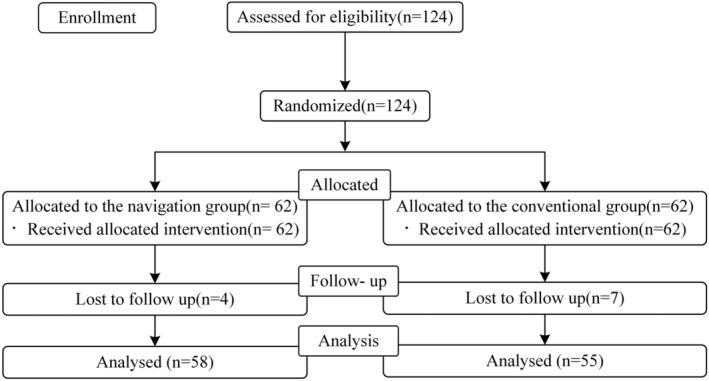
This was a prospective, multicenter, randomized controlled trial. One hundred and twenty-four patients undergoing primary THAs were included. The experimental group underwent VTS-assisted THA, and the control group underwent traditional surgical techniques. The main efficacy evaluation indicators were the proportion of anteversion and inclination angles in the Lewinnek safe zone, and secondary evaluation indicators included operation time, Western Ontario and McMaster University Osteoarthritis index (WOMAC) score, Harris score, short-form-36 (SF-36) score, and hip dislocation rate. Statistical analysis was performed mainly by t-test and chi-square test.
The proportion of both anteversion and inclination angles in the safe zone was 93.1% in the experimental group and 50.9% in the control group; the difference was significant (p < 0.01). The average operation time was 112.5 min in the experimental group and 92.6 min in the control group; the difference was significant (p < 0.01). There were no significant differences in WOMAC score, Harris score, or SF-36 score between the experimental and control groups at 3 months after the operation (p > 0.05). The dislocation rate was 0% in the experimental group and 1.6% in the control group; the difference was not significant (p > 0.05).
VTS-assisted THA can significantly improve the accuracy of acetabular prosthesis placement. However, there were no differences in short-term clinical outcomes or dislocation rates between the two groups.
全髋关节置换术(THA)的长期效果在很大程度上取决于髋臼假体放置的准确性。为了提高髋臼假体放置的准确性,我们使用了一种新的手术导航系统:视觉治疗解决方案(VTS)。本研究旨在验证该系统辅助 THA 的疗效和安全性。
这是一项前瞻性、多中心、随机对照试验。纳入了 124 例行初次 THA 的患者。实验组采用 VTS 辅助 THA,对照组采用传统手术技术。主要疗效评估指标为前倾角和倾斜角在 Lewinnek 安全区的比例,次要评估指标包括手术时间、西安大略和麦克马斯特大学骨关节炎指数(WOMAC)评分、Harris 评分、简明 36 健康调查量表(SF-36)评分和髋关节脱位率。统计分析主要采用 t 检验和卡方检验。
实验组前倾角和倾斜角在安全区的比例分别为 93.1%和 50.9%,差异有统计学意义(p<0.01)。实验组手术时间平均为 112.5 分钟,对照组为 92.6 分钟,差异有统计学意义(p<0.01)。术后 3 个月,实验组 WOMAC 评分、Harris 评分和 SF-36 评分与对照组相比差异均无统计学意义(p>0.05)。实验组脱位率为 0%,对照组为 1.6%,差异无统计学意义(p>0.05)。
VTS 辅助 THA 可显著提高髋臼假体放置的准确性,但两组在短期临床结果或脱位率方面无差异。