Godefroy Valérie, Durand Anais, Simon Marie-Christine, Weber Bernd, Kable Joseph, Lerman Caryn, Bergström Fredrik, Levy Richard, Batrancourt Bénédicte, Schmidt Liane, Plassmann Hilke, Koban Leonie
Université Claude Bernard Lyon 1, CNRS, INSERM, Centre de Recherche en Neurosciences de Lyon CRNL U1028 UMR5292, F-69500, Bron, France.
Paris Brain Institute (ICM), INSERM U 1127, CNRS UMR 7225, Sorbonne University, Paris, France UMR 7225, Sorbonne University, Paris, France.
bioRxiv. 2024 Sep 16:2024.09.12.612706. doi: 10.1101/2024.09.12.612706.
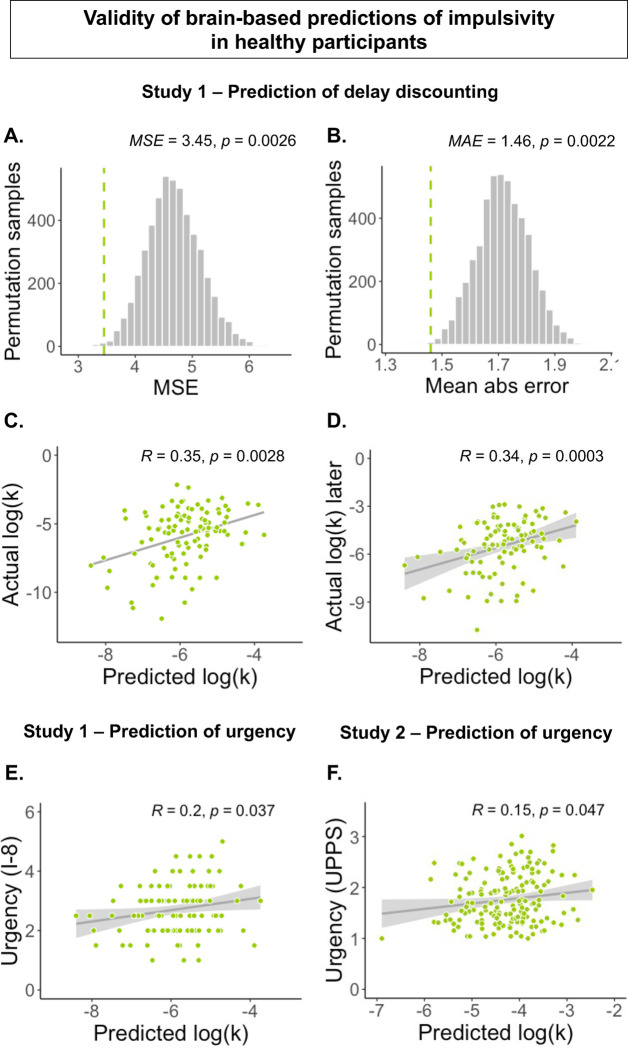
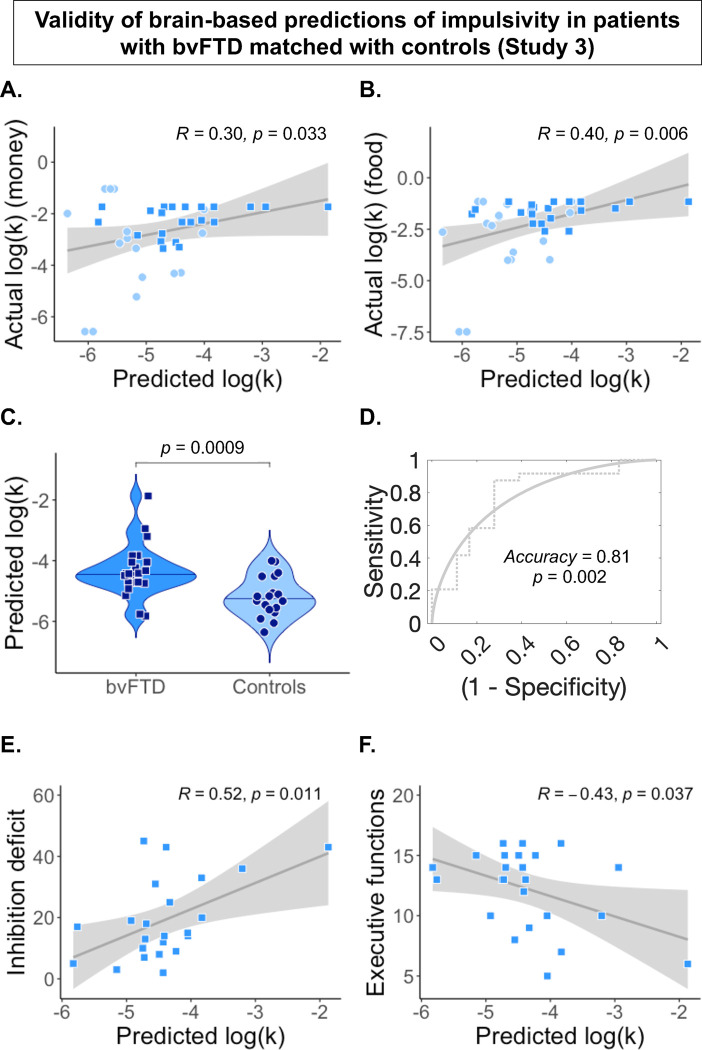
Impulsivity and higher preference for sooner over later rewards (i.e., delay discounting) are transdiagnostic markers of many psychiatric and neurodegenerative disorders. Yet, their neurobiological basis is still debated. Here, we aimed at 1) identifying a structural MRI signature of delay discounting in healthy adults, and 2) validating it in patients with behavioral variant frontotemporal dementia (bvFTD)-a neurodegenerative disease characterized by high impulsivity. We used a machine-learning algorithm to predict individual differences in delay discounting rates based on whole-brain grey matter density maps in healthy male adults (Study 1, N=117). This resulted in a cross-validated prediction-outcome correlation of =0.35 (=0.0028). We tested the validity of this brain signature in an independent sample of 166 healthy adults (Study 2) and its clinical relevance in 24 bvFTD patients and 18 matched controls (Study 3). In Study 2, responses of the brain signature did not correlate significantly with discounting rates, but in both Studies 1 and 2, they correlated with psychometric measures of trait urgency-a measure of impulsivity. In Study 3, brain-based predictions correlated with discounting rates, separated bvFTD patients from controls with 81% accuracy, and were associated with the severity of disinhibition among patients. Our results suggest a new structural brain pattern-the Structural Impulsivity Signature (SIS)-which predicts individual differences in impulsivity from whole-brain structure, albeit with small-to-moderate effect sizes. It provides a new brain target that can be tested in future studies to assess its diagnostic value in bvFTD and other neurodegenerative and psychiatric conditions characterized by high impulsivity.
冲动性以及对即时奖励而非延迟奖励的更高偏好(即延迟折扣)是许多精神疾病和神经退行性疾病的跨诊断标志物。然而,它们的神经生物学基础仍存在争议。在此,我们旨在:1)识别健康成年人中延迟折扣的结构磁共振成像特征;2)在行为变异型额颞叶痴呆(bvFTD)患者中进行验证,bvFTD是一种以高冲动性为特征的神经退行性疾病。我们使用机器学习算法,基于健康男性成年人的全脑灰质密度图来预测延迟折扣率的个体差异(研究1,N = 117)。这产生了交叉验证的预测结果相关性r = 0.35(p = 0.0028)。我们在166名健康成年人的独立样本中测试了这种脑特征的有效性(研究2),并在24名bvFTD患者和18名匹配对照中测试了其临床相关性(研究3)。在研究2中,脑特征的反应与折扣率没有显著相关性,但在研究1和2中,它们与特质紧迫性的心理测量指标相关,特质紧迫性是一种冲动性测量指标。在研究3中,基于脑的预测与折扣率相关,以81%的准确率将bvFTD患者与对照区分开,并且与患者中去抑制的严重程度相关。我们的结果表明一种新的脑结构模式——结构冲动性特征(SIS),它可以从全脑结构预测冲动性的个体差异,尽管效应大小为小到中等。它提供了一个新的脑靶点,可在未来研究中进行测试,以评估其在bvFTD以及其他以高冲动性为特征的神经退行性和精神疾病中的诊断价值。