Samma Sadia, Khan Md Sirajul Islam, Chowdhury Md Tazul Islam, Islam Mohammed Ariful, Fick Jerker, Kaium Abdul
Department of Agricultural Chemistry, Sher-e-Bangla Agricultural University, Dhaka, Bangladesh.
Department of Chemistry, Umeå Universitet, Umeå, Sweden.
Environ Health Insights. 2024 Sep 26;18:11786302241282601. doi: 10.1177/11786302241282601. eCollection 2024.
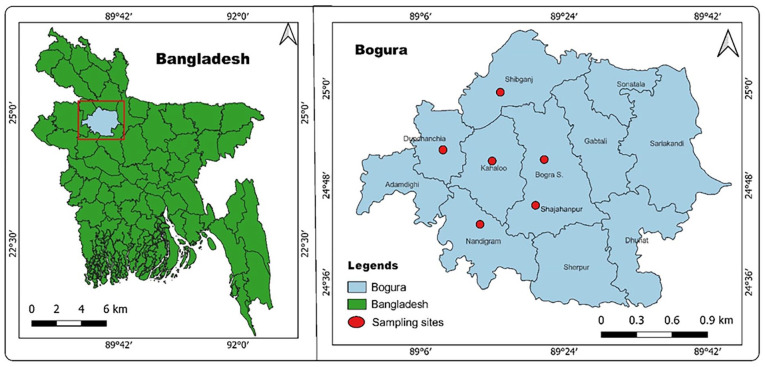
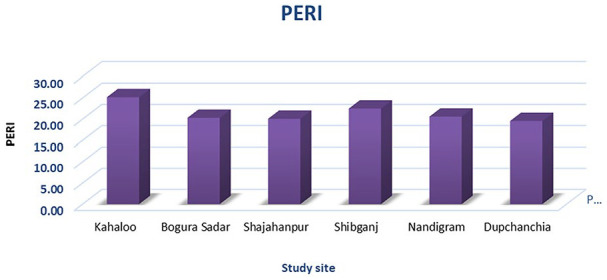
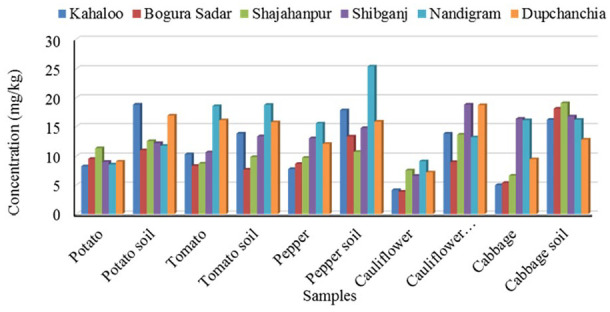
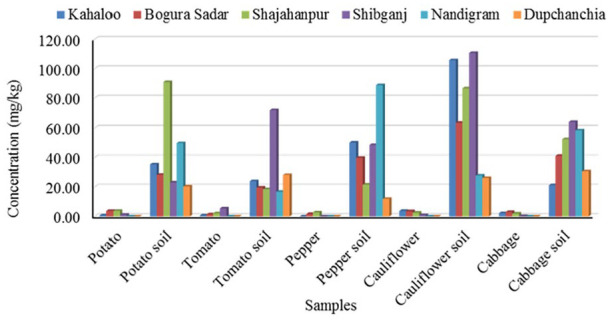
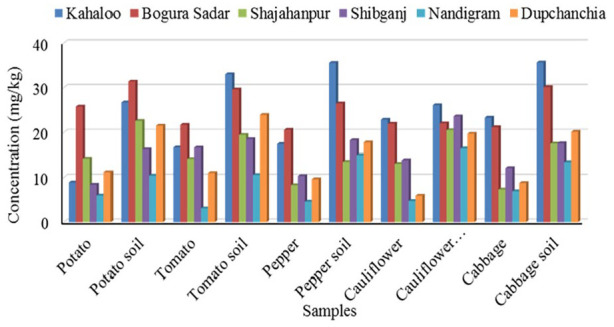
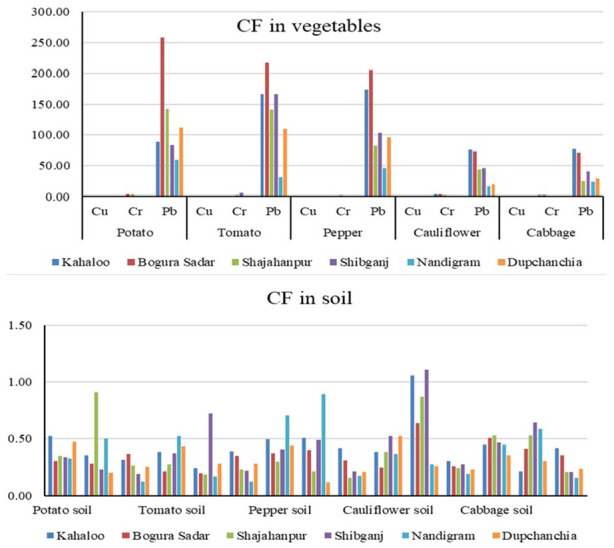
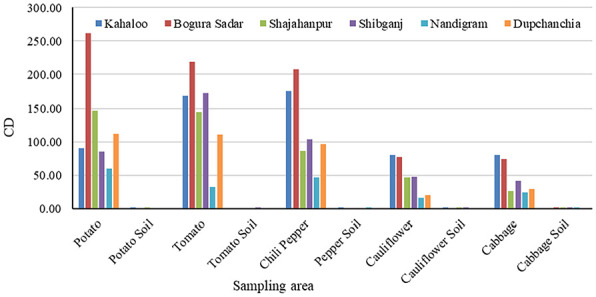
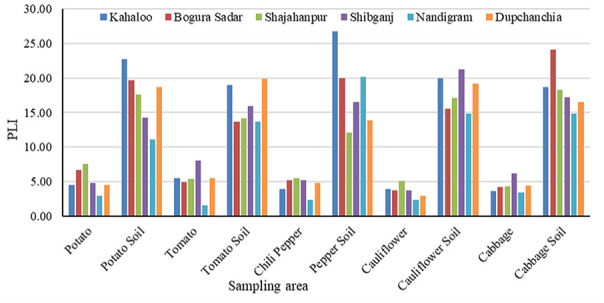
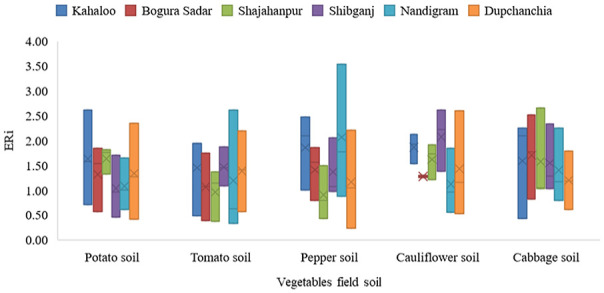
This study quantified hazardous heavy metals (Cu, Cr, and Pb) in soil and vegetables (potato, tomato, pepper, cauliflower, and cabbage) across six upazilas (Kahaloo, Bogura Sadar, Shajahanpur, Shibganj, Nandigram, and Dupchanchia) in Bogura district, Bangladesh, assessing their health and environmental impacts. The detection method was validated for its accuracy and precision with QC samples. Results indicated that Cu levels in all samples were within safe limits set by BFSA and FAO/WHO, whereas Cr and Pb in vegetables exceeded permissible levels, though soil concentrations remained within limits. Pb contamination was particularly severe in vegetables (CF > 6), and all vegetables showed significant contamination degrees (CD), highlighting extensive heavy metal pollution. The Pollution Load Index (PLI) identified Kahaloo and Bogura Sadar as the most polluted, whereas Nandigram and Dupchanchia were the least. Bioaccumulation factors (BF) for all metals were <1, suggesting minimal transfer to edible parts. However, the ecological risk index (ERi) and potential ecological risk index (PERI) suggested low ecological risks, but health risk assessments indicated that vegetable consumption poses significant carcinogenic and non-carcinogenic risks (CHR > 10, HI > 1) across all upazilas. The findings underscore the urgent need for measures to mitigate heavy metal pollution in these areas to safeguard environmental and public health.
本研究对孟加拉国博古拉区六个乡(卡哈卢、博古拉萨达尔、沙贾汉布尔、希布甘杰、南迪格拉姆和杜普昌基亚)的土壤和蔬菜(土豆、西红柿、辣椒、花椰菜和卷心菜)中的有害重金属(铜、铬和铅)进行了量化,评估了它们对健康和环境的影响。通过质量控制样品验证了检测方法的准确性和精密度。结果表明,所有样品中的铜含量均在孟加拉国食品安全局和粮农组织/世界卫生组织设定的安全限值内,而蔬菜中的铬和铅含量超过了允许水平,不过土壤中的浓度仍在限值范围内。蔬菜中的铅污染尤为严重(CF > 6),所有蔬菜均显示出显著的污染程度(CD),突出了广泛的重金属污染。污染负荷指数(PLI)确定卡哈卢和博古拉萨达尔污染最严重,而南迪格拉姆和杜普昌基亚污染最轻。所有金属的生物累积因子(BF)均<1,表明向可食用部分的转移极少。然而,生态风险指数(ERi)和潜在生态风险指数(PERI)表明生态风险较低,但健康风险评估表明,食用蔬菜在所有乡均带来显著的致癌和非致癌风险(CHR > 10,HI > 1)。研究结果强调迫切需要采取措施减轻这些地区的重金属污染,以保障环境和公众健康。