IUSS Cognitive Neuroscience (ICON) Center, Scuola Universitaria Superiore IUSS, Pavia, Italy.
Groupe d'Imagerie Neurofonctionnelle, Institut des Maladies Neurodégénératives-UMR 5293, CNRS, CEA, University of Bordeaux, Bordeaux, France.
Nat Commun. 2024 Sep 30;15(1):8452. doi: 10.1038/s41467-024-52186-9.
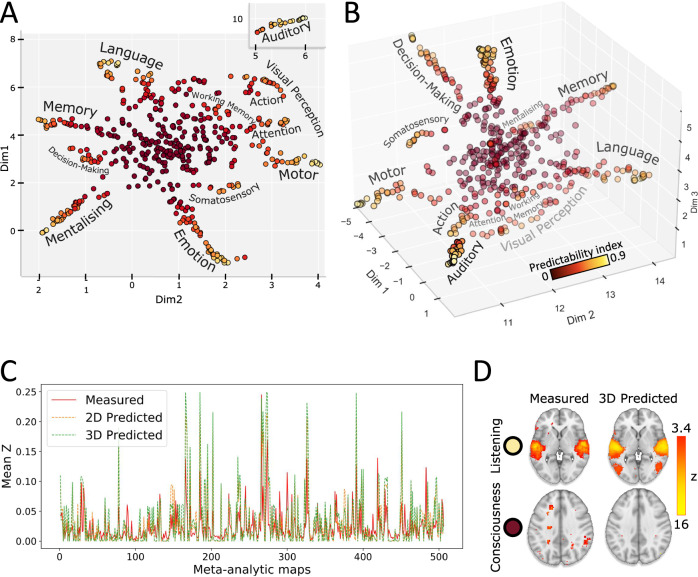
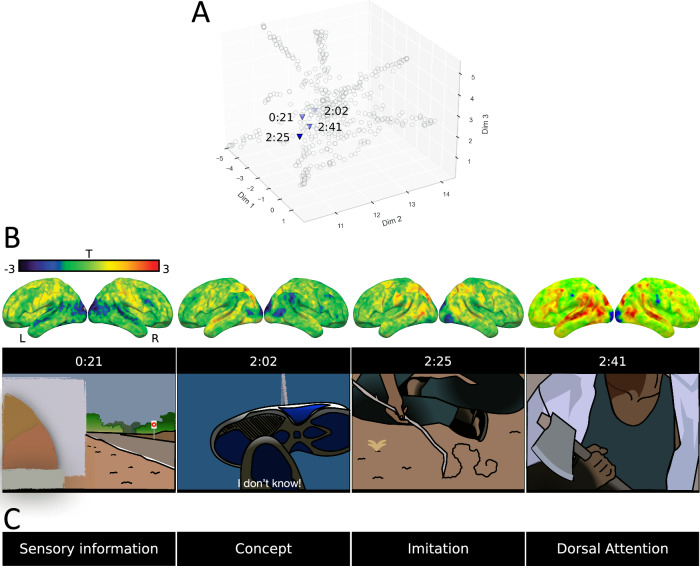
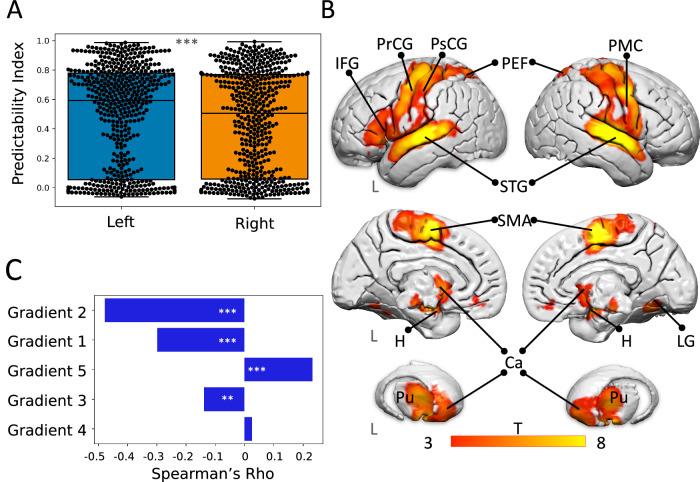
Over the past three decades, functional neuroimaging has amassed abundant evidence of the intricate interplay between brain structure and function. However, the potential anatomical and experimental overlap, independence, granularity, and gaps between functions remain poorly understood. Here, we show the latent structure of the current brain-cognition knowledge and its organisation. Our approach utilises the most comprehensive meta-analytic fMRI database (Neurosynth) to compute a three-dimensional embedding space-morphospace capturing the relationship between brain functions as we currently understand them. The space structure enables us to statistically test the relationship between functions expressed as the degree to which the characteristics of each functional map can be anticipated based on its similarities with others-the predictability index. The morphospace can also predict the activation pattern of new, unseen functions and decode thoughts and inner states during movie watching. The framework defined by the morphospace will spur the investigation of novel functions and guide the exploration of the fabric of human cognition.
在过去的三十年中,功能神经影像学积累了大量关于大脑结构和功能之间复杂相互作用的证据。然而,功能之间的潜在解剖和实验重叠、独立性、粒度和差距仍然了解甚少。在这里,我们展示了当前大脑认知知识的潜在结构及其组织。我们的方法利用了最全面的元分析 fMRI 数据库(Neurosynth)来计算一个三维嵌入空间形态空间,捕捉我们目前对大脑功能之间关系的理解。该空间结构使我们能够统计检验功能之间的关系,其表达方式为根据其与其他功能的相似性来预测每个功能图的特征的程度——可预测性指数。形态空间还可以预测新的、未见过的功能的激活模式,并在观看电影时解码思想和内在状态。形态空间定义的框架将激发对新功能的研究,并指导对人类认知结构的探索。