• 文献检索
  • 文档翻译
  • 深度研究
  • 学术资讯
  • Suppr Zotero 插件Zotero 插件
  • 邀请有礼
  • 套餐&价格
  • 历史记录
应用&插件
Suppr Zotero 插件Zotero 插件浏览器插件Mac 客户端Windows 客户端微信小程序
定价
高级版会员购买积分包购买API积分包
服务
文献检索文档翻译深度研究API 文档MCP 服务
关于我们
关于 Suppr公司介绍联系我们用户协议隐私条款
关注我们

Suppr 超能文献

核心技术专利:CN118964589B侵权必究
粤ICP备2023148730 号-1Suppr @ 2026

文献检索

告别复杂PubMed语法,用中文像聊天一样搜索,搜遍4000万医学文献。AI智能推荐,让科研检索更轻松。

立即免费搜索

文件翻译

保留排版,准确专业,支持PDF/Word/PPT等文件格式,支持 12+语言互译。

免费翻译文档

深度研究

AI帮你快速写综述,25分钟生成高质量综述,智能提取关键信息,辅助科研写作。

立即免费体验

中国重庆 COVID-19 大流行前后猩红热的流行病学变化:19 年监测和预测研究。

Epidemiological changes of scarlet fever before, during and after the COVID-19 pandemic in Chongqing, China: a 19-year surveillance and prediction study.

机构信息

Chongqing Center for Disease Control and Prevention, No. 187 Tongxing North Road, Beibei district, Chongqing Municipality, China.

School of Public Health and Management, Chongqing Medical University, No. 1 Yixueyuan Road, Yuzhong district, Chongqing Municipality, China.

出版信息

BMC Public Health. 2024 Sep 30;24(1):2674. doi: 10.1186/s12889-024-20116-5.

DOI:10.1186/s12889-024-20116-5
PMID:39350134
原文链接:https://pmc.ncbi.nlm.nih.gov/articles/PMC11443759/
Abstract

BACKGROUND

This study aimed to investigate the epidemiological changes in scarlet fever before, during and after the COVID-19 pandemic (2005-2023) and predict the incidence of the disease in 2024 and 2025 in Chongqing Municipality, Southwest China.

METHODS

Descriptive analysis was used to summarize the characteristics of the scarlet fever epidemic. Spatial autocorrelation analysis was utilized to explore the distribution pattern of the disease, and the seasonal autoregressive integrated moving average (SARIMA) model was constructed to predict its incidence in 2024 and 2025.

RESULTS

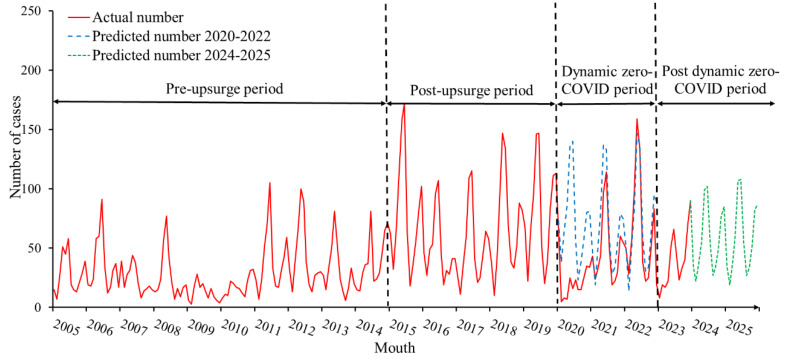
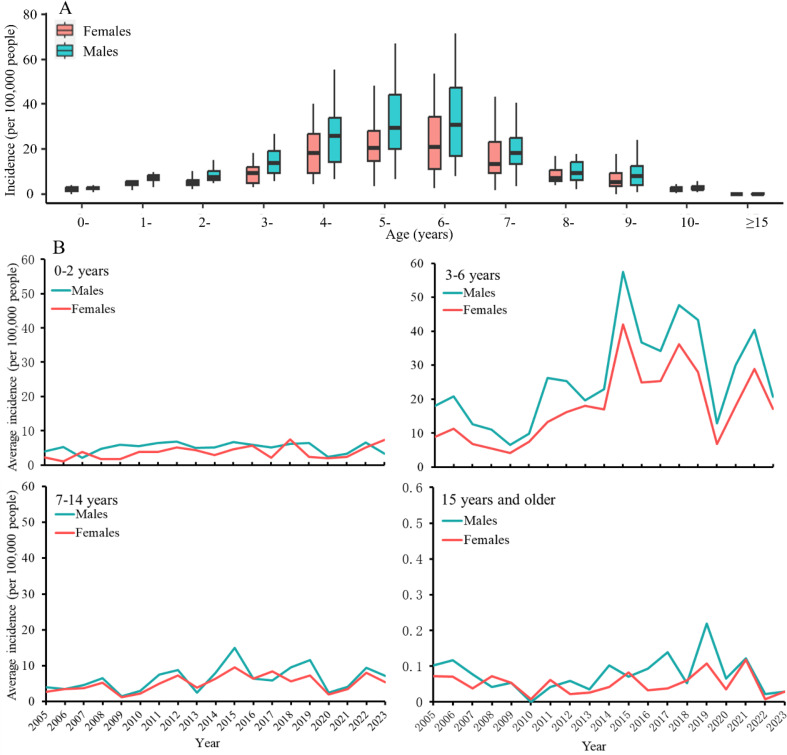
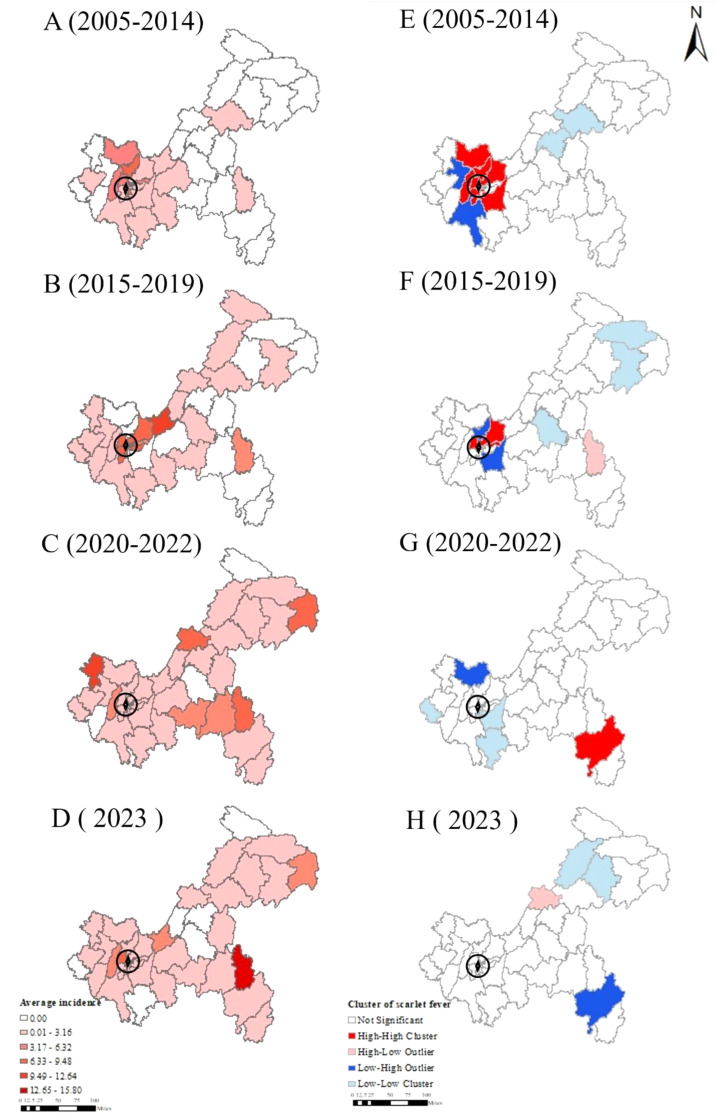
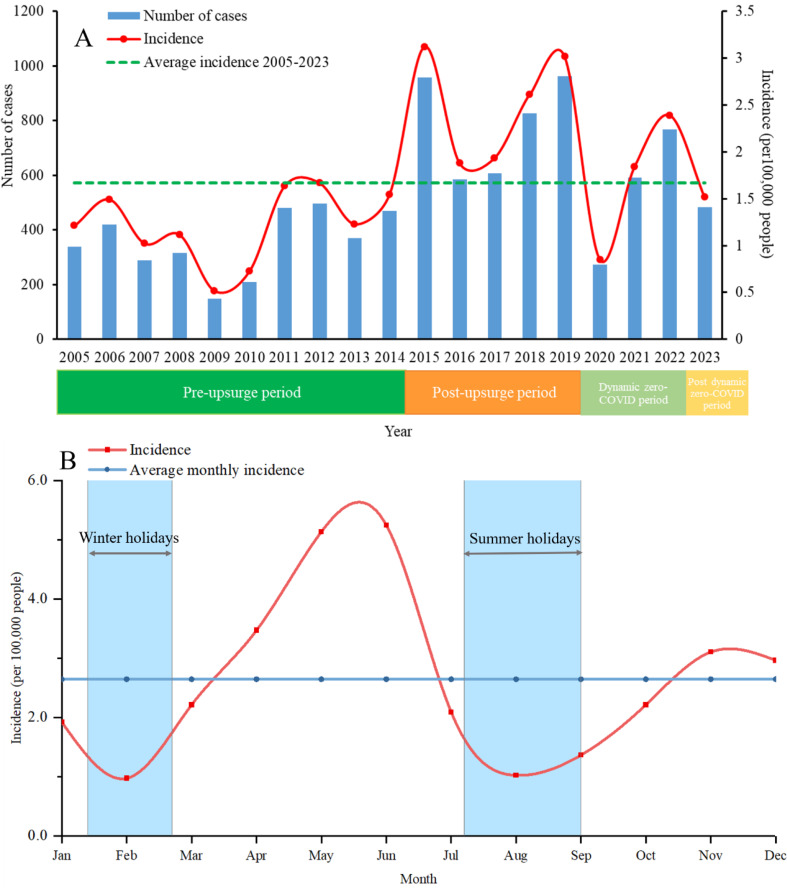
Between 2005 and 2023, 9,593 scarlet fever cases were reported in Chongqing, which resulted in an annual average incidence of 1.6694 per 100,000 people. Children aged 3-7 were the primary victims of this disease, with the highest average incidence found among children aged 6 (5.0002 per 100,000 people). Kindergarten children were the dominant infected population, accounting for as much as 54.32% of cases, followed by students (34.09%). The incidence for the male was 1.51 times greater than that for the female. The monthly distribution of the incidence showed a bimodal pattern, with one peak occurring between April and June and another in November or December. The spatial autocorrelation analysis revealed that scarlet fever cases were markedly clustered; the areas with higher incidence were mainly concentrated in Chongqing's urban areas and its adjacent districts, and gradually spreading to remote areas after 2020. The incidence of scarlet fever increased by 106.54% and 39.33% in the post-upsurge period (2015-2019) and the dynamic zero-COVID period (2020-2022), respectively, compared to the pre-upsurge period (2005-2014) (P < 0.001). During the dynamic zero-COVID period, the incidence of scarlet fever decreased by 68.61%, 25.66%, and 10.59% (P < 0.001) in 2020, 2021, and 2022, respectively, compared to the predicted incidence. In 2023, after the dynamic zero-COVID period, the reported cases decreased to 1.5168 per 100,000 people unexpectedly instead of increasing. The cases of scarlet fever are predicted to increase in 2024 (675 cases) and 2025 (705 cases).

CONCLUSIONS

Children aged 3-7 years are the most affected population, particularly males, and kindergartens and primary schools serving as transmission hotspots. It is predicted that the high incidence of scarlet fever in Chongqing will persist in 2024 and 2025, and the outer districts (counties) beyond urban zone would bear the brunt of the impact. Therefore, imminent public health planning and resource allocation should be focused within those areas.

摘要

背景

本研究旨在调查 2005-2023 年新冠疫情前后猩红热的流行病学变化,并预测 2024 年和 2025 年重庆市猩红热的发病率。

方法

采用描述性分析总结猩红热疫情特征,运用空间自相关分析探讨疾病的分布模式,构建季节性自回归求和移动平均(SARIMA)模型预测 2024 年和 2025 年的发病率。

结果

2005-2023 年,重庆市共报告猩红热病例 9593 例,年均发病率为 1.6694/10 万。3-7 岁儿童是主要发病人群,6 岁儿童的平均发病率最高(5.0002/10 万)。幼儿园儿童是主要感染人群,占病例的 54.32%,其次是学生(34.09%)。男性发病率是女性的 1.51 倍。发病率的月度分布呈双峰模式,4-6 月和 11-12 月各有一个高峰。空间自相关分析显示,猩红热病例明显呈聚集性分布,发病率较高的地区主要集中在重庆市城区及其周边地区,2020 年后逐渐向偏远地区蔓延。疫情上升期(2015-2019 年)和动态清零期(2020-2022 年)的猩红热发病率分别比疫情上升前(2005-2014 年)增加了 106.54%和 39.33%(P<0.001)。在动态清零期,2020 年、2021 年和 2022 年猩红热发病率分别较预测发病率下降了 68.61%、25.66%和 10.59%(P<0.001)。2023 年,动态清零期后,猩红热报告病例意外减少至 1.5168/10 万,而非增加。预计 2024 年(675 例)和 2025 年(705 例)重庆市猩红热发病率将增加。

结论

3-7 岁儿童是受影响最严重的人群,尤其是男性,幼儿园和小学是传播的热点。预计 2024 年和 2025 年重庆市猩红热发病率仍将居高不下,城区以外的(县)区将首当其冲。因此,应立即在这些地区进行公共卫生规划和资源配置。
https://cdn.ncbi.nlm.nih.gov/pmc/blobs/5a3b/11443759/ffef4be4278b/12889_2024_20116_Fig4_HTML.jpg
https://cdn.ncbi.nlm.nih.gov/pmc/blobs/5a3b/11443759/4e3066eb1c92/12889_2024_20116_Fig1_HTML.jpg
https://cdn.ncbi.nlm.nih.gov/pmc/blobs/5a3b/11443759/adbd897a5e42/12889_2024_20116_Fig2_HTML.jpg
https://cdn.ncbi.nlm.nih.gov/pmc/blobs/5a3b/11443759/186de6ec7ef5/12889_2024_20116_Fig3_HTML.jpg
https://cdn.ncbi.nlm.nih.gov/pmc/blobs/5a3b/11443759/ffef4be4278b/12889_2024_20116_Fig4_HTML.jpg
https://cdn.ncbi.nlm.nih.gov/pmc/blobs/5a3b/11443759/4e3066eb1c92/12889_2024_20116_Fig1_HTML.jpg
https://cdn.ncbi.nlm.nih.gov/pmc/blobs/5a3b/11443759/adbd897a5e42/12889_2024_20116_Fig2_HTML.jpg
https://cdn.ncbi.nlm.nih.gov/pmc/blobs/5a3b/11443759/186de6ec7ef5/12889_2024_20116_Fig3_HTML.jpg
https://cdn.ncbi.nlm.nih.gov/pmc/blobs/5a3b/11443759/ffef4be4278b/12889_2024_20116_Fig4_HTML.jpg

相似文献

1
Epidemiological changes of scarlet fever before, during and after the COVID-19 pandemic in Chongqing, China: a 19-year surveillance and prediction study.中国重庆 COVID-19 大流行前后猩红热的流行病学变化:19 年监测和预测研究。
BMC Public Health. 2024 Sep 30;24(1):2674. doi: 10.1186/s12889-024-20116-5.
2
Forecasting the monthly incidence of scarlet fever in Chongqing, China using the SARIMA model.利用 SARIMA 模型预测中国重庆猩红热的月发病率。
Epidemiol Infect. 2022 Apr 21;150:e90. doi: 10.1017/S0950268822000693.
3
Resurgence of scarlet fever in China: a 13-year population-based surveillance study.中国猩红热再现:一项基于人群的 13 年监测研究。
Lancet Infect Dis. 2018 Aug;18(8):903-912. doi: 10.1016/S1473-3099(18)30231-7. Epub 2018 May 29.
4
Epidemiological trend in scarlet fever incidence in China during the COVID-19 pandemic: A time series analysis.中国新冠大流行期间猩红热发病率的流行病学趋势:时间序列分析。
Front Public Health. 2022 Dec 15;10:923318. doi: 10.3389/fpubh.2022.923318. eCollection 2022.
5
Epidemiological study of scarlet fever in Shenyang, China.中国沈阳猩红热的流行病学研究。
BMC Infect Dis. 2019 Dec 21;19(1):1074. doi: 10.1186/s12879-019-4705-9.
6
Analysis of Epidemiological Characteristics of Scarlet Fever in Zhejiang Province, China, 2004-2018.2004-2018 年中国浙江省猩红热流行病学特征分析。
Int J Environ Res Public Health. 2019 Sep 17;16(18):3454. doi: 10.3390/ijerph16183454.
7
Spatiotemporal epidemiology of scarlet fever in Jiangsu Province, China, 2005-2015.2005 - 2015年中国江苏省猩红热的时空流行病学研究
BMC Infect Dis. 2017 Aug 30;17(1):596. doi: 10.1186/s12879-017-2681-5.
8
[Study on the epidemiological characteristics and incidence trend of scarlet fever in Shanghai, 2005-2012].[2005 - 2012年上海市猩红热流行病学特征及发病趋势研究]
Zhonghua Liu Xing Bing Xue Za Zhi. 2013 Jul;34(7):706-10.
9
Spatiotemporal Pattern Analysis of Scarlet Fever Incidence in Beijing, China, 2005-2014.2005 - 2014年中国北京猩红热发病率的时空模式分析
Int J Environ Res Public Health. 2016 Jan 15;13(1):131. doi: 10.3390/ijerph13010131.
10
Epidemiological characteristics and spatiotemporal clustering of scarlet fever in Liaoning Province, China, 2010-2019.2010 - 2019年中国辽宁省猩红热的流行病学特征及时空聚集性
Acta Trop. 2023 Sep;245:106968. doi: 10.1016/j.actatropica.2023.106968. Epub 2023 Jun 11.

本文引用的文献

1
Temporal shifts in 24 notifiable infectious diseases in China before and during the COVID-19 pandemic.中国 COVID-19 大流行前后 24 种法定传染病的时间变化。
Nat Commun. 2024 May 8;15(1):3891. doi: 10.1038/s41467-024-48201-8.
2
Analysis of a SARIMA-XGBoost model for hand, foot, and mouth disease in Xinjiang, China.中国新疆手足口病 SARIMA-XGBoost 模型分析。
Epidemiol Infect. 2023 Dec 4;151:e200. doi: 10.1017/S0950268823001905.
3
Epidemiological characteristics of common respiratory infectious diseases in children before and during the COVID-19 epidemic.
新型冠状病毒肺炎疫情前后儿童常见呼吸道传染病的流行病学特征
Front Pediatr. 2023 Aug 3;11:1212658. doi: 10.3389/fped.2023.1212658. eCollection 2023.
4
Impact of COVID-19 prevention and control on tuberculosis and scarlet fever in China's Guizhou.COVID-19 防控对中国贵州地区结核病和猩红热的影响。
Sci Rep. 2023 Jun 12;13(1):9540. doi: 10.1038/s41598-023-36263-5.
5
Epidemiological trend in scarlet fever incidence in China during the COVID-19 pandemic: A time series analysis.中国新冠大流行期间猩红热发病率的流行病学趋势:时间序列分析。
Front Public Health. 2022 Dec 15;10:923318. doi: 10.3389/fpubh.2022.923318. eCollection 2022.
6
Collateral Impact of COVID-19 Prevention Measures on Re-Emergence of Scarlet Fever and Pertussis in Mainland China and Hong Kong China.COVID-19 防控措施对中国大陆和中国香港猩红热和百日咳再流行的间接影响
Int J Environ Res Public Health. 2022 Aug 11;19(16):9909. doi: 10.3390/ijerph19169909.
7
Modeling the effects of air pollutants and meteorological factors on scarlet fever in five provinces, Northwest China, 2013-2018.模拟2013 - 2018年中国西北五省空气污染物和气象因素对猩红热的影响
J Theor Biol. 2022 Jul 7;544:111134. doi: 10.1016/j.jtbi.2022.111134. Epub 2022 Apr 22.
8
Impact of non-pharmaceutical interventions during COVID-19 pandemic on pertussis, scarlet fever and hand-foot-mouth disease in China.新冠疫情期间非药物干预措施对中国百日咳、猩红热和手足口病的影响
J Infect. 2022 Feb;84(2):e13-e15. doi: 10.1016/j.jinf.2021.12.023. Epub 2021 Dec 23.
9
Co-benefits of nonpharmaceutical intervention against COVID-19 on infectious diseases in China: A large population-based observational study.中国非药物干预措施对新冠疫情及其他传染病的协同效益:一项基于大规模人群的观察性研究。
Lancet Reg Health West Pac. 2021 Dec;17:100282. doi: 10.1016/j.lanwpc.2021.100282. Epub 2021 Oct 1.
10
Increased Incidence of Scarlet Fever - China, 1999-2018.1999 - 2018年中国猩红热发病率上升
China CDC Wkly. 2019 Dec;1(5):63-66.