Wang Rui, Liang Qing, Zhang Qian, Zhao Shuchao, Lin Yuxiang, Liu Bing, Ma Yinjiang, Mai Xiaoya, Fu Quanze, Bao Xiaorui, Wang Nan, Chen Binglin, Yan Peng, Zhu Yongsheng, Wang Kejia
Department of Pulmonary and Critical Care Medicine, The First Affiliated Hospital of Xiamen University, State Key Laboratory of Cellular Stress Biology, Cancer Research Center, School of Medicine, Xiamen University, Xiamen, Fujian, 361102, China.
Department of Pathology, The Affiliated Hospital of Qingdao University, Qingdao, Shandong, 266000, China.
Adv Sci (Weinh). 2024 Dec;11(45):e2403849. doi: 10.1002/advs.202403849. Epub 2024 Oct 1.
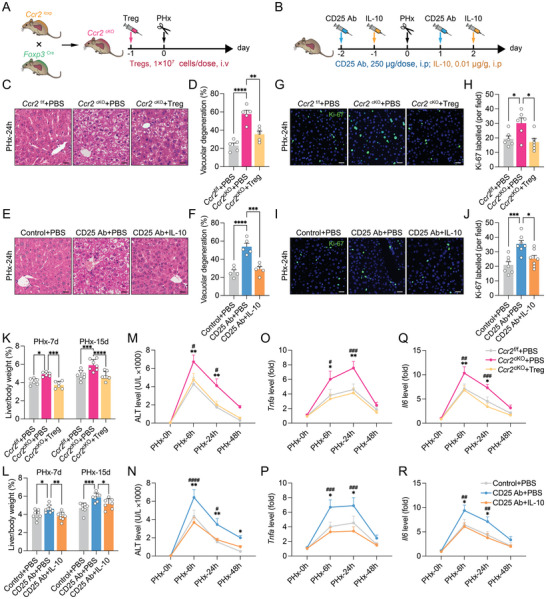
Inflammation is highlighted as an initial factor that helps orchestrate liver reconstitution. However, the precise mechanisms controlling inflammation during liver reconstitution have not been fully elucidated. In this study, a clear immune response is demonstrated during hepatic reconstitution. Inhibition of the hepatic inflammatory response retards liver regeneration. During this process, Ccl2 is primarily produced by type 1 innate lymphoid cells (ILC1s), and ILC1-derived Ccl2 recruits peripheral ILC1s and regulatory T cells (Tregs) to the liver. Deletion of Ccl2 or Tregs exacerbates hepatic injury and inflammatory cytokine release, accelerating liver proliferation and regeneration. The adoption of Tregs and IL-10 injection reversed these effects on hepatocyte regenerative proliferation. Additionally, Treg-derived IL-10 can directly induce macrophage polarization from M1 to M2, which alleviated macrophage-secreted IL-6 and TNF-α and balanced the intrahepatic inflammatory milieu during liver reconstitution. This study reveals the capacity of Tregs to modulate the intrahepatic inflammatory milieu and liver reconstitution through IL-10-mediated macrophage polarization, providing a potential opportunity to improve hepatic inflammation and maintain homeostasis.
炎症被认为是有助于协调肝脏重建的初始因素。然而,肝脏重建过程中控制炎症的精确机制尚未完全阐明。在本研究中,肝脏重建过程中出现了明显的免疫反应。抑制肝脏炎症反应会阻碍肝脏再生。在此过程中,Ccl2主要由1型天然淋巴细胞(ILC1s)产生,ILC1衍生的Ccl2将外周ILC1s和调节性T细胞(Tregs)募集到肝脏。删除Ccl2或Tregs会加剧肝损伤和炎性细胞因子释放,加速肝脏增殖和再生。采用Tregs和注射IL-10可逆转这些对肝细胞再生增殖的影响。此外,Treg衍生的IL-10可直接诱导巨噬细胞从M1型向M2型极化,从而减轻巨噬细胞分泌的IL-6和TNF-α,并在肝脏重建过程中平衡肝内炎症环境。本研究揭示了Tregs通过IL-10介导的巨噬细胞极化调节肝内炎症环境和肝脏重建的能力,为改善肝脏炎症和维持内环境稳定提供了潜在机会。