Nephew Lauren D, Rawl Susan M, Carter Allie, Garcia Nicole, Monahan Patrick O, Holden John, Ghabril Marwan, Montalvan-Sanchez Eleazar, Patidar Kavish, Desai Archita P, Orman Eric, Chalasani Naga
Division of Gastroenterology and Hepatology, Department of Medicine, Indiana University School of Medicine, Indianapolis, Indiana, USA
Indiana University Simon Comprehensive Cancer Center, Indianapolis, Indiana, USA.
BMJ Open Gastroenterol. 2024 Oct 2;11(1):e001537. doi: 10.1136/bmjgast-2024-001537.
To investigate how individual social determinants of health (SDOH) and cumulative social disadvantage (CSD) affect survival and receipt of liver transplant (LT) in patients with hepatocellular carcinoma (HCC).
We enrolled 139 adult patients from two Indianapolis hospital systems between June 2019 and April 2022. Structured questionnaires collected SDOH and social risk factor data. We compared SDOH and CSD by race, gender and disease aetiology, assigning one point per adverse SDOH. Multivariable competing risk survival analysis assessed associations between SDOH, CSD, survival and LT receipt.
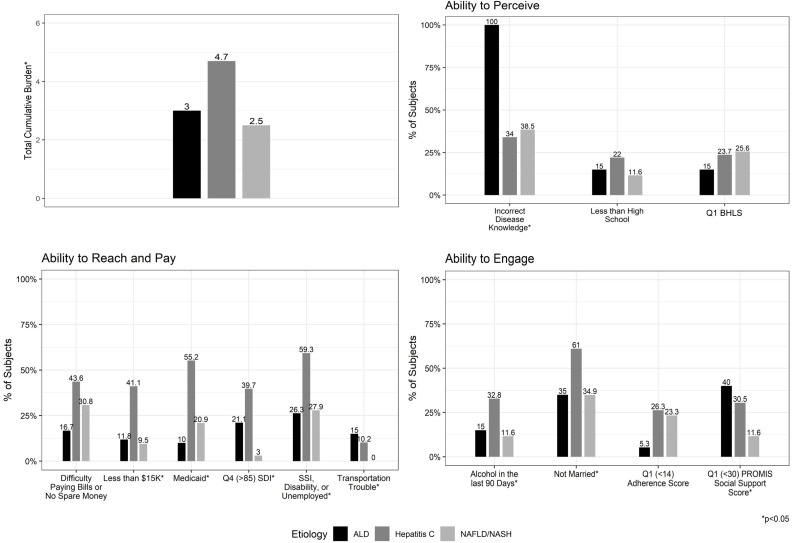
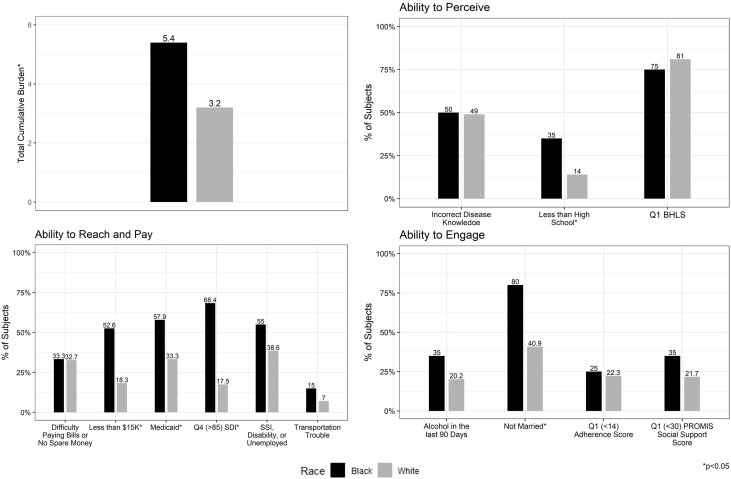
Black patients experienced higher CSD than white patients in the cohort (5.4±2.5 vs 3.2±2.1, p<0.001). Black patients were significantly more likely to have household incomes <US$15 000 per year (52.6% vs 18.3%, p=0.003), to be insured by Medicaid (57.9% vs 33.0%, p=0.04), and to live in high Social Deprivation Index areas (68.4% vs 17.5%, p<0.001) than white patients. Patients with hepatitis C virus and alcohol-related liver disease had more adverse SDOH than those with metabolic dysfunction-associated steatotic liver disease, while there were no significant differences by gender. On multivariable analysis, a higher health literacy score was a significant predictor of survival (HR 2.54, 95% CI 1.19 to 5.43 CI, p=0.02) and higher CSD was associated with a lower probability of receipt of LT (HR 0.80, 95% CI 0.68 to 0.95, p=0.01).
There are significant racial and aetiology-related differences in SDOH burden. Low health literacy and high CSD are linked to worse outcomes in HCC patients. Health literacy screening and targeted interventions for those with high CSD could improve LT access and survival rates.
探讨个体健康的社会决定因素(SDOH)和累积社会劣势(CSD)如何影响肝细胞癌(HCC)患者的生存及肝移植(LT)接受情况。
2019年6月至2022年4月期间,我们从印第安纳波利斯的两个医院系统招募了139例成年患者。通过结构化问卷收集SDOH和社会风险因素数据。我们按种族、性别和疾病病因比较SDOH和CSD,每个不利的SDOH因素计1分。多变量竞争风险生存分析评估SDOH、CSD、生存和LT接受之间的关联。
队列中黑人患者的CSD高于白人患者(5.4±2.5对3.2±2.1,p<0.001)。黑人患者家庭年收入低于15000美元的可能性显著更高(52.6%对18.3%,p=0.003),由医疗补助保险的可能性更高(57.9%对33.0%,p=0.04),且居住在社会剥夺指数高的地区的可能性高于白人患者(68.4%对17.5%,p<0.001)。丙型肝炎病毒和酒精性肝病患者的不利SDOH因素比代谢功能障碍相关脂肪性肝病患者更多,而性别之间无显著差异。多变量分析显示,较高的健康素养得分是生存的显著预测因素(风险比[HR]2.54,95%置信区间[CI]1.19至5.43,p=0.02),较高的CSD与接受LT的概率较低相关(HR 0.80,95%CI 0.68至0.95,p=0.01)。
SDOH负担存在显著的种族和病因相关差异。低健康素养和高CSD与HCC患者的不良结局相关。对高CSD患者进行健康素养筛查和有针对性的干预可改善LT的可及性和生存率。