Vinetti Giovanni, Turner Rachel, Taboni Anna, Rauch Simon, Seraglio Paolo Mario Enrico, Netzer Nikolaus, Strapazzon Giacomo, Gatterer Hannes
Institute of Mountain Emergency Medicine, Eurac Research, Bolzano, ITALY.
Department of Anaesthesia and Intensive Care Medicine, Hospital of Merano (SABES-ASDAA), Merano (BZ), ITALY.
Med Sci Sports Exerc. 2025 Mar 1;57(3):632-640. doi: 10.1249/MSS.0000000000003578. Epub 2024 Oct 4.
There is controversy whether there are meaningful physiological differences between hypobaric (HH) and normobaric hypoxia (NH). This study aimed to compare the cardiorespiratory responses to acute HH and NH under strictly controlled conditions. We hypothesized no differences at rest and during submaximal exercise, whereas during maximal exercise, a higher maximal ventilation (V̇ Emax ), peripheral oxygen saturation (SpO 2 ), and maximal oxygen consumption (V̇O 2max ) in HH than in NH.
In a randomized, single-blind, crossover design, eight young healthy subjects (three females) were studied in an environmental chamber in which either the barometric pressure (HH) or the inspired oxygen fraction (NH) was reduced to the equivalent of ~4000 m altitude. Measurements were taken at rest, and during submaximal (moderate and high intensity) and maximal cycling exercise.
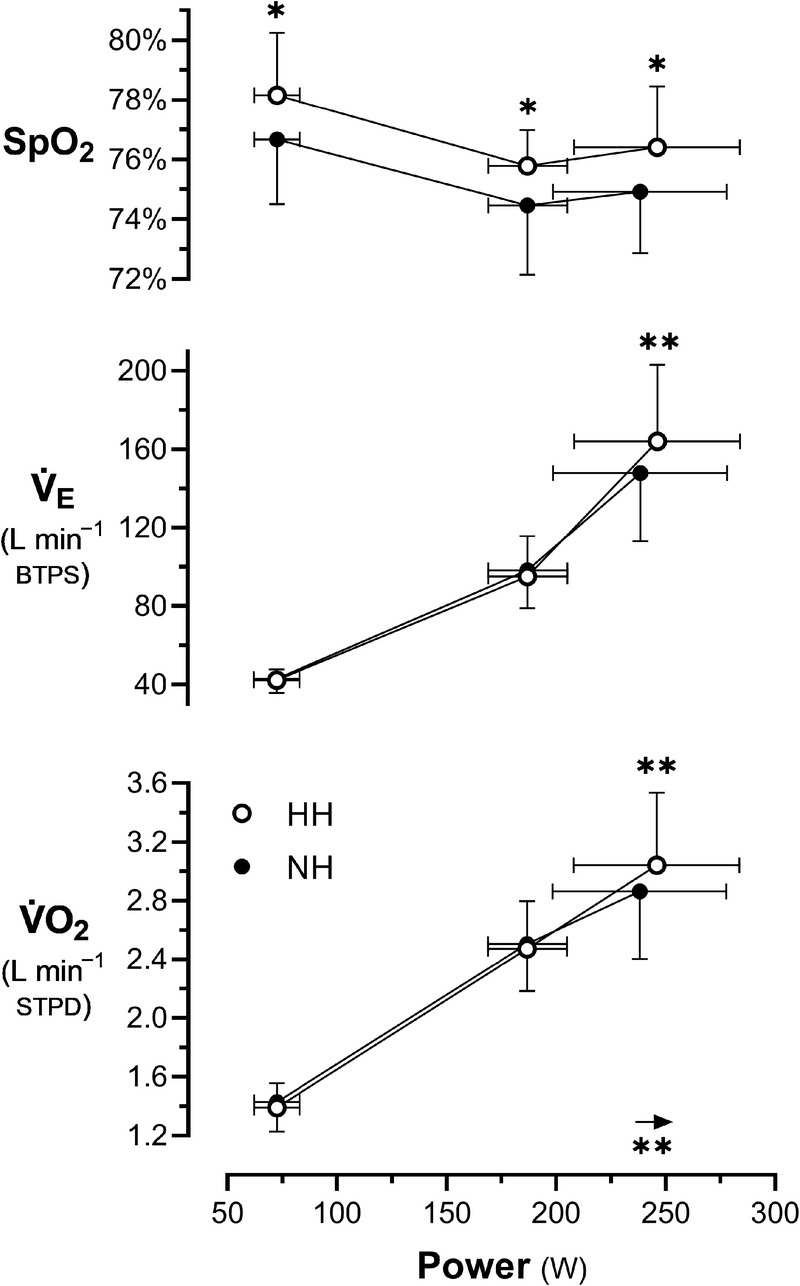
All resting parameters were similar between HH and NH, except for a lower root mean square of the successive R-R interval differences in HH ( P < 0.05). SpO 2 was 2% higher in HH at all exercise intensities ( P < 0.05). During submaximal exercise, minute ventilation was similar between HH and NH. However, HH yielded a 7% lower tidal volume during moderate-intensity exercise ( P < 0.05) and a lower respiratory exchange ratio during high-intensity exercise ( P < 0.01). V̇ Emax and V̇O 2max were 11% and 6% higher in HH, respectively ( P < 0.01 for both). SpO 2 at maximal exercise was positively correlated with V̇ Emax , V̇ Emax /V̇O 2max , and V̇O 2max .
The higher V̇O 2max found in HH than in NH can be attributed to the higher V̇ Emax counteracting desaturation at maximal exercise. Conversely, submaximal SpO 2 improved in HH through mechanisms other than increased ventilation. These findings are likely due to respiratory muscle unloading in HH, which operated through different mechanisms depending on exercise intensity.
关于低压缺氧(HH)和常压缺氧(NH)之间是否存在有意义的生理差异存在争议。本研究旨在比较在严格控制的条件下急性HH和NH时的心肺反应。我们假设在静息状态和次最大运动期间无差异,而在最大运动期间,HH时的最大通气量(V̇Emax)、外周血氧饱和度(SpO₂)和最大摄氧量(V̇O₂max)高于NH。
采用随机、单盲、交叉设计,在环境舱中对8名年轻健康受试者(3名女性)进行研究,在该环境舱中,气压(HH)或吸入氧分数(NH)被降低至相当于海拔约4000米的水平。在静息状态以及次最大(中等强度和高强度)和最大骑行运动期间进行测量。
除HH时连续R-R间期差值的均方根较低外(P<0.05),HH和NH的所有静息参数相似。在所有运动强度下,HH时的SpO₂均高2%(P<0.05)。在次最大运动期间,HH和NH的分钟通气量相似。然而,在中等强度运动期间,HH的潮气量低7%(P<0.05),在高强度运动期间呼吸交换率较低(P<0.01)。HH时的V̇Emax和V̇O₂max分别高11%和6%(两者均P<0.01)。最大运动时的SpO₂与V̇Emax、V̇Emax/V̇O₂max和V̇O₂max呈正相关。
HH时发现的V̇O₂max高于NH,这可归因于较高的V̇Emax抵消了最大运动时的氧饱和度降低。相反,HH时次最大SpO₂通过通气增加以外的机制得到改善。这些发现可能是由于HH时呼吸肌负荷减轻,其根据运动强度通过不同机制起作用。